
Where Light and Shadow Converge
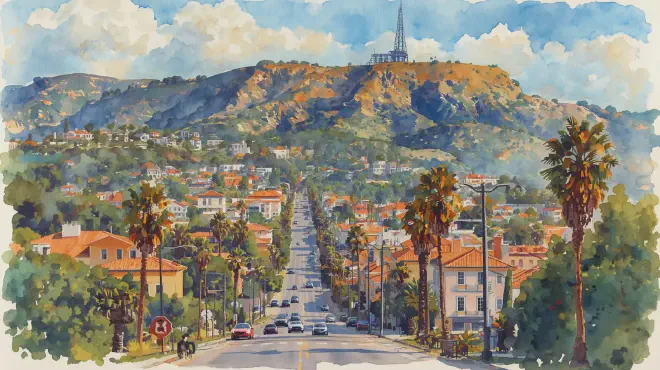
Los Angeles. This city facing the Pacific Ocean is one of the West Coast’s defining metropolises, yet it holds no single identity. The glamour of the film industry symbolized by the Hollywood sign, vibrant streets rich with Latin American culture, refined cultural districts lined with museums, and gentle waves lapping against beaches—all of these coexist beneath dry air and intense sunlight.
The Mediterranean climate, mild year-round, stays warm even in winter days, cooling only slightly in the mornings and evenings. This weather makes outdoor dining and beach time possible throughout the year. Mission-style architecture bearing traces of Spanish colonial rule, Art Deco buildings from the 1920s, and modern skyscrapers—the city spreads out in layers of time stacked upon one another.
Its proximity to Mexico has deeply rooted Latin culture in this place. Spanish resonates through the streets as commonly as English, while tacos and burritos are embraced as everyday meals. At the same time, a large Asian immigrant population means that in Koreatown and Little Tokyo, yet another cultural fragrance drifts through the air.
I chose late winter for a 2-night, 3-day visit. During this period when tourist numbers dwindle slightly, I wanted to walk through this multilayered city at my own pace.
Day 1: Welcomed by Ocean Breezes
I landed at Los Angeles International Airport just after 10 a.m. Stepping outside, what immediately struck me was the dry air and sunlight that felt pleasant on the skin even in winter. I considered renting a car but decided to use public transportation and rideshare services instead. I wanted to move through this city as locals do.
My first destination was Venice Beach. Though I’d booked a hotel downtown, I wanted to see the ocean first, so I dropped off my luggage and headed west. After about an hour on the Metro and bus, the views from the window revealed streets lined with palm trees, buildings painted with colorful murals, and young people carrying skateboards.
I arrived at Venice Beach a little past noon. Standing on the boardwalk, the Pacific Ocean spread before me. The sound of waves, the scent of salt, the laughter of people on roller skates—here was a space where tourist bustle mixed with the daily lives of locals.
As I walked, I stopped in front of a taco stand. A small shop like a street stall, its menu written on a hand-painted board. Drawn to the words “Fish Tacos,” I placed my order, and a young Latino owner skillfully prepared my meal. Freshly fried white fish topped with shredded cabbage, creamy sauce, and a squeeze of lime. I carried the paper-wrapped tacos to a bench along the beach.
One bite released the savory aroma of fish, the tang of sauce, and the crisp texture of cabbage spreading through my mouth. Eating tacos while gazing at the waves felt somehow symbolic of a journey’s beginning. On the next bench, an elderly couple quietly gazed at the sea. They too were part of this scenery.
That afternoon, I walked through Venice’s canal district. Created in the early 20th century to mimic Venice, Italy, the canals now lie surrounded by quiet residential neighborhoods. Crossing small bridges and following paths along the water, I saw people kayaking and residents reading on terraces. Few tourists, and a peaceful time flowing through. It felt impossible that this was the same Los Angeles—a space removed from the clamor.
In the evening, I took a bus back to the hotel. Outside the window, the cityscape began to bathe in sunset colors. From west to east along Sunset Boulevard, heading toward downtown. The views from the bus changed dramatically with each area—West Hollywood with its luxury boutiques, the Sunset Strip lined with billboards, and then the high-rises of downtown coming into view.
After checking into the hotel and resting briefly, I ventured into the night. Grand Central Market in downtown, a historic market that opened in 1917, has recently been renovated, with traditional shops coexisting alongside new ones. Walking through the market, I passed fruit vendors, butchers, seafood stalls, and stylish coffee stands.
I had dinner at a small Mexican restaurant inside the market. I ordered chicken mole, and a dish arrived covered in a complex sauce of chocolate and spices. At first, the combination seemed surprising, but when I tasted it, the deep flavors amazed me. A subtle sweetness and heat, with a nutty aroma. The owner told me this was a taste passed down through generations.
Leaving the market, downtown showed a different face at night. Illuminated buildings, music spilling from bars, people hurrying along sidewalks. On my way back to the hotel, I stopped at a convenience store for water. The cashier, a young Asian woman, spoke fluent English and Korean. In this small moment, I felt the city’s diversity.
Day 2: Between Art and the Natural World
The next morning, I had breakfast at a café near the hotel. A small shop where locals seemed to gather, where I ordered coffee and avocado toast. The California avocado was rich and creamy, its simple seasoning of lemon, salt, and olive oil highlighting the quality of the ingredient. Inside the shop sat people working on laptops, an old man reading the newspaper, a young mother with a stroller. The ordinary morning unfolded there.
In the morning, I headed to the Getty Center. This museum, built atop a hill in the Santa Monica Mountains, is itself a work of art. Riding the dedicated tram from the base of the hill, the city of Los Angeles spread out below. The buildings covered in white travertine stone, designed by Richard Meier, demonstrated a masterful use of light and space.
Inside, European paintings lined the galleries. Rembrandt, Monet, Van Gogh. People stood before these masterpieces, each spending their own time. I lingered longest before Van Gogh’s “Irises.” The blue and green hues seemed to speak quietly.
The museum gardens were also magnificent. Geometrically designed gardens, fountains, and terraces with sweeping views. I sat on a bench, gazing absently at the scenery for a while. The Pacific visible in the distance, the cityscape spreading before it. From here, the vastness of Los Angeles became tangible.
I had a light lunch at the museum café. A salad and soup set. Outside the window lay the gardens, and people quietly enjoying their meals. Though a tourist destination, this place held a meditative stillness.
In the afternoon, I headed to Hollywood. About thirty minutes on the Metro Red Line. Getting off at Hollywood/Highland station, I found myself at the heart of a tourist district. In front of the Chinese Theatre, handprints and footprints lined the forecourt as tourists took commemorative photos. People walking along the Hollywood Walk of Fame, gazing at star-shaped plaques.
To be honest, Hollywood’s main street felt a bit too noisy. Costumed characters solicited photos, souvenir shops lined up, and a manufactured atmosphere seemed to hang over everything. But one block off the main drag, the scene changed. A local bookstore, small cafés, a record shop. The true face of the city, hidden behind the tourist façade.
I wandered into a record shop where vinyl records covered the walls. A man who appeared to be the owner sat at the counter, slowly listening to music. I browsed the jazz section and picked up an old Miles Davis album. I didn’t buy it, but I felt a bit relieved that shops like this still remained.
At dusk, I headed to Griffith Observatory. Taking a rideshare up the hill, I arrived about thirty minutes before sunset. Standing on the terrace in front of the observatory, the entire panorama of Los Angeles spread before me. Downtown’s high-rise clusters in the distance, the Hollywood Sign to the right, and below, the city bathed in sunset light.
Many people had come to see this view, yet it remained strangely quiet. As the sun sank, the city’s lights began to glow one by one. The sky shifted from orange to pink, then to purple. Beneath it, the vast city seemed to breathe.
I went inside the observatory as well. The planetarium, exhibition halls, and massive telescope. A place where I felt anew the vastness of space and the smallness of planet Earth. Yet at the same time, I sensed the wonder of this city where millions of people live on this tiny planet.
That night, returning to downtown, I visited Little Tokyo. This district, etched with the history of Japanese Americans, remained lively even at night. Ramen shops, izakaya, Japanese grocery stores. A strange space where nostalgia and foreign exoticism mingled.
I entered a small izakaya and sat at the counter. The owner said he was a third-generation Japanese American, speaking fluent English and broken Japanese. I ordered edamame and a Sapporo beer, chatting a bit across the counter. His grandparents had immigrated here before the war and were sent to internment camps during it, he told me. Yet they returned to this city and continued their business. Listening to his story, I felt again the layered history of this place.
Day 3: Bidding Farewell to the Sound of Waves
The final morning began slowly. With time before checkout, I took a walk near the hotel. Downtown in the morning, being a weekday, bustled with commuters. Businesspeople in suits, workers in uniforms, students waiting for buses. Not Los Angeles as a tourist destination, but the face of a city as a place where people live.
After checking out and storing my luggage, I headed to my final destination: Santa Monica. Located north of Venice Beach, which I’d visited on the first day, I’d heard this town had a more settled atmosphere. I took the Metro to Santa Monica station and walked toward the ocean from there.
I arrived at the Santa Monica Pier around 11 a.m. Built in 1909, this pier is a place where an old amusement facility and fishing spot coexist. Walking to the end of the pier, waves lapped beneath my feet, and the Malibu coastline appeared in the distance.
On the pier sat a small amusement park, its Ferris wheel slowly turning. Being a weekday morning, the crowd was sparse. An old man fishing, a couple gazing at the sea from a bench, children running about. Though a tourist spot, I could feel it was also a gathering place for locals.
Leaving the pier, I walked along the beach. The sand was wide, the waves gentle. Surfers waiting for swells, young people playing beach volleyball, a woman spreading out her yoga mat. Each person spending their own time. I took off my shoes and walked on the sand. The sensation of cool sand, the coldness when waves reached my feet. A moment when I realized the journey’s end.
For lunch, I decided to eat on Third Street Promenade in Santa Monica. Along this pedestrian street lined restaurants, cafés, and shops. I chose a small bistro serving California cuisine.
A salad abundant with locally sourced vegetables and grilled salmon. Simple preparation, but the taste of the ingredients came through clearly. I ordered just one glass of California wine and slowly enjoyed the meal. Watching people pass by outside the window, I reflected on these three days.
After eating, I walked the streets a bit more. I entered a bookstore and picked up a book about Los Angeles’s history. It covered how this city had changed from the Spanish colonial era to the present. I didn’t purchase it, but I felt I’d gained a slightly better understanding of the city’s complexity.
A little past 3 p.m., I returned to the hotel to collect my luggage and headed to the airport. An hour or so by Metro and shuttle bus. The scenery from the window looked the same as when I’d arrived, yet somehow different. The roads I’d walked, the meals I’d eaten, the sights I’d seen, the words exchanged over three days—these layered together, forming my impression of this city.
Waiting at the airport gate, I looked back through photos on my phone. Beach waves, museum gardens, twilight cityscapes, the izakaya counter. With each photo, the air, sounds, and scents of those moments seemed to revive.
Boarding began, and I entered the plane. I took my window seat and waited for takeoff. Soon the aircraft began moving, accelerated down the runway, and gently lifted. Below spread the vast city of Los Angeles. The Pacific coastline, the city spreading across a basin surrounded by mountains, building clusters lit by sunset. From above, the city’s enormity and complexity became clear at a glance.
The Certain Sensations Left by Imagination
Watching the city grow smaller from the airplane window, I was enveloped in a strange sensation. This three-day journey consisted of roads I hadn’t actually walked, food I hadn’t actually eaten, scenery I hadn’t actually seen. Yet the sound of waves, the taste of tacos, the stillness of the museum, the colors of the evening sky—these remained certain within my heart.
Los Angeles is a city without a single face. Ocean and mountains, past and future, various cultures intersecting. It is chaos and simultaneously harmony. Perhaps this very complexity is the city’s charm.
Even an imaginary journey, by envisioning specific places, real buildings, authentic cuisine, and people’s lives, acquires a certain tangibility. In our memories, the boundary between places actually visited and places visited in imagination sometimes becomes ambiguous. Both, within the heart, become things we have “experienced.”
This travel diary is a record of imagination generated by AI. Yet the cityscapes, flavors of food, and images of people depicted here reflect one aspect of the real Los Angeles. When I truly visit this city someday, I hope these imaginary memories will serve as guideposts toward new discoveries.
Travel is not only about moving from place to place. It is about the heart moving, gaining new perspectives, and confronting oneself. Even an imaginary journey can achieve this—these three days taught me that.
The sound of Los Angeles’s waves still echoes in my heart.