
Eternal Stories Carved in Stone
Mahabalipuram is a small port town facing the Bay of Bengal, about an hour’s drive south of Chennai. During the 7th and 8th centuries, this ancient city flourished as a maritime gateway of the Pallava dynasty. The stone carvings registered as a UNESCO World Heritage Site are precious legacies that convey the advanced architectural techniques and artistic sensibilities of that era.
The Five Rathas carved from monolithic rocks, the massive relief known as “Arjuna’s Penance” etched into a hillside, and the Shore Temple standing at the water’s edge—these stone structures are like living textbooks chronicling the development of classical Indian architecture. Despite enduring tropical sunlight and sea winds for over 1,300 years, they continue to preserve their beauty to this day.
Present-day Mahabalipuram is a quiet town sustained by fishing and tourism. At dawn, colorful fishing boats return from the bay, bringing life to the fish market. The techniques passed down through generations of stone carvers remain alive, and the sound of chisels still echoes from workshops where modern artisans practice their craft.
To visit this place is not mere sightseeing but an experience akin to a dialogue across time. In this place where the thoughts of ancient stonemasons overlap with the lives of people today, what would I feel, and what would I carry home with me?
Day 1: Welcomed by Sea Breezes and Memories in Stone
The scenery gradually transformed on the taxi ride from Chennai International Airport. As we left the city’s commotion behind, a rural landscape dotted with coconut palms spread out before us, and the air took on the scent of the sea. The driver, Rajesh, enthusiastically shared the highlights of Mahabalipuram through broken English and animated gestures.
Around ten in the morning, I arrived at my destination. The small guesthouse called Sea Breeze Lodge, about a five-minute walk from the shore, was a charming building with white walls and blue window frames. The owner, Subramaniam, greeted me with a broad smile. The room was simple but clean, and through the window, I could glimpse the sea beyond the coconut palms.
After dropping off my luggage, I decided to find something to eat first. I headed to a small eatery called Arunachala Meals across from the guesthouse. The place was bustling with locals, and the aroma of South Indian thali served on banana leaves stirred my appetite.
The fish curry I ordered had an exquisite balance of coconut milk sweetness and tamarind tartness, bringing out the umami of the fresh fish. The accompanying rasam, a sour soup, and sambar, a lentil curry, each had their own distinctive flavors that made the white rice disappear quickly. A fisherman-looking man seated next to me smiled and said something to me, but I couldn’t understand Tamil and could only respond with a smile. Still, his warm gaze put me at ease.
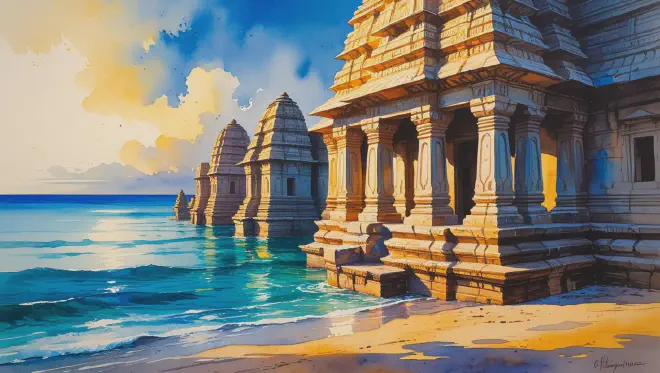
In the afternoon, I finally set out to explore the World Heritage stone carvings. My first destination was the Shore Temple. This temple standing at the edge of the Bay of Bengal was constructed in the early 8th century, and its two shrines made of granite left a deep impression. Having been exposed to strong winds and salt from the sea for centuries, the surface has weathered—yet this only adds to the weight of its ancient history.
The Shore Temple was especially beautiful in the slanting light of evening. The westward-tilting sun painted the stone surface gold and cast long shadows across the sand. As I listened to the waves and contemplated the thoughts of ancient stonemasons, my sense of time grew hazy. When the crowds of tourists had thinned, a young local man approached me and explained the temple’s history in fluent English. His name was Murugan, and he said he was studying archaeology at university.
“This temple symbolizes the prosperity of maritime trade at the time. Sailors would visit here to pray for safe voyages,” he told me. That twilight moment, conversing with a stranger in an unfamiliar land, felt like the journey’s first gift.
For dinner, I decided to eat at a seaside spot near my lodging. The outdoor restaurant called Moonlight Restaurant lived up to its name, offering dining under the glow of the moon. Tables were placed directly on the sand, and I could feel fine grains beneath my feet.
I ordered tandoori fish, said to have been caught that very morning. The fish was coated in spices, with a crispy exterior and tender, flaky flesh inside. Tearing it apart with the accompanying chapati flatbread, the flavor of the sea harmonized with the aroma of spices in my mouth.
A candle flickered on the table, swaying in the breeze, and beyond it, moonlight danced on the surface of the sea. The sound of waves, occasional calls of night birds, and the distant melody of tabla drums. The night in this land moved to an entirely different rhythm than the cities I knew.
On my way back to the guesthouse, I passed by a stone carving workshop. Though the hour had grown late, I could still hear the tap-tap of chisels from inside. Peeking through the window, I saw a craftsman concentrating intently on a small elephant sculpture. In his profile, I could see the pride and responsibility of a craft passed down through generations.
Back in my room, after a shower and lying in bed, the day’s events swirled through my mind. The sounds, smells, tastes, and warmth of the people I had encountered on my first day in this land. The journey had only just begun, but I already felt I had touched a part of Mahabalipuram’s allure. Wrapped in the sound of waves drifting through my window, I fell asleep with anticipation for tomorrow.
Day 2: Conversations with Gods Dwelling in Stone
I awoke to soft morning light filling the room. The clock read six in the morning. Perhaps still on Japan time, I had naturally woken early. Through the window, I could already see fishermen tending their nets.
I asked for a traditional South Indian breakfast at the guesthouse. The set of idli, steamed rice cakes served with sambar and coconut chutney, was simple but deeply nourishing. The refreshing sweetness of the coconut chutney was especially gentle on my morning stomach. The coffee was South Indian style—sweet with milk and slowly filtered to a rich, bold flavor that chased away any lingering drowsiness.
Around eight in the morning, I began my proper exploration of the ruins. My first stop was the massive relief known as “Arjuna’s Penance.” Carved into a single rock face approximately 30 meters wide and 13 meters tall, this masterpiece depicts a scene from the Hindu epic Mahabharata.
Countless figures—humans, animals, and gods—are intricately carved across the rock surface. The narrative unfolding on either side of the central cleft revealed different expressions depending on the viewing angle. The elephants were particularly striking, each with its own individual expression. The sight of a baby elephant nestled at its mother’s feet made my cheeks naturally relax into a smile.
A local guide named Arun, whom I met at this site, patiently explained the details of the relief. “See this cat striking a yoga pose? This is actually a satirical depiction of religious hypocrisy,” he said with a grin. The humor of ancient stonemasons reaching across 1,300 years felt wonderfully strange.
Next, I visited the Five Rathas, or Pancha Rathas. These five structures, each built in a different architectural style, form a precious complex that offers insight into the development of South Indian architecture. Carved from monolithic rocks, these buildings were never actually used as temples—they served more as an architectural laboratory.
The largest, the Dharmaraja Ratha, has a three-tiered structure with different decorations on each level. The more closely I examined the details, the more I was struck by the skill and aesthetic refinement of ancient architects and masons. The pillar decorations and wall reliefs, in particular, are so precise and beautiful that even modern technology would struggle to replicate them.
For lunch, I stopped at Heritage Café near the ruins. Though the tourist-oriented menu featured cuisines from various countries, I chose local home cooking. The chicken Chettinad curry was a dish that showcased the mastery of South Indian spice work. Black pepper, cinnamon, cardamom, and other spices intertwined in complex layers, elevating the chicken’s flavor. Despite the heat that made me sweat, I couldn’t stop eating.
In the afternoon, I visited a stone carving workshop. Many stone carvers still live in Mahabalipuram, preserving traditional techniques. Ramasamy, who ran the workshop, was born into a family of stone carvers spanning three generations and had apprenticed under his grandfather since age seven.
At the workshop, I could observe works at various stages of completion. From rough carving to finishing, a single sculpture could take months or even years to complete. Ramasamy was working on a Ganesha statue about one meter tall. “This elephant god is beloved as the remover of obstacles,” he explained in fluent English.
Watching the craftsman’s hands, I was moved by how the simple, repetitive actions of chisel and mallet gave birth to a living, expressive deity figure. The carving of the eyes was particularly delicate—slight differences in angle could dramatically change the expression. His years of experience backed a sure technique that breathed life into stone, and I was witnessing the very moment of artistic creation.
In the late afternoon, I went to see the massive spherical boulder known as Krishna’s Butter Ball. Though a natural formation, this rock sits on a slope in such perfect, precarious balance that it seems placed there by a god. Local children playing and leaning against the rock made for a heartwarming scene, showing how integral these monuments are to daily life here.
That evening, I attended a performance of Bharatanatyam, a classical dance, as a local cultural experience. The venue was an open-air stage near the shore, with seating simply arranged on the sand, yet the dancer’s passionate performance was overwhelming.
The dancer, Priya, was a professional who had trained in Chennai. Dressed in vibrant costume, she told stories through every gesture—the movement of her hands, her expressions, and her footwork. She seemed like a goddess emerged from mythology. The dance, accompanied by live tabla and viola, spoke directly to my heart even without understanding the words.
Particularly memorable was a piece depicting the dance of Lord Shiva. The power and grace of the god who creates and destroys the universe, expressed through a single human body, revealed the depth of Indian classical arts. Applause arose naturally from the audience, and I too clapped with genuine emotion.
After the performance, I happened to have a chance to speak with Priya. “Bharatanatyam is not merely dance—it is an offering to the gods. Through dance, we converse with the divine,” she said. Her words were striking. In this land, art, religion, and daily life are all organically intertwined.
Walking back to my lodging, I strolled along the nighttime shore. Moonlight illuminated the sea’s surface while waves broke the silence. Reflecting on the stone carvings I had seen during the day, I felt a profound emotion at the simple realization that ancient people had gazed at this same moon and heard these same waves. Though time flows ever onward, perhaps the essential beauty of this land remains unchanged.
Day 3: A Morning of Farewell and Memories Carved in the Heart
On my last morning, I woke early to watch the sunrise. At five-thirty, I headed to the shore while darkness still lingered. Several early-rising tourists and locals already stood on the sand, gazing toward the eastern horizon.
Soon the distant horizon began to brighten faintly, and the sun’s upper edge emerged from the sea. The sunrise over the Bay of Bengal slowly climbed into the sky, painting the water gold. The sight was so beautiful it defied words—it felt almost sacred.
An elderly local man standing beside me spoke in halting English: “Beautiful, isn’t it? I have watched this sunrise for seventy years.” He said his daily routine was a morning walk along this shore at the same hour each day. His face showed deep love for this land. This scenery was part of his life in ways I, a mere traveler, could scarcely imagine.
After breakfast, I used the remaining time before checkout to visit a small ruin I hadn’t yet seen. The Mahishasuramardini Cave Temple is a rock-cut cave temple with intricate reliefs carved inside. The sculpture of the goddess Durga slaying Mahisha, the buffalo demon, particularly overwhelms viewers with its dynamic composition and expressive detail.
At this cave temple, I encountered a group of university students majoring in archaeology. They had come from a Chennai university for field study and were intently sketching while observing the sculptures’ details. A student named Arsh, who seemed to be the group’s leader, spoke excitedly: “I’ve seen these carvings countless times in textbooks, but seeing them in person is a completely different kind of emotion.”
Seeing this younger generation earnestly engaging with their country’s cultural heritage made me realize that Mahabalipuram’s stone carvings are not mere relics of the past but living cultural assets that continue to thrive today. In the handshake we exchanged before parting, there seemed to be something that transcended culture and borders.
After packing, I said my farewell to Subramaniam, the guesthouse owner. Though my stay had been short, I was filled with gratitude for how he had welcomed me as warmly as family. “Please come back anytime. Mahabalipuram is your second home,” he said, and I felt my eyes grow warm.
For my final lunch, I returned to Arunachala Meals, where I had eaten over the past two days. This time I ordered a fish fry as the main dish. Fried to a golden crisp, the fish was crunchy outside and fluffy inside; a squeeze of lemon added a refreshing tartness that made it exquisite. This taste, I knew, would stay with me for a long time.
At two in the afternoon, my taxi arrived. The driver was Rajesh, the same man from my arrival. “How was it—Mahabalipuram?” he asked. As I answered “Wonderful,” I tried to burn the passing scenery into my memory.
The stone carving workshops, the Shore Temple, the coconut palms, the fishing port, the people passing by—everything I had encountered over these two nights and three days wove together into a single story in my heart. As the car set off toward Chennai, the landscape of Mahabalipuram gradually shrank behind me, but it remained firmly etched within.
Arriving at Chennai International Airport, I completed check-in procedures. At the duty-free shop, I purchased a small stone carving of Ganesha. Though not as exquisite as the ones I had seen at Ramasamy’s workshop, it was enough as a memento of this journey. The small deity fitting in my palm seemed to symbolize my days in Mahabalipuram.
Looking down from the airplane window, the vast expanse of the Indian subcontinent spread below. Somewhere in that landscape was the small dot of a town where I had spent three days, where the people I had met were now going about their daily lives. The thought filled me with a strange and moving feeling.
What Felt Real Despite Being Imaginary
This journey was an experience within imagination. I never actually saw Mahabalipuram’s stone carvings, never watched the sunrise over the Bay of Bengal, never exchanged words with local people. Yet what I have written here feels strangely vivid, accompanied by a sense of reality as if I had truly experienced it.
Perhaps this is due to the power Mahabalipuram itself holds. The stone carvings that have preserved their beauty for over 1,300 years, the craft techniques passed down through generations, the unchanging rhythms of sea and sky. When these elements combine, perhaps something emerges that transcends time and space.
Though this was an imaginary journey, genuine emotion and memory remain in my heart. The expressions of gods carved in stone, the aroma of spices, the sound of waves, the warm smiles of people. These things are real, and many travelers have actually experienced them.
Perhaps travel is not simply moving from place to place, but gaining new perspectives, encountering different cultures, and reflecting upon oneself. Through this imaginary journey, I was able to deepen my longing and respect for a distant foreign land.
Someday, if I have the opportunity to actually visit Mahabalipuram, I look forward to seeing how these imagined memories overlap with real experience. Perhaps the true value of travel lies not only in physically visiting a place but in opening one’s heart to engage with that land.
I hope this travel journal may serve as a reference for someone who will one day truly visit Mahabalipuram. And I hope to share the wonder of travel with as many people as possible.