
Introduction
Matanuska Glacier, located in south-central Alaska, is known as one of the few glaciers accessible by car. Approximately 180 kilometers northeast of Anchorage, cradled in the embrace of the Chugach Mountains, this glacier boasts a magnificent scale—roughly 43 kilometers in length and 6.4 kilometers in width.
What makes Matanuska Glacier special is not its beauty alone. This giant of ice, formed over more than 10,000 years, is a living witness to Earth’s climate change. Though it has been in retreat in recent years due to the effects of global warming, its bluish-white ice mass continues to overwhelm those who visit.
The surrounding region breathes with the culture of Alaska’s indigenous peoples and a history stretching back to the pioneer era. In the 1930s, as part of the New Deal policy, settlers from the Midwest established an agricultural community in this land, laying the foundation for what is now the Matanuska-Susitna Valley. The giant vegetables produced by fertile soil and long summer daylight hours remain a beloved attraction at the Alaska State Fair.
This journey is a quiet pilgrimage to a place where nature and human endeavor intersect.
Day 1: First Encounter with Ice
I landed at Ted Stevens Anchorage International Airport on a September morning, the air already crisp and cool. With each breath, a crystalline coldness permeated deep into my lungs. After completing the formalities at the rental car counter, I headed north on the Glenn Highway.
The scenery flowing past my window consisted of aspen forests dyed golden yellow and snow-dusted mountains in the distance. September in Alaska marks the height of its brief autumn, when the tundra landscape shines at its most beautiful. During the approximately two-hour drive, I could count on one hand the number of times I passed oncoming traffic. This vast land reminded me, once again, how small human beings truly are.
After passing the town of Palmer, a road sign appeared reading “Matanuska Glacier.” Something stirred deep in my chest. As I turned left at a curve, the view suddenly opened up. There it was—Matanuska Glacier.
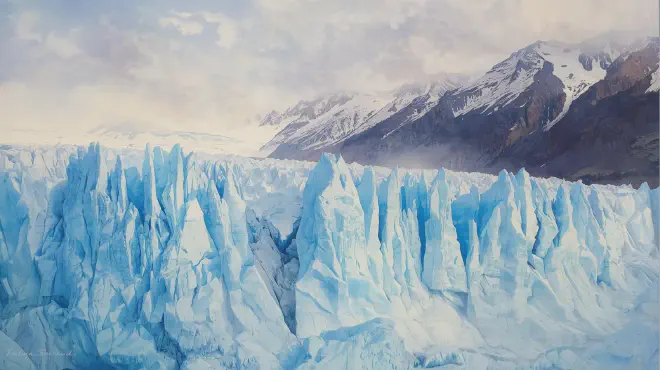
I was rendered speechless. Though I had seen it countless times in photographs, the scene spreading before my eyes far exceeded my imagination. The glacier’s terminus was covered in gray moraine, but the ice face visible beyond glowed a deep blue. It looked like a jewel oozing from the Earth’s interior.
I parked my car at the glacier access point, paid the entrance fee, and walked along the path. My footsteps echoed on the gravel. As I drew closer, I could feel the glacier’s immensity with my skin. A wall of ice, perhaps several dozen meters high, was approaching me slowly but surely. Of course, I couldn’t actually see it moving with my eyes, but knowing that this glacier travels at a rate of about 30 centimeters per year created the illusion of sensing the breath of an enormous living creature.
I spent the afternoon exploring the glacier’s surroundings. The Matanuska River, flowing from the glacier, was clouded milky white with rock flour ground down by the ice. This water eventually flows into Cook Inlet and toward the Pacific Ocean. A single snowflake becomes part of the glacier, and after thousands of years, returns to the sea. Witnessing part of this grand cycle, my concept of time became hazy.
Tom, a guide I met near the glacier, was a local who had lived here for over thirty years. “This glacier changes a little bit every year,” he told me. “Even standing in the same spot, it shows you a different face than last year. That’s the charm of glaciers.” His words carried the deep affection that only someone who has faced this land for many years could possess.
That night I stayed at a nearby lodge. The log-cabin-style building was rustic on the outside but warm and well-appointed inside. The fireplace crackled, and outside the window spread a sky full of stars. Seeing the number of stars that could never be viewed in urban areas, I was reminded once again of Alaska’s natural abundance.
Dinner was grilled local salmon. The fatty flesh was so tender it could be cut with chopsticks, and the subtle saltiness brought out the ingredient’s deliciousness. The side vegetables were also locally sourced, with the sweetness of the potatoes particularly memorable. It felt as though I was tasting on my tongue the sun’s bounty stored during Alaska’s brief summer.
Lying in bed, I reflected on the day. The sculptural beauty of the glacier as a natural formation, the long passage of time that had nurtured it, and the lives of the people who inhabit this land. I felt how all of these intertwined to create Alaska’s unique appeal. As I thought about getting even closer to the glacier tomorrow, I fell into a deep sleep.
Day 2: Invitation into a World of Ice
When I woke in the morning, the world outside my window was lightly dusted with snow. It must have fallen during the night, with cotton-ball-like snow piled on tree branches. Snow falling in late September is typical of Alaska. The temperature was around minus 2 degrees Celsius, but perhaps due to the dry air, the cold didn’t feel particularly harsh.
I ate breakfast in the lodge’s dining room. Reindeer sausage, hotcakes, and yogurt garnished with local berries. It was my first time eating reindeer meat, which was lighter than beef with a distinctive wild flavor. Eating while gazing at the snow-covered landscape through the window was truly an Alaska-only experience.
That day, to get even closer to the glacier, I participated in a glacier hiking tour that required wearing crampons. The guide, Mark, was a veteran with expertise in glaciology who knew the routes for walking safely on the glacier.
“The glacier’s surface is much more complex than it appears,” he explained. “There are crevasses and moulins. But with proper knowledge and equipment, you can safely experience the world of ice.”
Starting from the glacier’s edge, my footsteps made a distinctive creaking sound. I immediately understood that the hardness and texture of the ice was completely different from ordinary snow or ice. This was ice compressed over thousands of years.
As I proceeded, I was amazed by the diversity of the glacier’s surface. Some places were smooth as a mirror, while others had ice intricately intertwined in lace-like patterns. Peering into the bottom of a crevasse, a world of deep blue spread before me. That blue was different from the blue of sky or sea—a mystical hue unique to glaciers.
“This blue color comes from the ice absorbing the red components of light and reflecting only the blue,” Mark explained. “The denser the ice, the more pronounced this phenomenon becomes.” Even hearing the scientific explanation, knowledge seemed trivial before such beauty.
In the afternoon, I stepped away from the glacier slightly to observe the surrounding nature. The Matanuska Glacier area is home to wildlife including black bears, moose, and caribou. That day I was fortunate enough to spot a moose mother and calf in the distant forest. Watching the massive mother with her small offspring toddling behind reminded me that life continues to be passed down even in this harsh natural environment.
The vegetation around the glacier was also fascinating. In areas where the glacier had retreated, pioneer plants like willows and fireweed first take root. Then, over time, forests of aspen and spruce gradually form. It was a valuable experience to see and learn nature’s resilience and the weight of time with my own eyes.
In the evening, I visited a small nearby settlement where I met a family of Alaska Natives who had lived on this land for generations. Grandmother Mary shared legends about the glacier that had been passed down in the region.
“Long ago, people believed the glacier was the incarnation of a giant white bear,” she spoke in a quiet voice. “That bear carved mountains, created valleys, and gave birth to rivers. Our ancestors lived by showing respect to the glacier and offering gratitude.” While different from modern scientific knowledge, perhaps the essence—reverence for nature—remains fundamentally the same.
That night I stayed at the same lodge again. Dinner was fried local halibut and vegetable soup. The halibut was mild yet sweet, with a crispy coating that was exquisite. The soup contained local potatoes, carrots, and wild mushrooms, allowing me to fully savor the earth’s bounty.
Returning to my room, I found the aurora dancing outside my window. Curtains of pale green light shimmered across the night sky. I was deeply grateful for the good fortune of seeing it, thanks to the combination of late September timing and that day’s clear weather. Gazing at the aurora, I felt anew just how special a place I was in.
Day 3: Farewell and Crystallized Memory
The final morning was wrapped in fog. Moisture from the previous night’s cold had risen from the river, covering the entire valley in a white veil. It was a fantastical sight, but it seemed to foreshadow my farewell to the glacier, making me feel somewhat melancholy.
After breakfast, I checked out and went to see the glacier one last time. The glacier appearing as the fog gradually lifted seemed like a mystical presence emerging from another world. I was surprised at how the same glacier’s expression changed so dramatically depending on weather and light conditions.
I spent my final moments quietly before the glacier. Ruminating on my two days of experiences, I savored the magnitude of what this place had given me. The glacier’s overwhelming presence, the flow of deep time, the relationship between nature and humanity, and above all, gratitude for living on this beautiful Earth.
As I sat on a nearby bench reviewing photos I’d taken during the trip, Tom, whom I’d met yesterday, called out to me. “Leaving already?” he said. “The glacier will remember you. Come back again.” His words made me feel once more the warmth of the people of this land.
Before heading back, I stopped at the nearby visitor center, where I could learn more details about the glacier’s history and geological background. Viewing an exhibition of photographs documenting the glacier’s retreat, I confronted the reality of Earth’s environmental changes. It made me ponder what I could do to preserve this beautiful glacier for future generations.
For lunch, I had a reindeer burger, an Alaska specialty, at a local diner. The reindeer patty was savory, and its combination with local vegetables was superb. The diner was filled with locals, and just listening to their casual conversations allowed me to glimpse a fragment of life in this land.
During the afternoon drive back to Anchorage, I looked back at the glacier many times. Though it grew smaller with distance, its presence in my heart seemed to grow larger instead. An Alaskan folk song I heard in the car deepened the journey’s afterglow.
Even after arriving in Anchorage with time to spare, I explored the city a bit. At the downtown Alaska Native Heritage Center, I learned about Alaska’s diverse indigenous cultures. This overlapped with the stories of people I’d met around Matanuska Glacier, deepening my understanding of this land’s history and culture.
On the way to the airport that evening, I stopped at a souvenir shop and purchased a small sculpture with a glacier motif made by a local artist. The piece, crafted from blue glass, beautifully reproduced the glacier’s color and would allow me to recall that beauty even after returning home.
During my wait at the airport, gazing at distant mountains visible through the window, I summarized these three days. Matanuska Glacier was not merely a tourist destination. It was a book inscribed with Earth’s history, a work of art embodying nature’s power, and a teacher showing both human smallness and the possibility of coexistence with nature.
Moreover, on this journey, encounters with people living there became a great treasure, not just the glacier itself. Their wisdom and kindness cultivated in a harsh natural environment, along with their deep respect for nature, were fresh and suggestive to someone like me living in an urban area.
As the plane took off, Alaska’s land spread below my window. Endless forests and mountains, and the small Matanuska Glacier visible in the distance. From above, it became clear how human endeavors are merely part of nature. At the same time, I felt that precisely because of this, we need to cherish nature and face it with humility.
Epilogue
This journey is certainly a product of imagination. However, knowledge about the real place called Matanuska Glacier, experiences of people who have visited there, and my own longing for nature combined to create a journey that, while imaginary, feels as though it truly happened.
The glacier’s blue radiance, Alaska’s clear air, the warmth of local people, and my small self before overwhelming nature. These sensations might be fully experienceable even without physically standing in that place, through imagination and knowledge.
Travel does not necessarily mean only physical movement. An experience where the heart moves, new discoveries are made, and one’s worldview expands—isn’t that what true travel is? In that sense, this imaginary journey can surely be called a journey of genuine value.
Matanuska Glacier continues to move quietly but surely even now. The beautiful scenery it has carved out and the culture nurtured there will continue to move many people’s hearts. And whether actually visiting that land or traveling there in imagination, people will surely gain similar inspiration and learning.