
To a Land of Memory, Where a White Castle Stands
When you hear the name Belarus, what landscape comes to mind? This country, whose name means “White Russia,” is a land surrounded by quiet forests and lakes in Eastern Europe. The capital, Minsk, having suffered great damage during World War II, exists today as a layering of orderly streets from the Soviet era and cultural memories that stretch back even further.
The people of this country speak Russian and Belarusian, living quiet daily lives in a city where Orthodox church bells ring. The cuisine, influenced by Russia, Poland, and Lithuania, has its own distinctive flavor, with simple home-cooked dishes using potatoes that warm the heart. Long winters and short summers, and beautiful autumn foliage mark the passage of time in this land.
Though it was a short journey of just two nights and three days, I was able to touch the silence and gentleness of this country. It was certainly an imaginary journey, but it resurfaces vividly in my mind as a memory that lingers still.
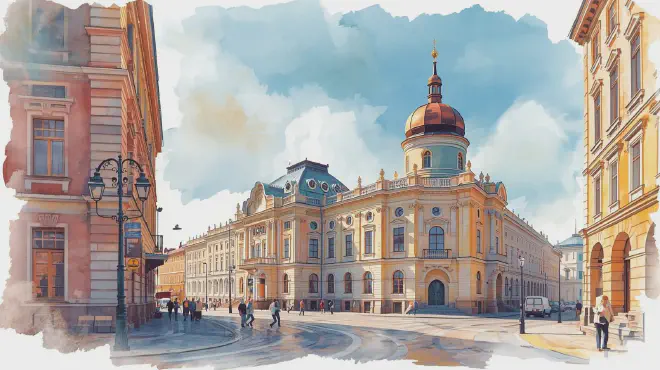
Day 1: Footsteps Echoing in a Silent City
I arrived at Minsk International Airport on a morning flight. It was late October, and the air was already quite cold—I could see my breath turn white. From the bus window heading into the city, I saw more greenery than I had imagined, with birch trees turning golden yellow. The driver, an older man, was initially unfriendly, but when he saw me struggling with a map, he told me the location of my hotel in broken English.
My first impression of Minsk was “quiet.” There was none of the hustle and bustle of Moscow or Warsaw, and even people’s footsteps seemed to echo modestly. After checking in at the hotel, I first headed to the Old Town. Walking along the cobblestone streets, the white walls and golden dome of the Cathedral of the Holy Spirit came into view. The interior was dim, with candlelight illuminating the icons. Watching the local people quietly offering prayers, I felt the depth of these people’s hearts.
For lunch, I went to a small restaurant called “The Gasto” near the cathedral. The menu was written in Russian and Belarusian, and a waitress brought me an English menu. Her name was Natasha, and she told me shyly that she was studying English at university.
I ordered “draniki,” a traditional Belarusian potato pancake. It was a simple dish made from grated potatoes, but eaten with sour cream, a gentle, humble flavor spread through my mouth. The accompanying salad contained beets and cabbage, with a pleasant subtle sourness.
In the afternoon, I visited the National Art Museum of Belarus. This museum displays works by Belarusian painters from the 19th to 20th centuries. What particularly impressed me were the early works of Marc Chagall, a Jewish Belarusian painter. From his paintings depicting scenes of his hometown Vitebsk, one could sense the tranquil beauty of this land. Alexandr, the museum curator, explained the works in fluent English. “Chagall left here for Paris, but his heart was always in Belarus,” he said with a slightly sad smile.
In the evening, I walked along the Nemiga River. The river wasn’t particularly large, but its quiet flow softened the city’s noise. Benches lined the banks, where locals sat conversing while watching the sunset. I sat on one of the benches and looked up at the sky dyed orange. From afar, I could hear Orthodox church bells ringing, announcing the end of the day.
For dinner, I ate at a home-style restaurant called “Krama” near the hotel. There I tasted “Belarusian-style borscht.” It was slightly lighter than Russian borscht, with a distinctive dill aroma. The accompanying black bread developed a deeper wheat flavor the more I chewed. When Petro, the owner, heard I was from Japan, he happily told me his son loved anime.
On my way back to the hotel, walking along the quiet street lit by streetlamps, the warm light spilling from windows comforted my heart. The lives of Belarusian people, while not glamorous, held a certain warmth. That night, lying in bed, I felt my chest swell with anticipation for what discoveries tomorrow might bring.
Day 2: Forest Memories and the Lake’s Melody
For breakfast at the hotel restaurant, I had Belarusian-style kasha (porridge) with smetana (sour cream) and local honey. Outside the window, leaves from the street trees fluttered down. Today, I thought I would venture a bit further to experience the nature around Minsk.
In the morning, I headed to Mir Castle, about 30 minutes from the city. From the bus window, I could see endless forests and fields. I had heard that about 40% of Belarus’s land is forest, and indeed, such a landscape spread before me. The forest woven from birch, oak, and pine trees was like something from a fairy tale.
Mir Castle, built in the 16th century, is also registered as a UNESCO World Heritage site. It’s a beautiful building with distinctive red brick walls and square towers, mixing Gothic and Renaissance styles. Irina, the guide who showed me around the castle, spoke about its history in fluent English. “This castle has welcomed many rulers since the times of the Grand Duchy of Lithuania. It was destroyed in war, but was restored as a source of pride for the Belarusian people.”
Standing in the castle courtyard, I could almost picture the lives of nobles from centuries ago. The autumn wind caressed the castle walls, playing a somewhat melancholic tune. In the castle’s exhibition rooms, weapons, ornaments, and beautiful tapestries from that era were displayed. What particularly impressed me was the Belarusian folk costume. The beautiful decoration of red and blue embroidery on white linen fabric spoke to the delicacy of these land’s women’s handiwork.
For lunch, I had “kartoplyanka,” a potato soup, at a small café near the castle. The warm soup, filled with sausage and vegetables, warmed me from the core. When the café owner learned I was traveling alone, she kindly asked, “How do you like Belarus?” When I answered, “It’s a very beautiful country,” she smiled with pleasure.
In the afternoon, I headed to Narochansky National Park. Lake Naroch, Belarus’s largest lake, is highly transparent and surrounded by forests, a beautiful lake indeed. There was a small pier at the lakeshore from which one could view the entire lake. The October lake was silence itself, with water birds occasionally skimming across its surface.
Walking along the lakeside path, I found a local elderly man sitting alone on a bench, gazing at the lake. His name was Alexei, and he said he often came here after retirement. “This lake is my heart’s homeland,” he told me in a slow cadence. “During the war, during Soviet times, and now, this lake has remained unchanged here.” His words carried the quiet weight that only someone who has walked through a long life possesses.
As I strolled around the lake, pine cones fallen from pine trees and colorful fallen leaves scattered at my feet. I could hear children’s voices in the distance, and I saw families enjoying picnics. I realized that for Belarusian people, this nature is part of their daily life.
On the way back to Minsk in the evening, we passed through a small village. Wooden houses dotted the landscape, with chickens walking around in the yards. Warm light spilled from windows, and I could see the shadows of families preparing dinner. The bus driver pointed to a small church in the village and told me, “It’s a 17th-century church.” The small church with white walls stood quietly at the village center.
For dinner, I ate at a restaurant called “Etnomir” in central Minsk. This place serves traditional Belarusian dishes with a modern twist. “Beef Stroganoff Belarusian-style” had an excellent sour cream and mushroom sauce, and the accompanying buckwheat blini were fragrant and delicious. For dessert, I had “syrniki,” cottage cheese pancakes. The warm pancakes drizzled with honey gently soothed the day’s fatigue.
On the way back from the restaurant, walking through the city center, I saw young people happily conversing in cafés and bars. Belarus’s younger generation lives cherishing tradition while accepting new culture. That sight made me feel hope for this country’s future.
Day 3: A Parting Melody and Lingering Memories
On the final morning, I woke up a bit early and took a walk in a park near the hotel. Walking on the dew-soaked lawn, I saw a squirrel jumping from branch to branch. In the park, I passed people enjoying morning jogs and walking their dogs. When I greeted them with “Dobrae ranitsa (good morning),” they all responded with gentle smiles.
After breakfast, for my last bit of sightseeing, I visited the Belarusian National Museum of History. Here, the country’s history from ancient times through the Soviet era to the present is displayed. What particularly moved me was the World War II exhibition. Belarus has a tragic history of losing about 25% of its population in the war, and those records touch the viewer’s heart. However, in the postwar reconstruction exhibits, one could sense the people’s strong will and hope.
Marina, the museum curator, told me, “We will never forget our sad history, but at the same time, we continue to hold hope for the future.” Her grandparents experienced the war and have passed down those memories. “By knowing history, we can learn the importance of peace.” Her words left a deep impression at the end of my journey.
For lunch, I had my last Belarusian meal at a restaurant called “Belarusian Kitchen” near the museum. “Zatirka,” a traditional soup made with grated potatoes and sour cream, had a simple yet soul-warming flavor. The accompanying “koperki,” smoked fish, also had a distinctly Belarusian taste, etched into my tongue as a memory of this journey.
In the afternoon, I visited the central market to buy souvenirs. At the market, local people were selling vegetables, fruits, and handmade goods. I purchased handkerchiefs embroidered with traditional Belarusian patterns and small crafts made from birch wood. When the elderly vendor heard I was from Japan, she welcomed me with a warm smile, saying, “Thank you for coming from such a distant place.”
Before heading to the airport, I visited the Cathedral of the Holy Spirit one more time. Watching people quietly praying in the dim interior of the evening cathedral, I felt that these three days of travel had been real. Candlelight illuminated the icons, and from somewhere came the sound of sacred music. I too lit a candle and clasped my hands together with gratitude for this beautiful country and its gentle people.
On the bus to the airport, I burned the scenery passing by the window into my heart. Birch forests, small villages, and quietly flowing rivers. The landscape of Belarus is not glamorous, but it has a beauty that resonates deeply in the heart. While checking in at the airport, I recalled the faces of the people I had met. Natasha’s shy smile, Alexei’s quiet eyes, Marina’s sincere gaze. These brief encounters made this journey something special.
The plane took off, and below, the city of Minsk grew smaller. The landscape of forests and lakes visible from the window was beautiful like a single painting. These three days spent in this quiet country are deeply engraved in my heart and will never fade.
What Felt Real Though It Was Imaginary
This journey was certainly a product of imagination. I never actually set foot on Belarusian soil, never walked the streets of Minsk, in reality. Yet in my heart, this journey truly exists. The simple taste of draniki, the silence of Lake Naroch, the candlelight of the Cathedral of the Holy Spirit, and the warm smiles of the people I met. All of these remain as vivid memories, though imaginary.
Perhaps travel doesn’t necessarily mean only physical movement. If one’s heart moves, touches a new world, and can feel something there, then it becomes a genuine travel experience. The longing for the country of Belarus, the interest in its culture, the affection for its people. These emotions live within me no differently than they would from an actual trip.
Perhaps precisely because it was an imaginary journey, I was able to touch the essence of that land beyond the constraints of reality. Without language barriers, time limitations, or budget worries, I could purely face the beauty of the country and the hearts of its people. And when the day comes that I truly visit Belarus, this imaginary journey will surely make that real journey something deeper.
Memory is a mysterious thing. Sometimes what we’ve actually experienced and what we’ve drawn in imagination become indistinguishable. The memory of this journey now exists as a certain part of my life. Together with my affection for the beautiful country of Belarus and the gentle people who live there.