
What Stirs in Bavaria’s Heart
Munich, the capital of Bavaria in southern Germany, rests quietly at the foot of the Alps. In this city, cobblestone streets that retain the atmosphere of medieval times exist in exquisite harmony with modern urban functions. The palaces and churches where the history of the Kingdom of Bavaria still breathes, and the beer culture of the birthplace of the world-famous Oktoberfest. The Isar River flows gently through the city, while the peaks of the Alps draw the horizon in the distance.
The old town where the Glockenspiel of the neo-Gothic New Town Hall resounds, the verdant English Garden, and the cultural district known as the Museum Quarter. Munich is not merely a tourist destination, but a place where the pride and traditions of the Bavarian people continue to live. What would I discover in this city, visited at the end of autumn?
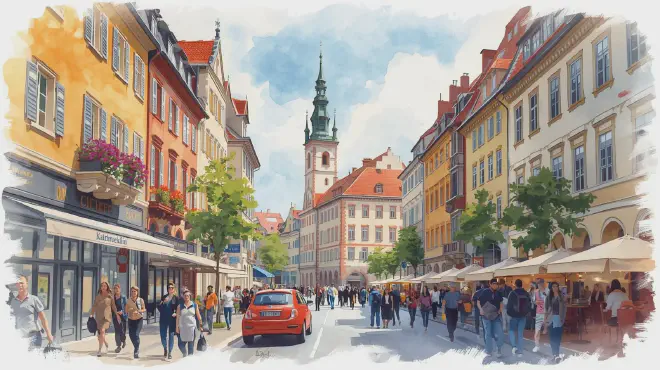
Day 1: Footsteps Echoing on Cobblestones and the First Taste
The moment I stepped off the train at Munich Central Station, cold, crisp air caressed my cheeks. At the end of November, the city was already preparing for its Christmas markets, wrapped in an atmosphere both bustling and warm. Dragging my heavy suitcase, avoiding the tram tracks, the sensation of walking on cobblestones made the beginning of my journey feel real.
In the morning, after dropping off my luggage at the hotel, I headed to the old town. Arriving at Marienplatz, I was overwhelmed by the imposing beauty of the New Town Hall. The neo-Gothic building possessed the solemnity of a medieval cathedral, yet also showed a somehow approachable expression. The square was filled with a mix of locals and tourists, and people wrapped in blankets enjoyed warm drinks at café terrace seats.
At eleven o’clock, along with the chiming of the bells, the Glockenspiel began to move. The melody played by 43 bells tells the story of historical events in Bavaria. Not only tourists but locals too stopped and looked up—this sight left an impression on me. In this moment, I felt myself certainly enveloped in Munich’s time.
For lunch, I decided to eat at a long-established Gasthof facing the square. When I pushed open the heavy wooden door, warm light illuminated the dimly lit interior, where the aroma of beer mingled with laughter. Shown to my seat with a “Grüß Gott” greeting, I ordered Schweinshaxe (roasted pork knuckle). The surprise when an enormous chunk of meat was carried to my plate, the acidity of the accompanying sauerkraut, and above all, the refreshing quality of a liter of Maßbier. It was a moment when I absorbed Bavarian food culture with my entire body.
In the afternoon, I visited the Frauenkirche. This church with its distinctive twin towers is beloved by citizens as Munich’s landmark. The interior was surprisingly austere, yet that very austerity made its sanctity as a place of prayer stand out. Light streaming through the stained glass created fantastical patterns on the stone floor. Even I, a tourist, felt my heart naturally grow calm.
As evening approached, I strolled through the English Garden. November twilight comes early, and the breath of people walking in the park was white, with only the sound of stepping on fallen leaves echoing. I came across people surfing on the Eisbach, and even in this cold, the sight of them challenging the river’s current made me feel the resilience of the Bavarian people.
I spent the evening at a beer garden in the old town. Sitting at an indoor table, mixing with the locals, I savored Weißbier. From the neighboring table, I could hear conversation in Bavarian dialect. Though I couldn’t understand the words, their warm resonance reached my heart across borders. Biting into Leberkäse (Bavarian-style meatloaf) and pretzels, I felt myself dissolving into the city’s night.
On my way back to the hotel, illuminated buildings lit up the cobblestones. Walking through the night city where the sound of my shoes echoed, my anticipation for tomorrow quietly grew.
Day 2: The Harmony Woven by Art and Nature
In the morning, I woke to soft light streaming through the hotel window. Munich mornings in November are cold, but the air is clear and pleasant. For breakfast, I bought Brötchen (small bread rolls) and coffee at a nearby bakery, deciding to eat while walking. Watching the pigeons gathering for breadcrumbs and citizens active from early morning, I felt I was glimpsing the everyday life of this city.
In the morning, I visited the Alte Pinakothek in the Museum Quarter. This museum boasts one of Europe’s finest collections, housing paintings from the 14th to 18th centuries. Standing before Dürer’s self-portrait, I felt as if pierced by his sharp gaze. Rubens’ rich colors, Rembrandt’s deep shadows. Each work spoke across time. In the museum’s silence, I spent luxurious time facing art.
I had lunch at a small café near the museum. Spätzle (handmade pasta) and an assortment of sausages, along with local apple juice. The simple yet nourishing dishes made me once again feel the depth of Bavarian food culture. The café’s madame explained the dishes in broken English, and her kindness resonated warmly in my heart.
In the afternoon, I extended my visit to Nymphenburg Palace. This palace, used as the Bavarian royal family’s summer residence, is known for the magnificence of its Baroque style and the beauty of the gardens surrounding it. While the palace interior’s lavish decorations were splendid, what moved my heart most was the garden extending from the palace.
The vast garden was wrapped in autumn’s garb. Trees dyed golden, the still surface of ponds, and the Alps visible in the distance. With each step, the scenery changed, creating the illusion of walking through a painting. Sitting on a bench by the pond, watching swans swim gracefully, time seemed to flow slowly. With few tourists around, I felt the luxury of having to myself the beauty woven by nature and history in the silence.
In the evening, I visited the Viktualienmarkt. Known as Munich’s largest food market, this place is rooted in local life. Fresh vegetables, cheese, sausages, bread—Bavaria’s abundant ingredients lined up in profusion. Conversations in dialect exchanged between sellers and buyers, cheerful shopkeepers offering samples. Amid the market’s characteristic vibrant atmosphere, I too purchased local cheese and sausages.
For dinner in the evening, I ate at Augustiner Bräu. At this traditional Brauhaus (brewery-restaurant), you can taste beer brewed on-site. Haxe (pork knuckle) and dumplings, along with rich dark beer. The waiter’s cheerful service and casual interactions with locals at neighboring tables. Beyond the language barrier, there was warmth in sharing the common pleasure of food.
On my way back to the hotel, I walked along the Isar River. The river surface sparkled in the streetlights, and the buildings on the opposite bank reflected in the water. Munich’s night was quiet, with few walkers. Only the murmur of the river and the sound of church bells in the distance colored the night’s silence.
Day 3: A Morning of Farewells and Memories Carved in the Heart
On the final morning, I woke a bit early and went for a walk. Walking through the old town with few people yet about, places usually crowded with tourists showed different expressions in the morning quiet. Cleaning staff sweeping the cobblestones, craftsmen preparing at bakeries, citizens walking their dogs. It was precious time glimpsing Munich’s “true face.”
For breakfast, I went to a café I’d come to like during my stay. Weißwurst (white sausage) and pretzels, with sweet mustard. While savoring this traditional Bavarian breakfast, I organized the memories of these three days in my mind. When the owner learned it was my final day, he warmly said, “Auf Wiedersehen (until we meet again).”
In the morning, I visited Marienplatz one last time. Listening to the Glockenspiel’s music, I recalled the first morning. The fresh surprise I felt then, and the familiarity I feel now. Though only three days, I realized that affection for this city had certainly been born.
I did my shopping at the Fünf Höfe shopping arcade. Bavarian traditional crafts, local chocolate, and beer glasses. Though all small items, they would become precious objects that revive the memories of this journey.
For lunch, I ate at a Gaststätte near the station. Simple Schnitzel (cutlet) and potatoes, and my last München beer. That it tasted more flavorful than usual—was it because of the premonition of parting? Through the restaurant window, I could see people coming and going, and travelers heading to the station. Soon, I too would become one of them.
Early in the afternoon, I checked out of the hotel and headed to the central station. While waiting for the train on the platform, memories of the landscapes, tastes, and people I’d encountered over three days came back to life in my heart. The texture of Marienplatz’s cobblestones, the silence of the Frauenkirche, the beauty of Nymphenburg Palace’s garden, the warm time at the beer garden. All of these had become part of who I am now.
As the train slid into the station, it announced that the time to part with Munich had come. As the cityscape visible through the window gradually grew smaller, I waved to this city in my heart with gratitude.
The three days spent at the foot of the Alps were not a long time. However, by touching Bavarian culture and history, the warmth of its people, and beautiful nature, they left deep satisfaction in my heart. It was a journey that made me realize anew that travel is more than physical movement—it is also a journey of the heart.
What Was Felt as Real Though Imaginary
This journey is a record of an imaginary trip drawn in my mind. Yet, as I write these words, the coldness of Marienplatz’s cobblestones, the foam of beer at the beer garden, the murmur of the Isar River—all come back vividly, as if I had actually experienced them.
Though imaginary, the soul of the city called Munich certainly dwells here. Bavaria’s history and culture, the way people live, nature’s expressions shown through the changing seasons. All of these continue to live within me through this imagined journey.
Travel is not only about setting foot in new places. Touching different cultures in one’s mind, walking unknown street corners, imagining interactions with local people—these too may be certain forms of travel. While hoping that this imaginary Munich journey will someday develop into a real journey, I put down my pen.
Auf Wiedersehen, München. Until the day we meet again.