
A Sandy Paradise Embraced by the Atlantic
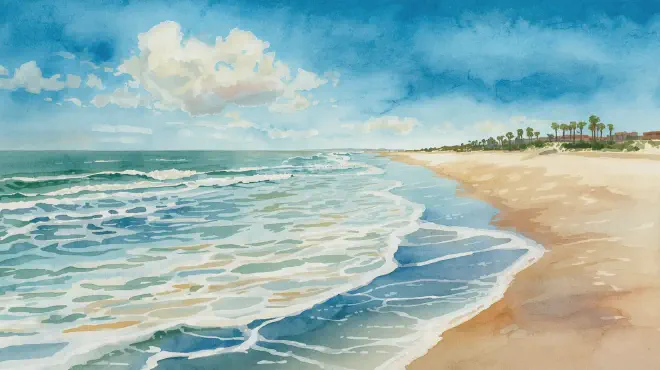
Along the northeastern coast of South Carolina, golden sands stretch toward the Atlantic Ocean. Myrtle Beach takes its name from the wax myrtle, an evergreen shrub that once grew abundantly throughout this region. Situated at the heart of the Grand Strand—a sixty-mile arc of coastline—this town began as a lumber settlement in the early 1900s before transforming into one of the East Coast’s most beloved beach resorts.
Blessed with the mild climate of the American South, the area draws crowds from spring through autumn. Yet in late winter and early spring, a gentler character emerges. The salt breeze carries a quiet calm that settles over the entire town, revealing a face quite different from the summer bustle. Golf courses dot the landscape—so many that the region has earned the nickname “Golf Capital of the World”—and a distinctive food culture thrives here, blending Southern culinary traditions with the freshest seafood. Lowcountry cuisine, the regional cooking of coastal South Carolina, lives on in dishes like gumbo, grits, and the iconic shrimp and grits.
I chose to visit not for the flashy tourist attractions, but to gather small fragments of ordinary life amid the rhythm of the tides. I wanted to let time wash over me like the waves themselves.
Day 1: Drawn by the Salt Wind
I landed at Myrtle Beach International Airport just past two in the afternoon. Stepping out of the small terminal, the soft sunlight of late March brushed against my skin. The temperature hovered around sixty-four degrees Fahrenheit. I picked up a rental car and headed south along Kings Highway. Palm trees lined both sides of the road, interspersed with signs for mini-golf courses and seafood restaurants. Perhaps because it was off-season, traffic was light. I rolled down the window and let the scent of the ocean fill the car.
My accommodation was a small hotel right on the beachfront. After checking in, I found that my room’s balcony offered an unobstructed view of the Atlantic. The waves were calm, and a few scattered figures strolled along the sand. I set down my bags and headed straight for the beach.
The moment my feet touched the sand, I slipped off my shoes. The sand was cooler than I expected, its gritty texture pleasant against my bare soles. I walked to the water’s edge and watched the waves advance and retreat. In the distance, an elderly man stood knee-deep in the surf, fishing rod in hand, utterly still. He seemed to have become part of the landscape itself.
After wandering for a while, I made my way to Broadway at the Beach, an entertainment complex centered around Lake Broadway, an artificial lake ringed by restaurants and shops. It had the brightness of a tourist destination, yet something about it evoked the nostalgic charm of an old American amusement park. I sat on a bench by the water and watched the evening sky reflected on its surface. Across the lake, a family was feeding the ducks. Children’s laughter drifted over the still water.
For dinner, I went to Sea Captain’s House, a seafood buffet restaurant I had heard much about. This establishment has been serving guests since the 1930s and remains a local favorite. Stepping inside, I was greeted by warm wooden interiors and an atmosphere that felt almost homey. The buffet featured fried shrimp, crab legs, fried oysters, hush puppies—those Southern staples made from deep-fried cornmeal—coleslaw, and macaroni and cheese.
I filled my plate with small portions of everything and found a seat. The shrimp had a light, crispy batter, and a squeeze of lemon brought out a subtle sweetness. The hush puppies were crisp on the outside, tender within; spread with butter, they released a simple, comforting sweetness. Looking around, I noticed mostly older couples and multi-generational families. Everyone seemed to be savoring their time, unhurried.
Back at the hotel, I stepped onto the balcony to gaze at the nighttime sea. Only the steady rhythm of the waves broke the silence. Far offshore, a fishing boat’s light bobbed gently in the darkness. The stillness of that first evening seeped quietly into my heart.
Day 2: Tracing Memories Along the Shore
Morning found me at Peggy’s Pancake House, a small café near the hotel. This breakfast spot has been a local institution for years, and even at seven o’clock, regulars already filled the seats. The menu offered American breakfast classics: pancakes, waffles, omelets, biscuits and gravy. I ordered blueberry pancakes with bacon and a side of grits.
The pancakes arrived enormous—about eight inches across—glistening with melted butter and drenched in maple syrup. The first bite revealed a fluffy interior studded with blueberries, their tartness harmonizing perfectly with the syrup’s sweetness. Grits, made from ground corn simmered to a creamy consistency, had a simple, earthy flavor. A pat of butter and a pinch of salt made them the perfect companion to the salty bacon.
After breakfast, I drove south to Huntington Beach State Park, about twenty minutes from Myrtle Beach. This quiet preserve retains a wilder character. Within the park stands Atalaya Castle, a Moorish-style mansion built in the 1930s as a wealthy family’s winter retreat. Though now weathered and crumbling, the structure still bears traces of its former elegance.
Walking around the castle, I saw ivy clinging to stone walls bleached by sea winds. Through the empty window frames, the Atlantic spread before me, and I wondered if those who once lived here had gazed upon this same view. The interior was closed to visitors, but peering through openings, I could make out tiled floors and the remnants of fireplaces. In that profound silence, I felt the weight of history pressing gently upon me.
I walked the park’s beach, so different from the tourist strands. Here, there were almost no people. Driftwood lay scattered across the sand, and seabirds occasionally descended to the water’s edge. At my feet, small shells and sea glass glinted. I crouched to pick up a piece—blue, its edges worn smooth by the waves—and held its coolness in my palm.
In the afternoon, I visited Brookgreen Gardens, a vast estate near Murrells Inlet, south of Myrtle Beach. Built on the grounds of a former plantation, this 9,100-acre property encompasses sculpture gardens, a wildlife preserve, and historic structures.
Past the entrance, ancient live oaks spread their branches like a canopy overhead, draped with Spanish moss—that silver-gray plant so characteristic of the South. Throughout the gardens, works by American sculptors stood quietly among the greenery. By a pond, a bronze figure gazed at its own reflection on the water’s surface, creating a doubled presence that seemed to exist in two worlds at once.
In the wildlife preserve, I spotted white-tailed deer, wild turkeys, and alligators. Walking along the boardwalk, I noticed an alligator in the marsh, only its eyes visible above the water. It remained utterly motionless, as if it too had become part of the landscape. Watching it, I felt I was learning something about how creatures exist within nature—patient, still, perfectly at home.
As evening approached, I visited the Marshwalk, a wooden boardwalk along the inlet at Murrells Inlet. Seafood restaurants line the walkway, offering meals with views over the water. At Creek Rascals, a casual spot, I ordered raw oysters and shrimp and grits.
The oysters arrived on a bed of ice, accompanied by lemon wedges and cocktail sauce. Sliding one into my mouth, I tasted the sea’s salinity followed by a faint milky sweetness. Utterly fresh. The shrimp and grits exemplified Lowcountry cuisine: creamy grits topped with shrimp sautéed in garlic and butter, enriched with andouille sausage and bacon. Each bite was rich yet somehow gentle, filling my mouth with layers of flavor. I understood anew the depth of Southern food culture.
From the deck, I watched the sunset paint the inlet orange. Across the water, in the salt marsh, a great egret stood in solitary stillness. As the tide shifted and the light changed, I surrendered myself to the gentle pace of time in this place.
Day 3: Morning Farewell, Memories to Carry Home
On my final morning, I rose early to watch the sunrise. The view from my balcony was beautiful, but I wanted to stand on the sand and greet the dawn with my feet on the earth. At half past six, I descended to the beach while darkness still lingered. The eastern sky brightened gradually, the horizon blushing orange. With only the sound of waves for company, I watched the sun emerge.
Light spilled across the water, and each wave began to sparkle. Before that sight, words felt unnecessary. Simply being there was enough to feel complete. Joggers passed, dog walkers ambled by. Everyone was welcoming the morning in their own quiet way.
After returning to the hotel for a simple breakfast, I set out for one last walk before checkout. I strolled along the Myrtle Beach Boardwalk, a wooden promenade stretching about 1.2 miles with the Atlantic on one side and hotels and restaurants on the other. Few tourists were about yet; I watched maintenance workers silently sweeping the boards.
Along the boardwalk rises the SkyWheel, a Ferris wheel standing nearly two hundred feet tall. Its climate-controlled gondolas offer panoramic views of the entire Grand Strand. I wished I had time to ride it, but settled for admiring it from below. Bathed in morning light, its white frame gleamed like a symbol of hope.
Partway along the boardwalk, I stopped at a small place called The Boiling Seafood and picked up a Lowcountry boil for a late breakfast. Shrimp, sausage, corn, and potatoes boiled in Cajun spices, handed to me in a paper bag. I found a bench, opened the bag, and the aroma of spices rose up. I peeled the hot shrimp with my hands and bit in. The heat of the spices and the sweetness of the shrimp burst together. The corn and potatoes had absorbed the flavors completely. Heedless of my messy hands, I ate with single-minded focus.
When I finished, I wiped my hands and looked once more at the sea. For three days, I had gazed upon this ocean. The same water, yet it showed me an entirely different face depending on the hour and the weather. That, I thought, is what travel is like. The same place leaves entirely different memories depending on your state of mind, the people you meet, what you eat, the sky above.
Shortly after noon, I checked out and drove to the airport. The scenery through the window was the same as when I arrived, yet now it felt dear to me. Three days is brief, but this place had left something within me. Not grand tourist spectacles, but small fragments: the smell of salt air, the memory of waves, the warmth of Southern cooking, the unhurried rhythm of people’s lives.
At the airport, I returned the rental car and entered the terminal. With time before my flight, I bought a small magnet from the gift shop. Holding the one that read “Myrtle Beach,” I hoped I would never forget this journey.
In Closing: What Felt Real Though Imagined
This journey never actually took place. And yet, as I wrote, I felt certain I had stood on that Myrtle Beach sand, breathed in the salt wind, tasted the warmth of shrimp and grits. This is the power of imagination—and the magic that words possess.
Travel need not mean only physical movement. When the heart stirs, when imagination expands, when we let our thoughts wander to unknown lands—that too is a form of journey. With Myrtle Beach as my stage, I spent three fictional days there. Those days exist nowhere in reality, yet perhaps, for someone reading these words, they have begun to take shape.
Even in an imaginary voyage, the respect for the land, the understanding of its culture, the vision of how people live—these are genuine. And perhaps, when one day I truly visit, these imaginings will make that experience all the richer.
Myrtle Beach, South Carolina. A town of sand and sea breeze on the Atlantic coast. There, people go about their lives; there, history has unfolded; there, the landscape endures. If this imaginary journey might someday become a small spark for someone’s real adventure, I would be glad.