
Embraced by the City That Never Sleeps
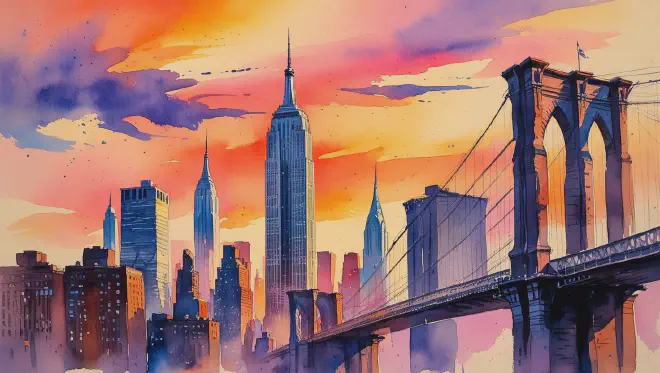
New York. A true melting pot where people from around the world come to chase their dreams. Manhattan’s skyscrapers, many built between the late 19th and early 20th centuries, still define the city’s iconic skyline—the Empire State Building and the Chrysler Building standing as monuments to an era of ambition and architectural daring. On this narrow island, cradled between the Hudson and East Rivers, Central Park breathes as the city’s green lung, while Broadway and Times Square pulse with the intersection of countless cultures.
The history of immigration runs deep through these streets. Little Italy, Chinatown, and the Jewish heritage of the Lower East Side each preserve their distinct cultural identities while coexisting in remarkable harmony. New York’s food culture reflects this diversity as well—from authentic bagels to pizza to delicatessen fare, one need only stand on a street corner to encounter flavors from every corner of the globe.
Autumn in New York is something special. The trees in Central Park turn to gold, and the skyscrapers stand crisp against the clear air. It was during such a season that I found myself walking these streets alone.
Day 1: Glimpses Through the Canyons of Steel
I landed at John F. Kennedy International Airport around ten in the morning. Taking the AirTrain to Jamaica Station, then the LIRR to Penn Station, I watched through the window as Queens’ residential neighborhoods gradually gave way to the approaching Manhattan skyline. The moment I stepped into Penn Station’s chaos, the clamor of New York rushed over me—the exhaust of subway trains, the voices of passersby weaving together, and that distinctive subterranean smell. This was unmistakably New York.
After checking into my hotel, I headed for the Brooklyn Bridge. Walking through Lower Manhattan, with its preserved downtown character, I found myself surrounded by cobblestone streets and old brick buildings that evoke a distinctly European atmosphere. Stepping onto the bridge’s pedestrian walkway, the East River flowed quietly below while the residential neighborhoods of Brooklyn Heights across the water gleamed beautifully in the afternoon sun.
Near the middle of the bridge, I stopped and turned around. Manhattan’s skyline confronted me with overwhelming presence. One World Trade Center stretched straight toward the blue sky, surrounded by countless other towers. The wind was strong, brushing against my cheeks. On the bridge, alongside tourists, I noticed locals cycling to work—a reminder that this bridge functions not merely as a tourist attraction but as part of daily life.
In the afternoon, I wandered through the South Street Seaport. This district, preserving the atmosphere of a 19th-century port, features old sailing ships moored along the waterfront and brick warehouses converted into restaurants and shops. I ordered clam chowder at a café overlooking the harbor, and the rich, warm soup seeped into my tired body. The umami of the clams, the mellowness of the cream, and the texture of celery and onion harmonized perfectly. Through the window, the Staten Island Ferry traced white wakes as it crossed the harbor.
As evening approached, I boarded the Staten Island Ferry to see the Statue of Liberty. This free ferry also serves as transportation for locals, and I saw businesspeople heading home from work and housewives carrying shopping bags. As we moved away from Manhattan, the full panorama of the city gradually revealed itself. The setting sun reflected off the buildings, and the golden towers looked like a castle of light.
When the Statue of Liberty came into view, I felt a tremor in my chest at her majesty. This statue, a gift from France in 1886, has stood in New York Harbor for over 130 years, welcoming countless immigrants seeking new lives. Silhouetted against the setting sun, Lady Liberty remains a symbol of hope and freedom that still moves the hearts of all who see her.
For dinner, I went to Little Italy. At a small Italian restaurant called Benvenuto, facing the old cobblestone street, an elderly Italian-American proprietor welcomed me warmly. The osso buco I ordered featured veal shank braised slowly in tomato sauce until the meat was tender enough to cut with chopsticks. The accompanying risotto alla Milanese spread saffron’s fragrance and deep richness across my palate. The owner spoke proudly of how he recreated the taste of his homeland, Milan.
Leaving the restaurant, Mulberry Street revealed a different face under the glow of streetlamps. Each shop’s sign cast warm light, and the evening breeze carried the scent of garlic and basil. This neighborhood, built by Italian immigrants over more than a century, still breathes as a living culture.
On my way back to the hotel, I cut through Chinatown. Grocery stores and herbal medicine shops open late into the night, the sound of mahjong drifting from social clubs—the neighborhood’s unique nocturnal rhythm was palpable. Signs in Chinese characters lined the streets, creating the illusion of having wandered into another country entirely. Reflecting on how so many diverse cultures could coexist within a single city, I let my first night in New York slip away.
Day 2: An Afternoon Wrapped in Green and Art
My second morning began with that quintessential New York breakfast: a bagel. Joining the early-morning New Yorkers lined up outside H&H Bagels, I ordered an everything bagel with cream cheese and smoked salmon. The outside was crisp and fragrant, the inside chewy—the rich cream cheese and the salmon’s saltiness matching perfectly. Topped with poppy seeds, sesame, garlic, and onion, the everything bagel offered different flavors with each bite.
Walking with breakfast in hand, I naturally found myself heading toward Central Park. Entering from the 59th Street entrance, the urban cacophony fell away as if by magic. Late October in Central Park meant peak autumn colors. Oaks and maples painted gradients from gold to deep crimson.
At the great lawn called Sheep Meadow, people enjoyed their morning in their own ways—walking, jogging, walking dogs. Sitting on the grass and looking around, I could hardly believe I was surrounded by skyscrapers. Birdsong filled the air, and squirrels darted from tree to tree.
On my way to Bethesda Fountain, I paused on Bow Bridge to look down at The Lake. The reflection of autumn foliage on the water contrasted beautifully with the buildings beyond. Couples rowed boats across the lake while tourists took photographs on the shore. I had seen this scene countless times in films, but witnessing it firsthand, I felt my spirit cleansed by its beauty and serenity.
In the afternoon, I visited the Metropolitan Museum of Art. This museum, facing Fifth Avenue on the east side of Central Park, boasts one of the world’s largest collections. Climbing the grand marble stairs, my heart raced with anticipation for the art I was about to encounter.
In the Egyptian galleries, the actual Temple of Dendur stands on display. This temple, originally on the banks of the Nile, was saved from flooding caused by the Aswan High Dam through a collaboration between America and the Egyptian government. In its gallery, with its enormous glass wall, the temple’s reflection in the surrounding pool creates an ethereal atmosphere, as if I had been transported to the Nile itself.
In the European paintings section, I spent a long while before Vermeer’s “Young Woman with a Water Pitcher.” A woman in a blue turban and yellow jacket holds a pitcher in natural light streaming through a window. I was captivated by Vermeer’s characteristic tranquility and masterful rendering of light. In the same room hung Rembrandt’s self-portrait—the deep gaze of the aging painter left a profound impression.
The hours I spent in the museum felt as though time itself had stopped. The privilege of experiencing humanity’s accumulated artistic heritage from ancient times to the present moved me once again.
In the evening, after leaving the museum, I strolled through the residential streets of the Upper East Side. Along Fifth Avenue, luxurious prewar apartment buildings lined the street, their substantial stone facades exuding historical weight. Madison Avenue was flanked by high-end boutiques, where upper-class women browsed in elegant attire.
At night, I returned downtown to explore Greenwich Village. This neighborhood of narrow cobblestone streets and low brick buildings was the center of the 1960s folk revival movement. Café Wha?, where Bob Dylan and Joni Mitchell once performed, still operates as a live music venue—tonight, guitar strains drifted up from its small basement space.
I had dinner at a small bistro near Washington Square Park. The duck confit had skin crisped to perfection, the meat tender enough to shred with a fork. The accompanying potato gratin was creamy, fragrant with rosemary. At the next table, a group of what appeared to be local university students debated art theory passionately—a testament to the intellectual atmosphere of this neighborhood.
Stepping outside, the Washington Square Arch was beautifully illuminated against the night. In the park, street musicians performed while others played chess. I could hear NYU students chatting with friends, feeling the young energy of this city. Sitting on a bench in the evening breeze, I reflected on a day saturated with art and culture.
Day 3: A Final Morning Etched in Memory
On my last morning, I woke early and headed for the Brooklyn Heights Promenade. I walked across the Brooklyn Bridge once more, arriving at the promenade just as dawn began to break. This walkway, offering unobstructed views of Manhattan’s skyline across the East River, is beloved by locals as a morning walking route.
Manhattan’s towers bathed in morning light showed a different beauty from sunset. Golden light reflected off the glass surfaces, making the whole city appear to glow. A thin morning mist hung over the Hudson River, creating an ethereal atmosphere. Local residents walked dogs and joggers passed by—I felt keenly that this was both a tourist destination and a living neighborhood.
Sitting on a promenade bench with the coffee I had brought, I reflected on the past three days. New York is certainly a busy and noisy place, but it is also one where diverse cultures coexist, each maintaining its unique beauty while existing in harmony. The diversity built by immigration history, deep respect for art and culture, and above all, the energy of its people—these, I realized, are what make this city extraordinary.
In the morning, I visited One World Observatory. The observation deck on floors 100 through 102 of One World Trade Center offers 360-degree views of all New York. During the elevator ascent, images projected on the walls take visitors through New York’s history in chronological sequence.
Manhattan, seen from above, looked like an intricately crafted miniature. Central Park appeared as a green rectangle, surrounded by orderly rows of skyscrapers. The shape of Manhattan island, sandwiched between the Hudson and East Rivers, was clearly visible—I was struck anew by the wonder that over eight million people live on this narrow strip of land.
At Ground Zero below, the 9/11 Memorial was visible—the memorial created where the Twin Towers once stood. The sound of water flowing around black stone panels inscribed with victims’ names creates a space of profound quiet. I was deeply moved by the spirit of New Yorkers who remember this tragedy while moving forward with hope.
In the afternoon, combining last-minute shopping with brunch, I visited Chelsea Market. This indoor market, converted from a former Nabisco factory, houses vendors offering cuisine from around the world. At Lobster Place, I ordered a lobster roll—a sandwich generously packed with fresh Maine lobster. The sweetness of the lobster, lightly sautéed in butter, paired perfectly with the soft brioche bun.
Walking through the market, various aromas mingled to create a distinctive atmosphere. At cheese specialty shops, I sampled their offerings; at bakeries, the fragrance of fresh-baked bread whetted my appetite. For souvenirs, I purchased Manhattan-themed chocolates from a popular local chocolatier.
In the evening, before heading to the airport, I visited Times Square once more. The nighttime square buzzed with a different energy than during the day. Amidst the flood of light from giant electronic billboards, people from around the world moved through the scene. Broadway theatergoers, shopping tourists, New Yorkers heading home from work—all merged together, generating this city’s unique energy.
On the subway to JFK Airport, scenes from the past three days flashed through my mind. Manhattan’s skyline viewed from the Brooklyn Bridge, Central Park’s autumn colors, the masterpieces at the Metropolitan Museum, and the smiles of people I encountered on the streets. Though my stay was brief, I had savored the depth and allure of New York.
Waiting at the departure gate, gazing at New York’s night lights through the window, I felt my affection for this city had grown even deeper. With a wish to return someday, I concluded my three days in New York.
What Felt Real Despite Being Imaginary
This journey was entirely a product of imagination—I never actually walked the streets of New York. Yet these three days, painted through words, remain in my heart with the vividness and emotion of a real experience.
The feel of wind on the Brooklyn Bridge, the fragrance of a bagel, the silence of Central Park, the dialogue with art at the Metropolitan Museum, and the clamor of Times Square. All of these were events in imagination alone, yet something about them appeals unmistakably to the senses. Perhaps that is the special magic that New York holds.
Travel is not only about visiting new places—it is also about facing oneself and gaining new perspectives. Through this imaginary journey, I was reminded once more of the beauty of diversity, the richness of culture, and the wonder of human energy.
Real travel comes with constraints of time, money, and practicality—but imaginary travel knows no limits. These three days in New York, painted in the mind, may have been freer than any actual journey, purer than any lived experience.
The memory of this journey—though imaginary, yet feeling somehow real—will remain unfaded in my heart. And someday, when I truly walk the streets of New York, I hope this imagined journey will serve as a bridge to reality.