
Ancient Souls at the Edge of the World
Just ten kilometers north of mainland Scotland, beyond the Pentland Firth, the Orkney Islands float in a silence that feels suspended in time. Of the approximately seventy islands in this archipelago, only twenty are inhabited. Here, human life has persisted continuously since the Neolithic period five thousand years ago, its story breathing within weathered stone.
The name Orkney derives from the Old Norse “Orkneyjar” (Seal Islands). From the 9th to 15th centuries, this land lay under Viking rule, their culture and traditions taking deep root. Yet even earlier, around 3200 BCE, the settlement of Skara Brae was built, its structures so perfectly preserved that it earned the nickname “Scotland’s Pompeii.”
Today, approximately 22,000 people live on these islands, centered around Mainland. Most work in agriculture, fishing, and tourism, cherishing traditional ways of life while passing their days in tranquility. The island’s strong winds are harnessed for wind power generation, making Orkney a leader in renewable energy.
Winters are long and harsh, but summer brings near-midnight sun, with wildflowers painting the grasslands. The purple of heather, the white of seabirds, and the endless blue of the sea—this is a serene and beautiful world built over long ages by nature and humanity together.
Day 1: Crossing the Firth into the Islands of Time
At 6:30 in the morning, I stood at Scrabster harbor in northern Scotland, waiting for the ferry to Kirkwall. The October morning was cold, the sea wind stinging my cheeks. Gripping a coffee cup in my gloved hands, I gazed at the hazy island silhouettes beyond the Pentland Firth.
The ferry “MV Hamnavoe” departed on schedule. There were more passengers than I’d expected—locals mixed with tourists like myself. On deck, the salt wind blew fiercely, whipping my hair about. The firth was rougher than anticipated, the ship pitching heavily. Yet even these swells heightened my anticipation for the journey ahead.
After a ninety-minute crossing, we arrived at Kirkwall harbor just after 8 AM. The harbor was small, retaining the atmosphere of a nostalgic fishing village. Margaret, the owner of the B&B I’d booked, was there to meet me. She appeared to be in her mid-sixties, greeting me with a warm smile: “Welcome to Orkney.”
The B&B stood at the edge of a small farm, a ten-minute drive from the harbor. The stone building was old, built in the 18th century, she told me. My room was simple but clean, with windows overlooking pastures and the distant sea. After setting down my luggage, I consulted with Margaret over tea about the day’s plans.
“First visit the Kirkwall Cathedral, then go to Skara Brae in the afternoon,” she advised. “But don’t rush—take time to feel the island’s atmosphere. That’s what matters.” Her words seemed to teach me how to spend my time on these islands.
St. Magnus Cathedral in Kirkwall was a beautiful structure of red sandstone. Construction began in 1137, the cathedral dedicated to St. Magnus, the Viking martyr-earl. Inside was solemn, light streaming through stained glass to illuminate the stone pillars with an otherworldly glow. Few tourists were present, just a local quietly offering prayers in the silence.
While exploring the ruins of the Bishop’s Palace beside the cathedral, I was approached by a local elder. “First time in Orkney?” he asked in fluent English. He was John, a retired teacher. “The charm of these islands can’t be grasped in haste. Take your time, listen to the wind.” As we conversed, lunchtime approached.
I had lunch at a small café near the cathedral called “The Reel.” Orkney beef stew and bread baked on the island were simple but deeply flavorful. Through the window, I watched locals walking slowly along cobblestone streets. The scene made me realize that time flows differently here than on the mainland.
In the afternoon, I drove to Skara Brae. The twenty-minute drive from Kirkwall to the west coast wound through rolling pastureland—a pleasant road. Sheep grazing peacefully and stone boundary markers told of the land’s long history.
When I arrived at Skara Brae, I was speechless. A five-thousand-year-old Neolithic village preserved so perfectly it seemed people had lived there until yesterday. Stone houses, beds, shelves, hearths—the lives of ancient people laid bare. Each time wind swept through the ruins, I had the illusion of hearing ancient voices.
At the visitor center, I learned the village had been buried by sandstorms and re-emerged during a great storm in 1850. A time capsule, truly miraculous. Erin, the guide explaining the site, told me, “Standing here, you feel the continuity of human life.” Indeed, the five-thousand-year gap seemed to lose meaning in that moment.
Returning to the B&B in the evening, Margaret had prepared dinner: fresh salmon, island-grown potatoes, and salad from her garden. Simple, but the ingredients’ flavors came through clearly.
“Orkney food is unpretentious. But what this land and sea provide has a richness that rivals any haute cuisine,” Margaret said. After dinner, I sat before the peat fire in the living room, listening to stories of island history—tales of wartime, the era when fishing thrived, and the current reality of young people leaving the islands.
Past 10 PM, the sky outside remained faintly bright, the view from my window mystical. Distant sheep bleated, wind brushing the roof like a lullaby. In bed, I thought about the warmth of the people I’d met today and the strange power this island possessed. What discoveries awaited tomorrow? With such expectations in my heart, I fell into deep sleep.
Day 2: Ancient Doorways Woven from Wind and Stone
I woke at 6:30 to birdsong. Opening the window, crisp air flowed into the room. Last night’s rain had made the grasslands appear even more vividly green. Margaret’s breakfast was a traditional island combination: kipper (smoked herring), scrambled eggs, and oatcakes.
“Today, walk through Stromness, then visit the Ring of Brodgar and Maeshowe,” Margaret advised. “Especially Maeshowe—at this time of year, there’ll be few people, and you can feel the ancient atmosphere in peace.”
Stromness was a forty-minute drive. Along the way, we passed Loch of Harray, a beautiful lake. Cloud shadows moving slowly across the water’s surface made it seem as though the earth itself were breathing. The island’s nature, never flashy, possessed a quiet beauty that sank deep into one’s heart.
Stromness contrasted sharply with Kirkwall. Narrow cobbled streets led down to the harbor, lined with merchant buildings from the 18th and 19th centuries. This had once been an important trading port linking the North Sea and Baltic Sea. Though now a quiet fishing harbor, echoes of past prosperity lingered in the buildings’ character.
Walking along the harbor, I met Andrew, a fisherman. In his fifties, he came from a family that had fished these waters for generations. “The types of fish are changing lately. Maybe climate change,” he said while mending his nets. “But this sea is our life. Whatever changes come, we have to live with them.” His words held both the strength and resignation of those who live by the sea.
I had lunch at “Julia’s Café” near the harbor. Orkney crab cakes and potato soup let me savor the sea’s bounty fully. Through the café window, I watched the harbor with its gently rocking fishing boats.
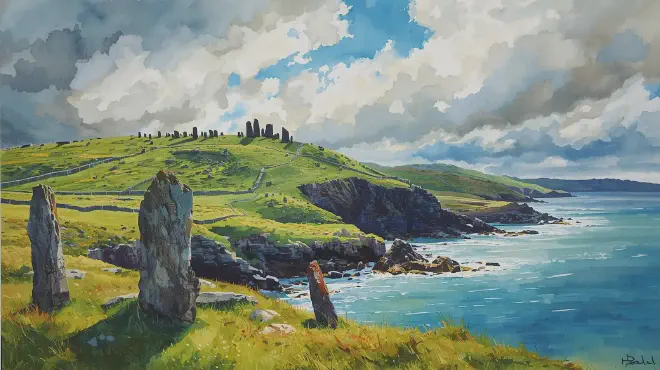
In the afternoon came the Ring of Brodgar. This Neolithic stone circle, a UNESCO World Heritage site, stands on a small rise about fifteen minutes from Stromness.
Approaching on foot, I was overwhelmed by its majesty. Twenty-seven massive stones form a circle 104 meters in diameter. The tallest reaches 4.7 meters—impossible to imagine how people four and a half thousand years ago transported and erected these stones. The surfaces bore patterns carved by long ages of wind and rain, looking almost like ancient script.
Standing in the circle’s center, I felt enveloped by a strange sensation. The sound of the wind changed, time’s flow seeming to slow. Had ancient people performed rituals here? Observed the stars? The answers remain forever unknown, but this place clearly holds special power.
At the Bridge of Brodgar, a five-minute walk away, I learned of a tradition where lovers pledge their devotion. Watching a young couple cross hand-in-hand, my heart warmed at this gentle custom rooted in the land.
I arrived at Maeshowe, the final destination, near evening. This five-thousand-year-old tomb chamber was built around the same time as Skara Brae. Entering through a narrow passage, I marveled at the precisely fitted stonework. Most mystical of all was its design—on the winter solstice alone, sunlight penetrates the passage to reach the inner chamber.
Maeshowe’s interior was dim and cool. Touching the stone walls, I felt the weight of five thousand years. Here ancient people mourned their dead and prayed for their journey to the afterlife. These practices surely arose from the same fundamental human feelings we experience today.
On the return to the B&B, I encountered the sun setting over the western sea. Orkney sunsets possess a unique beauty different from those on the mainland. The silhouettes of small islands on the water were fantastical, like ink paintings.
Dinner was Margaret’s homemade roast lamb. Island-raised mutton had no gamey taste, tender and delicious. “Orkney sheep grow up in the sea wind, giving the meat distinctive flavor,” she explained. Dessert was Orkney fudge, a local specialty.
After dinner, Margaret’s husband David joined us to discuss island music. Orkney has distinctive fiddle music, melodies preserved from Viking times. David brought out an old fiddle and played a short piece. The simple, beautiful melody resonated through the firelit room.
“Music is the island’s memory. Feelings that words can’t convey, we weave into melodies and pass to the next generation,” David said. That night in bed, the beautiful fiddle tune wouldn’t leave my mind. I realized how the ancient ruins I’d touched today and the islanders’ modern lives maintained a strange harmony. Though time flows on, perhaps humanity’s essential nature doesn’t change.
Day 3: Eternal Memories Etched on a Morning of Farewells
The final morning began with the most beautiful sunrise yet. The sun rising from the eastern sea cast long shadows across the pastures, gilding distant islands. The sky was impossibly blue, yesterday’s rain a lie. Having to leave the island on such a beautiful morning felt almost regrettable.
At breakfast, Margaret advised on spending the final day. “See the Italian Chapel and Old Man of Hoy, then catch the afternoon ferry. But even just this morning, walk through Kirkwall again. You’ll surely find something different from yesterday.”
Before checking out, I strolled through the B&B’s garden. Margaret’s carefully tended flower beds held blooms adapted to the island’s harsh climate. “Growing flowers here isn’t easy. But that’s why the joy is greater when they bloom,” she told me. Her words seemed to embody the islanders’ entire way of life.
Before returning to Kirkwall, I visited the Italian Chapel. During World War II, Italian prisoners of war held on the island built this small church. Though converted from a Nissen hut, it was surprisingly beautiful, the interior murals and decorations authentically Italian.
A memorial to the Italians who built the chapel stood outside. Far from home on this island, they poured prayers to God and longing for their homeland into creating this beautiful church. Even in war’s tragic circumstances, humans don’t lose the power to create beauty. I was deeply moved by this truth.
Next I headed for the Old Man of Hoy at the island’s western edge. This 137-meter-high sea stack of sandstone is one of Orkney’s iconic landmarks. Viewing it from the clifftop viewpoint, I gasped at nature’s sculptural artistry.
Seabirds danced in the strong winds on the precipice—fulmars, puffins, gannets, various species making this harsh environment their home. Watching them, I understood these islands are precious sanctuaries for wildlife too.
Back in Kirkwall, I discovered small alleys and shops known only to locals that I’d missed yesterday. An antique shop held replicas of Viking artifacts and old books chronicling island history. The elderly shopkeeper smiled, saying, “The island’s true treasures aren’t in tourist guides.”
Lunch was lamb pie at “The Shore,” a restaurant near the harbor—a fitting final meal on the island. The flaky pastry encased tender braised lamb and vegetables. Each bite seemed to carry the taste of this island’s soil.
At 2 PM, I said goodbye to Margaret at the harbor. “Come back anytime. Orkney will remember you,” she said, her words resonating deeply in my chest. Though a brief stay, she and David had welcomed me with the warmth of true family.
As the “MV Hamnavoe” left the harbor, Orkney’s silhouette slowly diminished. Standing on deck looking back, the ruins I’d visited and faces I’d met surfaced in memory. Though only two nights and three days, these islands had carved deep impressions in my heart.
In the middle of the firth, surrounded 360 degrees by sea, a thought struck me. Orkney might indeed be geographically remote. But here lies the wellspring of human memory. The lives of people five thousand years ago, Vikings’ courage, wartime Italians’ prayers, and the islanders’ peaceful present—all layered together to create this archipelago’s unique charm.
Arriving at Scrabster harbor, I was no longer the same person. Orkney’s wind, stone, and sea had created a new room in my heart. Returning to the mainland and daily life, that island’s memory would continue breathing quietly within me.
What Felt Real Though Only Imagined
This journey was an imaginary record spun in my mind. I never actually set foot on Orkney soil, never met Margaret or David, never touched the stones of ancient ruins. Yet strangely, these travel memories exist firmly in my heart.
Orkney’s crisp morning air, Skara Brae’s intricate stonework, Maeshowe’s mystical dimness, the awe of the ancients felt at the Ring of Brodgar, and the warm smiles of islanders—all these experiences, though only in my head, are etched as actual memories.
The strange power of imaginary travel may lie in touching a place’s essence beyond reality’s constraints. Transcending barriers of time, money, and physical distance, imagination lets us journey anywhere in the world. Such experiences are never “fake”—in their impact on the heart, they hold value equal to real travel.
These fictional three days spent on the Orkney Islands, surrounded by wind, stone, and sea, taught me much. The continuity of human life, the importance of harmony with nature, richness in simple living, and genuine kindness to strangers. These lessons, though from imagined experience, have certainly enriched my life.
Perhaps one day I’ll truly visit the Orkney Islands. How the landscapes and people from this imaginary journey will overlap with the real islands intrigues me deeply. Surely some parts will differ from imagination, but the islands’ essential charm will likely match what I felt in this reverie.
Travel isn’t only about movement. It’s about opening one’s heart to new worlds, enriching one’s inner self through encounters with different cultures, nature, and people. In that sense, this imaginary journey to Orkney was undoubtedly a real journey for me.
The sound of wind still lingers in my ears. The memory of five-thousand-year-old stones still resonates quietly deep in my heart. This journey to the Orkney Islands—imaginary yet undeniably present—will continue within me.