
A Beautiful Island Port Town Floating in the Mediterranean
Porto-Vecchio is a small port town located in the southeastern part of Corsica. This island, about 170 kilometers from mainland France, is French territory yet possesses its own distinct language and culture, earning it the name “Île de Beauté” (Island of Beauty).
The name Porto-Vecchio means “old port.” Once a fortified city built by the Genoese Republic, the old town still retains its 16th-century citadel. White limestone ramparts covered with vivid purple bougainvillea. Walking through the narrow cobblestone alleys, one can hear conversations in Corsican drifting from somewhere unseen.
The reason to visit this town is, above all, the beauty of its sea. Beaches like Santa Giulia and Palombaggia boast transparency reminiscent of the Caribbean. The sea changes from emerald green to cobalt blue, its expression shifting with the time of day, never failing to captivate.
Looking inland, the Mediterranean scrubland called maquis spreads out, carrying the scent of rosemary, thyme, and myrtle on the wind. These fragrant plants serve as fodder for Corsican pigs and sheep, supporting the island’s culinary culture.
In just two nights and three days, one cannot know everything about this island. But it was time enough to touch the azure sea, the ancient stone town, and the pride of the island’s people.
Day 1: Into a World of Blue and White
I landed at Porto-Vecchio airport just past 2 PM in September. The vacation season was winding down, and the airport was quiet. Stepping out of the small terminal, what struck my eyes was dry earth and the blue sea visible in the distance. The air was dry with a somewhat wild fragrance. I later learned it was the scent of maquis.
I rented a car and headed toward the town center. The road was surprisingly well-maintained, and I arrived at the old town in about fifteen minutes. The hotel I’d booked was a small inn on a hill in the old quarter. Opening the heavy door of the stone building, I found a bright reception area facing a courtyard. The madame, with sun-bronzed skin and white hair tied back, greeted me in fluent French. I received my room key and climbed the narrow stairs.
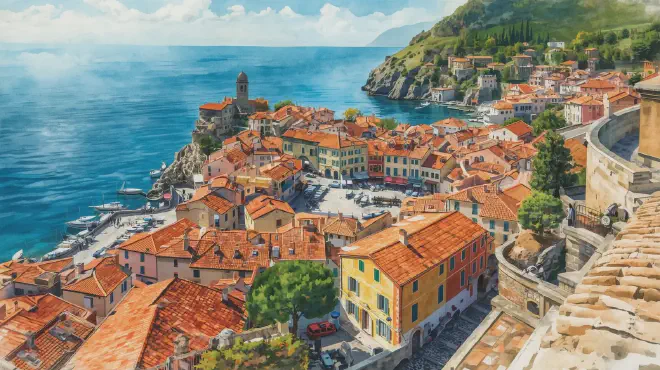
The third-floor room was simple but clean, and from the window, I could overlook the entire inlet of Porto-Vecchio. Countless yachts lay at anchor, their white sails reflecting the afternoon light. I stood by the window for a while, gazing at the landscape. Church bells rang in the distance. Looking at my watch, it was just past three o’clock.
I left my luggage and decided to walk through the town. The old town’s alleys twisted like a labyrinth. Climbing and descending cobblestone slopes, I made my way toward the old fortress. From atop the citadel, the entire town spread before me. Red-tiled roofs and white-walled houses, and beyond them, the sea. The wind was strong, tousling my hair. The sea visible through gaps in the ramparts was bluer than I’d imagined.
Past five o’clock, I descended from the old town and walked along the marina. Restaurants and cafés lined the waterfront, their terrace seats filled with people enjoying apéritifs. Still early for dinner, but wanting to eat something light, I entered a small bistro.
The menu was written in French and Corsican, and I could understand only about half. When I asked the server, they recommended Corsican regional dishes. I ordered “beignets de brocciu,” fritters made with Corsican sheep’s milk cheese. The plate that arrived was crispy on the outside, creamy inside, with a subtle sweetness of sheep’s milk. Paired with white wine, my fatigue seemed to dissolve.
Outside the window, the sunset was beginning to tint the marina. Yacht masts cast long shadows, and the sea surface glowed orange. Mediterranean twilight carries a certain melancholy. After finishing my meal, I walked the cobblestone alleys again. At night, the old town grew even quieter. Here and there, streetlamps softly illuminated the stone walls.
I returned to the hotel and took a shower. Opening the window, cool night air flowed in. Lying in bed, I reflected on the day. A strange sensation, as if nothing had begun yet, yet something had already started. A dog barked in the distance. I heard no sound of waves. Realizing how high up on the hill I was, I closed my eyes.
Day 2: Following the Island’s Bounty—Sea and Mountain
At 7 AM, birdsong woke me. Light streaming through gaps in the curtains painted the room white. Opening the window, the morning air was surprisingly clear, mixed with the scent of maquis. Different from yesterday—a green fragrance.
Hotel breakfast was served on the courtyard terrace. Bread in a basket, homemade fig jam, Corsican honey. Particularly impressive was the chestnut blossom honey. Amber-colored, with a distinctive bitterness and deep sweetness. When madame recommended “we also have maquis honey,” I tried that as well. This one was wilder, with a stronger herbal aroma. Drinking coffee, I considered the day’s plans.
In the morning, I decided to visit Santa Giulia beach, a short distance from town. Driving south for about twenty minutes, maquis began spreading on both sides of the road. Low shrubs stretched endlessly, and locals had mentioned wild boar occasionally crossing through. Rounding a curve, the bay suddenly appeared before me.
The sea at Santa Giulia lived up to its reputation. Shallow and transparent, I could clearly see each grain of sand at my feet. Entering the water, it was warmer than expected. Even in September, it must be close to 25 degrees Celsius. Walking toward the open sea, the water level only reached my knees for quite some distance. Looking back, white sand beach and green hills rising behind it. With almost no wind, the water surface was mirror-still.
After spending about an hour at the sea, I bought a sandwich from a beachside shack. Simple, filled with Corsican ham, coppa and lonzu. Sitting on the sand, I ate while listening to the waves. The salty ham soaked into my body after swimming. I drained my mineral water and looked at the sea once more. In the afternoon light, the sea had changed to a deeper blue.
Past 2 PM, I left the beach and headed inland. My destination was Lecci, a small village. About thirty minutes northwest of Porto-Vecchio, climbing mountain roads. The road gradually narrowed, hairpin curves continuing. Opening the window, I could feel the air growing cooler as altitude increased.
The village of Lecci clung to a rocky mountainside as if glued there. Stone houses stood in stepped formation, alleys barely wide enough for two people to pass. I parked at the village entrance and walked toward the center. The village was hushed, almost no sign of people. Siesta time, perhaps.
In the village’s small square, one café was open. Sitting on the terrace, I ordered an espresso. The madame who brought it spoke French with a heavy Corsican accent when I asked about the village. “There used to be more people. Now the young ones leave the island,” she said with a somewhat lonely smile.
Leaving the café, I walked through the village. An old church, closed shops, weathered stone walls. Yet it didn’t feel like ruins. People still lived here, protecting this land. A quiet pride seemed to emanate from the entire village.
In the evening, I returned to Porto-Vecchio. I decided to dine at a different restaurant from last night. Down an alley slightly inland from the marina, the kind of place locals frequent. The menu listed “civet de sanglier”—wild boar stew. When I asked the male server, he said, “It’s autumn, perfect timing.”
The dish that arrived was a rich stew simmered in deep red wine. The wild boar meat was tender, with the wild taste of an animal raised on maquis. Side dishes were chestnut purée and polenta. This combination was exquisite, and the wine flowed freely. A local Corsican wine, made from Niellucciu grapes. Robust, with an earthy aroma.
Stepping outside after the meal, night had fallen. Marina lights rippled on the water surface, and accordion music drifted from afar. Perhaps a festival somewhere? Walking toward the sound, I found several young people performing in a small square. Traditional Corsican music, they said. Polyphonic singing melted into the night air.
After listening for a while, I returned to the hotel. Today had been a day of touching many things—sea and mountain, food and music. Back in my room, I lay in bed. Leaving the window slightly open, cool air flowed in. Closing my eyes, the colors of today’s sea, the quietness of the mountain village, and the taste of wild boar mixed together, appearing and disappearing like dreams.
Day 3: A Morning of Farewell, and What Remains
On the final morning, I woke a bit early. Past six o’clock, the sky still dim. But wanting to see that sea once more, I got ready. Leaving the hotel, I descended the old town’s slopes and headed to the marina. The morning marina had no human presence, just yachts rocking quietly.
I walked to the end of the breakwater. The eastern sky gradually brightened, and the sea’s color changed. From gray to blue, blue to gold. The moment the sun showed its face above the horizon, the sea surface gleamed all at once. Breathtakingly beautiful. That such a quiet yet powerful morning could exist—I simply stood transfixed.
Returning to the hotel, I had breakfast. Again on the courtyard terrace, the same bread and jam. Yet the taste seemed different from yesterday. Knowing I would soon leave this place, everything felt precious. Madame said, “Come back again.” I answered “Certainly,” but would I really be able to return?
I checked out and loaded my luggage into the car. My flight was at 2 PM. With some time remaining, I decided to walk through the old town once more. The same alleys I’d walked yesterday and the day before. But in the morning light, they showed a different face. Light reflecting off stone walls, wind passing through alleys, the sound of shop shutters opening in the distance.
Near the old port, I found a small bakery. Entering, the aroma of freshly baked bread filled the air. On the shelves were “canistrelli,” traditional Corsican cookies. Anise-flavored biscuits, meant to be dunked in coffee, the shopkeeper told me. I bought some as souvenirs.
Looking at my watch, it was time to head to the airport. Getting in the car, I slowly left the town behind. The old town citadel in the rearview mirror, white walls, blue sky. Everything growing smaller. The road to the airport should have been the same as when I arrived, yet it looked different. Perhaps because it had become a familiar landscape.
Arriving at the airport, I returned the rental car. After checking in, I headed to the departure gate. At the small airport café, I drank my final espresso. Bitter, strong, with a somehow nostalgic taste. Outside the window, the small propeller plane I would board.
Boarding began. Climbing aboard, I took a window seat. The engines started, and the aircraft moved toward the runway. At the moment of takeoff, the island spread below. The town of Porto-Vecchio, blue sea, green maquis. Everything grew smaller and eventually disappeared into clouds.
Settling deep into my seat, I closed my eyes. Two nights and three days had been short. Yet what I saw, ate, and felt on this island remained firmly in my chest. The blueness of the sea, the taste of wild boar, the resonance of polyphony, the quietness of the village, the morning light. Fragmentary memories overlapped like a mosaic.
The plane gained altitude, leaving Corsica behind. Outside the window was now only blue sky. But in my heart, that azure sea, the wind-swaying maquis, and the ancient stone town would remain forever. As certain memory, or as beautiful dream.
What Was Felt Though Only Imagined
This two-night, three-day journey through Porto-Vecchio that I’ve recounted was, in reality, never taken—an imaginary trip. Yet while writing, what I felt was that the essence of travel might not necessarily lie only in physically visiting a place.
Corsica exists. The town of Porto-Vecchio, the sea at Santa Giulia, the village of Lecci—all exist in reality. There is truly a blue Mediterranean sea, the fragrance of maquis, wild boar stew, and polyphonic singing. What I’ve depicted in this travel account was spun from imagination and research, yet I wrote while feeling the breath of real places.
Imaginary journeys possess freedoms that real travel doesn’t. Unbounded by time, unconcerned with budget, unaffected by weather, one can capture only ideal moments. Yet simultaneously, imaginary journeys lack the sensation of treading soil, the coldness of sea breeze, the anxiety of getting lost, and unexpected encounters.
Still, I believe traveling through words has its own distinct value. While following the text, each reader can sketch their own Porto-Vecchio in their heart. It might differ slightly from the landscape the writer imagined, but I think that’s perfectly fine.
Someday, I might truly visit Corsica. When that happens, the memory of this imaginary journey and real experience will overlap, creating something new. Or perhaps I’ll never visit in my lifetime. Yet by writing or reading these words, azure seas, an ancient port town, and the scent of maquis already exist within the heart.
It is an imaginary journey that nevertheless truly happened.