
Introduction
Portofino — a jewel-like harbor town cradled by the Ligurian Sea. Located in northwestern Italy, about an hour’s drive from Genoa, this village of only 500 residents has captivated travelers from around the world for centuries.
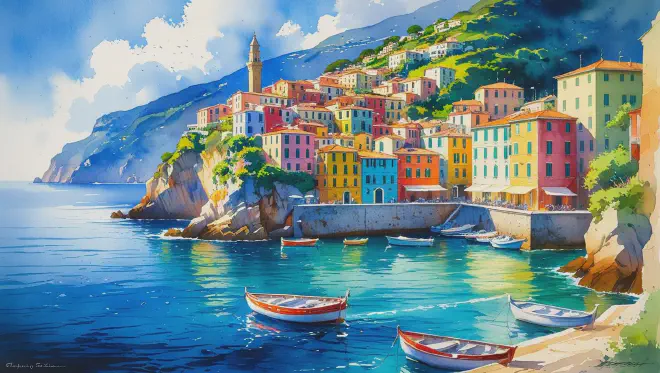
Pastel-colored houses perched on steep cliffs embrace a small, crescent-shaped harbor like a scene lifted from a painting. The ancient Romans called this place “Portus Delphini” — the Port of Dolphins — for the pods that once played in these waters. During the Middle Ages, the town served as an important port for the maritime republic of Genoa. By the late 19th century, Northern European nobility had discovered it as a cherished summer retreat.
Blessed with the warm Mediterranean climate unique to the Ligurian coast, the town is surrounded by hills covered with olive trees, lemon groves, and maritime pines. The local cuisine harmonizes the bounty of both sea and mountains, particularly the famous pesto Genovese made with fragrant basil, and dishes featuring the freshest seafood. Traditional breads like focaccia and farinata welcome visitors with their comforting warmth.
Day 1: First Steps into a Town of Color
The little Fiat 500 I rented in Genoa wound its way along the coastal road. Through the window, the blue of the Mediterranean and the green of the mountainside created a striking contrast. Around eleven in the morning, I finally spotted the sign for Portofino. I parked near the entrance of the town and walked along the narrow cobblestone path toward the harbor.
Descending the slope, I found myself captivated by the decorations painted on the walls of the houses. Terracotta, lemon yellow, salmon pink, lime green. Each building painted a different color — a tradition dating back to when fishermen needed to spot their homes from the sea. That tradition lives on, and today, the entire town resembles one grand work of art.
When I reached the harbor, I stopped in my tracks, breathless. Houses arranged themselves around the small bay like seats in an amphitheater. White yachts swayed elegantly at their moorings, their reflections dancing on the water’s surface. In that moment, I felt wrapped in a stillness so beautiful it seemed to stop time.
For lunch, I chose a trattoria called “Il Pitosforo” along the harbor. From a terrace table overlooking the water, I ordered trofie al pesto, the local specialty. The hand-twisted short pasta was coated in deep green basil pesto. The first bite released the fragrance of basil across my palate, followed by the rich depth of pine nuts and Parmigiano-Reggiano. Paired with a local Vermentino, the meal was perfect.
In the afternoon, I wandered through the narrow alleys of the town. Unlike the bustling harbor, the residential lanes were quiet and peaceful. Laundry hung on lines stretched between windows. A cat dozed on a stone step in a patch of sunlight. At a small provisions shop, I bought a bottle of local olive oil. The shopkeeper, Maria, told me proudly, “This oil comes from my brother’s grove.”
As evening approached, I climbed the hill to the Church of San Giorgio. Built in the 11th century, this small church offers a panoramic view of all of Portofino. The setting sun painted the harbor gold, and the pastel houses glowed in the warm light. Inside, the church was simple, with a statue of Saint George standing in quiet dignity. Watching locals come to pray, I felt the depth of faith that runs through this community.
For dinner, I ate at the restaurant of the Hotel Splendido, a historic hotel built in 1901 that has hosted countless celebrities over the years. I chose acqua pazza made with locally caught fish. The acidity of tomatoes, olives, and capers brought out the sweetness of the fish, and the focaccia served alongside was wonderfully fragrant.
After dinner, I strolled along the harbor, savoring the evening stillness. The nighttime Portofino was utterly transformed from the daytime bustle — it became something dreamlike. Buildings glowed under streetlamps, their reflections shimmering in the water. Small waves lapped softly against the breakwater. The only sounds were faint music drifting from restaurants and the gentle clink of yacht masts in the breeze. I fell asleep that night with anticipation for what tomorrow would bring.
Day 2: A Day Immersed in Nature
I woke at six and looked out at the harbor from my hotel window. The early light reflected off the water, bathing the whole town in gold. Before breakfast, I walked down to the harbor. No tourists yet — only local fishermen tending to their boats. When I called out “Buongiorno,” a weathered fisherman named Giuseppe smiled back at me, deep wrinkles creasing his sun-browned face.
Back at the hotel, I enjoyed breakfast. Yogurt drizzled with local honey, freshly baked croissants, and rich espresso. Eating while gazing out at the Mediterranean felt like pure bliss.
In the morning, I set out on the hiking trail from Portofino to San Fruttuoso. The hills behind the town are covered with maritime pines and olive trees. As I climbed the old stone path, the harbor grew smaller below me. Along the way, the scent of wild rosemary and thyme filled the air, and small butterflies fluttered from flower to flower.
About an hour later, I arrived at the Abbey of San Fruttuoso. This Benedictine abbey, built in the 10th century, is now preserved as national heritage. In front of the abbey lies a small cove, beneath which rests the “Christ of the Abyss” — a bronze statue of Christ submerged in the sea. Placed there in 1954, it has become a symbol of the fishermen’s prayers for safety at sea.
I rested at the abbey’s small café and drank lemonade made by a local woman. The tartness of lemon balanced perfectly with the sweetness of local honey. Francesco, the caretaker, told me stories of the region’s history — how in medieval times, people sought refuge here from pirate raids.
In the afternoon, I returned to Portofino and took a small boat to Paraggi Beach. Seeing the town from the water offered a new perspective. The buildings rose in tiers toward the sea, like an ancient amphitheater.
Paraggi Beach is a small pebble cove with remarkably clear water. I decided to swim. The June sea was still cool, but my body adjusted quickly. The water was so transparent I could see the bottom, where small fish darted about. Afterward, I relaxed at a small beach bar with a Spritz Veneziano, olives, and local focaccia. Drinking in the sea breeze felt extraordinary.
In the evening, I walked to the lighthouse. The path wound through pine groves, and along the way, I spotted wild fig trees bearing small, unripe fruit. From the lighthouse, the horizon stretched endlessly over the Ligurian Sea. I waited there as the sun sank into the water, engraving the beauty of that moment into my memory.
Dinner was at a small osteria called “Da Ugo” near the harbor. I started with marinated sardines caught locally, followed by the house specialty — branzino al sale, sea bass baked in a salt crust. When the waiter cracked open the salt shell at the table, steam and the aroma of the fish rose together. The flesh was moist, seasoned perfectly by the salt. I paired it with a local red, Rossese di Dolceacqua.
After dinner, I stopped at a gelateria along the harbor for a nighttime treat. I tried an unusual combination — lemon and basil gelato — and found it surprisingly refreshing. Sitting on a bench and gazing at the sea while eating gelato felt like the perfect ending to a wonderful day.
Day 3: Morning Farewell and Lasting Memories
On my final morning, I woke earlier than usual. Perhaps some part of me sensed that the time to leave this beautiful town was drawing near. I took a morning walk around the harbor. In the dim light, fishermen were already beginning their preparations — mending nets, checking their boats. These scenes must have remained unchanged for centuries.
I returned to the hotel for my last breakfast. The same menu as before, yet today it tasted different. I sipped my espresso slowly, fixing the view of the harbor in my mind.
In the morning, I visited the town’s small shops for souvenirs. At the provisions shop I had found earlier, I bought olive oil and local pesto Genovese. Maria smiled and said, “Whenever you eat this pesto back in Japan, remember Portofino.” She added a piece of homemade focaccia as a gift.
At a small atelier along the harbor, a local artist was painting the view of the port. His work was realistic, yet carried a poetic quality. “The light here is special,” Luca told me. “It changes completely between morning and evening, and with every season.” I bought one of his small watercolors as a memento.
For lunch, I returned to “Il Pitosforo,” where I had eaten on my first day. I sat at the same terrace table and enjoyed my final meal. This time I ordered linguine alle vongole — pasta with clams. The fresh clams, tomatoes, and garlic mingled perfectly. I chose a light local rosé to accompany it.
As I ate, I reflected on the past three days. Portofino is a small town, but the beauty and warmth contained within it are immeasurable. Giuseppe’s smile, Maria’s kindness, Francesco’s patient explanations, Luca’s passion — each encounter made this journey something truly special.
Around two in the afternoon, the time came to leave. I loaded my luggage into the car and sat in the driver’s seat. Before starting the engine, I looked back at the harbor one more time. The pastel houses seemed to glow, as if reluctant to say goodbye. I pulled away slowly, climbing the winding road. In the rearview mirror, Portofino grew smaller and smaller.
On the way back, I stopped in Santa Margherita Ligure. From there, I could still see the bay of Portofino. From a distance, it looked like a jewel. I took a few photographs and whispered a quiet “thank you” in my heart.
Driving toward Genoa’s airport, these three days began to feel like a dream. And yet, the scent of olive oil in my bag, the taste of pesto lingering on my tongue, and the beautiful landscapes etched into my heart all reminded me that it had indeed been real. Portofino was not merely a tourist destination — it was a place that enriched the soul.
Afterword
This journey was born from imagination, yet it remains in my heart as something truly experienced. The beautiful harbor of Portofino, the pastel-colored houses, the warm encounters with locals, and the deep blue of the Mediterranean — all of it lingers as vividly as if I had actually walked those streets.
Memory is a curious thing. Places we have truly visited can fade with time, while landscapes carefully drawn in the imagination sometimes remain more beautiful and more deeply etched than reality. This imaginary journey to Portofino will surely stay with me as one of those special memories.
If someday I truly visit Portofino, I look forward to seeing how this imagined journey and the real one might overlap. I am certain that the real place will be even more beautiful than I imagined, offering new discoveries and new moments of wonder.