
The Quiet Heartbeat of a Newborn Nation
The Republic of Kosovo’s capital, Pristina, is a small city of around 200,000 people situated in the heart of the Balkan Peninsula. Having declared independence from Serbia in 2008, this young nation’s capital presents a distinctive landscape where Ottoman-era architecture mingles with modern buildings.
Surrounded by the Šar Mountains, this land has long flourished as a crossroads of trade routes, experiencing successive rulers—Ottoman, Austro-Hungarian, Yugoslav, and now Kosovo. This complex history is etched into every street corner; one can witness mosques standing beside Orthodox church bell towers, and signs in Albanian and Serbian displayed side by side.
The majority of residents are ethnic Albanians, whose warm character and the rich culinary culture particular to the Balkans give this city its unique charm. Perhaps because Pristina remains relatively unknown as a tourist destination, genuine and unpolished encounters await here.
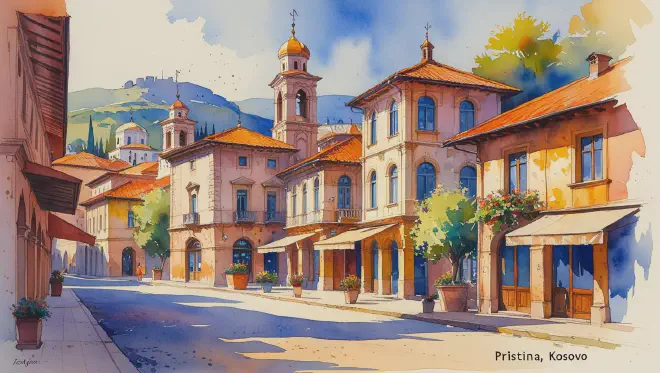
Day 1: Footsteps on Cobblestones and the Fragrance of Beginnings
I landed at Pristina International Airport on a crisp mid-October morning. The airport was small, and immigration took only moments. The taxi driver spoke to me in broken English, but when he noticed my halting Albanian, he happily switched to his mother tongue. Through the window, the landscape unfolded—white houses dotting gentle hills and the Šar Mountains hazy in the distance.
“Mirë se erdhe në Prishtinë (Welcome to Pristina).”
With these words from the driver, we arrived at the city center. What first caught my eye was the lively scene along Mother Teresa Boulevard. New buildings and old ones leaned into each other, while men sat at café terraces drinking Turkish coffee and chatting. Women walked by with colorful scarves wrapped around their heads, shopping bags in hand.
My accommodation was a small family-run guesthouse tucked into a corner of the old town. The stone building dated from the late 19th century, and an old Ottoman-era map hung on the lobby wall. The elderly man at reception welcomed me in fluent English, handing me the room key along with a hand-drawn map.
“My father drew this. It shows you the real Pristina—things you won’t find on tourist maps.”
In the afternoon, I walked through the old town following that map. Threading through narrow cobblestone alleys, I came upon the Sultan Mehmed Fatih Mosque. Built in the 14th century, this mosque is one of Pristina’s oldest structures. I washed my hands at the courtyard fountain and stepped into the prayer hall wrapped in silence. Afternoon light filtered through colorful stained glass, painting beautiful patterns on the carpets below.
Leaving the mosque, I encountered an old man selling antique books nearby. His stall displayed old volumes in Albanian, Serbian, and Turkish. Though we shared no common language, he handed me a book of poetry, turned the pages, and recited a beautiful Albanian poem aloud. Its cadence was as clear as a mountain stream.
In the evening, I headed to Mother Teresa Square. At the square’s center stood a bronze statue of Mother Teresa, born in this region. Her compassionate expression glowed warmly in the setting sun. Young people gathered around the square, some playing guitar, others singing. Their voices echoed off the stone buildings, stirring something nostalgic within me.
For dinner, I went to a small restaurant called “Liburnia,” recommended by a local. This establishment serves Albanian home cooking, with a menu entirely in Albanian. The grandmother who ran the place explained the dishes through gestures and expressions.
First came “fërgesë me kos,” a soup of yogurt and cucumber. Refreshingly flavored with mint, it soothed the weariness of travel. For the main course, I ordered “ćevapčići”—small grilled sausages of minced meat—and “somun,” a flatbread. The smoky aroma of charcoal-grilled meat harmonized perfectly with the warmth of freshly baked bread.
During the meal, a family at the neighboring table smiled at me. The father spoke to me in simple English, while their son shyly waved. This warmth beyond words brought comfort on a night in a foreign land.
Walking back to the hotel under streetlamps illuminating the cobblestones, I felt Pristina’s unique charm. It was the charm of a city where the simple, pure rhythms of people’s lives still breathe—something absent in major tourist destinations. From my room window, the night sky showed stars that refused to surrender to the city lights. What encounters would tomorrow bring?
Day 2: Mountain Melodies and the Hands of Craftsmen
When morning light began to dance on the cobblestones, I had breakfast in the hotel’s small dining room. They brought out “kajmak”—a thick, rich Balkan yogurt drizzled with honey—and “burek,” a pastry of thin phyllo wrapped around cheese. The coffee came in a small cup, Turkish-style, and the innkeeper explained the custom of savoring it down to the grounds that settle at the bottom.
In the morning, I decided to visit Gazimestan, a hill on the outskirts of Pristina. This was the site of the Battle of Kosovo in 1389, a place of profound significance for both Serbians and Albanians. The half-hour bus ride passed through gentle farmland. Wheat fields stretched toward mountains veiled in morning mist, creating an almost dreamlike scene.
Standing atop Gazimestan, a 360-degree panorama opened before me. The Šar Mountains and Kopaonik range lined the distance, while the Kosovo plains spread below. The landscape was so peaceful it seemed impossible that a great battle had once taken place on this beautiful land. Before the monument, listening to the wind rustling through the grassland, I quietly felt the weight of history.
Lunch was at a small village at the foot of the hill. At a traditional farmhouse restaurant called a “konaq,” goats and chickens wandered freely in the yard. The grandmother there served “flija,” simple bread made from cornmeal, along with homemade cheese and a salad of tomatoes and cucumbers picked from the garden. Every dish had a robust, honest flavor—food that made you feel the earth’s blessings directly.
In the afternoon, I returned to Pristina and strolled through the artisan quarter of the old town. Along narrow cobblestone lanes, workshops for copperware, leather goods, and woodwork stood in rows. I stopped at one of them, the studio of a coppersmith named Ahmet Haxhi. He came from three generations of craftsmen, preserving traditional Ottoman techniques handed down from his grandfather’s time.
“This is a traditional Pristina pattern.”
Haxhi showed me a copper tray etched with intricate geometric designs. The pattern was a beautiful Islamic geometric motif, and merely looking at it brought a sense of calm. His movements were precise, and the rhythmic sound of his hammer filled the workshop.
In the back of the studio, his son worked silently. Witnessing this transmission of skill from parent to child moved me deeply. Haxhi gave me a small copper dish and smiled, saying, “A memento of Pristina.” Engraved on it was the city’s symbol—the clock tower.
In the late afternoon, I visited the National Library. This building is known for its distinctive, almost spacecraft-like appearance. Built in 1982, the library stands as a symbol of Kosovo’s modern architecture. Inside, the atmosphere was surprisingly serene, with many students absorbed in their studies. From the upper floors, the entire cityscape of Pristina spread out below. The city bathed in sunset light evoked a gentle melancholy.
For dinner, I went to “Tiffany,” a café-restaurant popular among local youth. Though modern in décor, it serves traditional Kosovan cuisine. I ordered “përlesh,” a lamb stew. Slow-cooked with plenty of vegetables and seasoned with spices, the dish warmed me to the core.
At the next table sat a group of what appeared to be university students. They spoke good English and were earnestly discussing Kosovo’s future. One of them, a young woman named Alta, struck up a conversation with me.
“Kosovo is still a young country, but we have hope. I want more people to know about this city.”
Her words carried a deep love for her homeland. I caught a glimpse of the hope that the younger generation holds for the future, sensing the bright possibilities of this nation.
On my way back to the hotel, I walked through the old town at night. The sound of my footsteps on the cobblestones mingled with the distant call to prayer from a mosque, creating the city’s mystical atmosphere. Old buildings with lit windows seemed wrapped in a silence where time stood still.
Day 3: A Morning of Farewell and Melodies That Linger in the Heart
I greeted my final morning on the hotel’s rooftop terrace. The cityscape of Pristina glowed in the morning sun, and distant mountains were tinged with pale purple. The air was crisp, and birdsong adorned the refreshing morning silence.
After breakfast, I set out for one last walk. First, I headed to the Pristina Ethnographic Museum. Housed in a beautiful Ottoman-era building, the museum displays Kosovo’s rich cultural heritage. Traditional costumes and crafts from Albanian, Serbian, Turkish, and Roma communities were all represented.
What struck me most were the traditional wedding garments. The beautiful dresses embroidered with gold thread and the men’s folk costumes adorned with fine details spoke to each ethnic group’s aesthetic sensibility and technical mastery. A female curator patiently explained each exhibit.
“Each of these costumes, from every ethnic group, is truly beautiful. Our country may be small, but it is culturally very rich.”
Her proud expression left a lasting impression.
For my final stop of the morning, I visited the central market near the Grand Hotel Pristina. This is the center of local life, where fresh vegetables, fruits, meat, and cheese are displayed in close quarters. Being mid-October, autumn harvests were abundant—large red apples, fragrant pears, purple grapes—all glistening and inviting.
A cheese vendor let me sample “kaçkavall,” a traditional cheese. Slightly salty, the rich flavor of sheep’s milk spread across my palate. He wrapped a small portion and handed it to me, saying, “For a souvenir.”
For lunch, I returned to “Liburnia,” the restaurant from my first day. The grandmother remembered me and welcomed me warmly. Today she recommended “tavë kosi,” a traditional rice dish. Like a risotto with lamb and vegetables, it was fragrant with saffron—a heartwarming meal fitting for my final day.
In the afternoon, I spent a leisurely time around the Clock Tower (Sahat Kulla). Built in the 19th century, this tower is an iconic symbol of Pristina. In the small park below, elderly men chatted on benches while children ran about energetically.
In a corner of the park, I found the old bookseller I had met on my first day. He remembered me, and this time he gave me a small Albanian dictionary as a gift. On the cover, he had written by hand: “Miqësi (Friendship).”
As the time to leave for the airport drew near, I returned to the hotel to pack. The man at the front desk said, “Please come back,” and gave me a small pin badge in the shape of Kosovo’s flag.
On the way to the airport, the taxi driver took a different route than before. Passing through residential areas, beautiful rural landscapes opened up—a small church and cemetery, stone farmhouses, cattle grazing in meadows. This, too, was an essential face of Pristina.
Drinking one last coffee at the airport, I reflected on these three days. Pristina was indeed a small city, but it possessed a warmth and depth that larger cities cannot offer. Perhaps it was precisely because this city is still developing as a tourist destination that I could encounter people in their natural, unguarded state.
While waiting to board, I sent a message to the contact Alta had given me. “Thank you for a wonderful time. May Kosovo’s future be bright.” The reply came quickly: “Let’s meet again. Next time, please stay longer.”
Looking down at Pristina from the airplane window, the city was wrapped in morning mist, almost dreamlike. The sun setting beyond the Šar Mountains painted a beautiful ending to this journey.
What Felt Unmistakably Real, Though Imagined
This journey was, of course, a product of imagination. Yet the unique charm of a city called Pristina, the warmth of its people, the rich culture of the Balkans, and the hopeful spirit of a young nation all reached my heart unmistakably—even through the medium of imagination.
Footsteps echoing on cobblestones. The call to prayer drifting from a mosque. Beautiful handicrafts born from an artisan’s hands. The comforting cuisine of a family-run restaurant. And above all, the smiles of people who naturally welcomed a stranger from far away. All of these things breathe within my heart, though they were imagined.
Travel is not only about visiting new places—it is also an exchange of hearts with the people we meet there, an experience that deepens understanding and empathy for different cultures. Even if that journey takes place in the imagination, its essence remains unchanged. What Pristina taught me was that there are still many beautiful, unknown places in the world, and warm-hearted people waiting to be discovered.
Perhaps one day I will truly visit this city. When that time comes, I hope this imagined journey will make the real one all the richer. For now, I gaze at the small pin badge of Kosovo’s flag and hold that hope close.