
A Village on Sacred Rock Walls
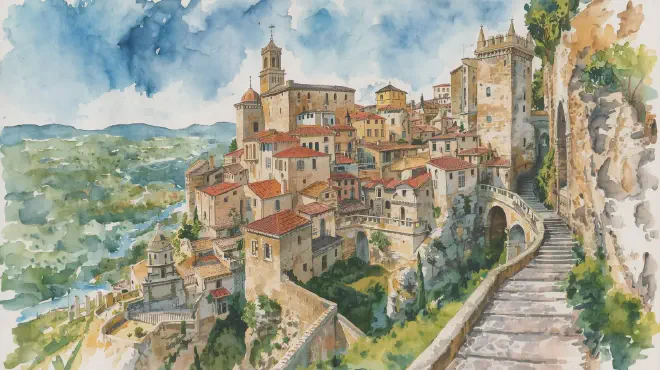
In the Lot department of southwestern France, the miraculous village of Rocamadour suddenly appears in a deep gorge. This medieval pilgrimage site, clinging to the sheer cliffs carved by the Alzou River, presents a mystical spectacle as if the rock wall itself had become a sacred place of prayer.
The houses built on the white limestone cliffs blur the boundary between rock and building when viewed from afar, creating a beautiful harmony where nature and human habitation become one. As a sacred site that has existed since the 12th century, it sits along the pilgrimage route to Santiago de Compostela, where countless believers have offered their prayers. Seven sanctuaries are carved into the rock wall, centered around the Chapel of Notre-Dame, known for its Black Madonna.
Though the village has a population of only about 600, it welcomes 1.5 million tourists and pilgrims annually. The steep stone staircases, buildings preserving their medieval character, and above all, the serene and sacred atmosphere of this place continue to captivate visitors. Surrounded by the rich nature of the Quercy region, it is also a treasure trove of gastronomy, including truffles, foie gras, and Roquefort cheese.
Day 1: Following the Pilgrims’ Footsteps
I left Toulouse early in the morning by train to Figeac, then transferred to a bus, arriving in Rocamadour around 10 a.m. As the bus climbed the mountain road, the scenery from the window gradually became more undulating, revealing the beautiful landscape of the Quercy region dotted with white limestone cliffs.
A few minutes’ walk from the bus stop, I stopped involuntarily at the panoramic view of Rocamadour that suddenly appeared before me. Houses clinging to the sheer cliff, the ancient castle towering above them, and the sanctuaries carved into the rock face. The overwhelming presence far exceeded anything I had seen in photographs. It felt like slipping back in time to the Middle Ages.
My accommodation, Hôtel Beau Site, was on a hill overlooking the village as its name suggests, offering a panoramic view of Rocamadour from the room’s window. After dropping off my luggage and catching my breath, I immediately headed to the village center.
In the afternoon, I began exploring from the lower village (La Cité), the starting point for Rocamadour tourism. The narrow cobblestone alleys lined with souvenir shops and small restaurants all utilized medieval buildings, with even modern signage blending into the old stone walls. Though bustling with tourists, it was impressive that there was a devout atmosphere beyond mere commercialism.
As I began climbing the sacred staircase (Grand Escalier), I felt the weight of history in each step. Pilgrims in the Middle Ages climbed these 216 stone steps on their knees while praying. I too stopped midway, gazing at the landscape spread below, imagining their state of mind. I wondered if the power of faith was strong enough to overcome such a difficult journey.
Upon reaching the sanctuary complex, the first thing that caught my eye was the Chapel of Notre-Dame. The Black Madonna enshrined in this 12th-century chapel is said to have performed many miracles, and pilgrims from around the world still visit today. In the dimly lit chapel, the Black Madonna illuminated by candlelight indeed radiated a mysterious presence.
I visited each sanctuary one by one, including the Basilica of Saint-Sauveur, the Chapel of Saint-Blaise, and the Chapel of Saint-Louis, each with its own distinct history and characteristics. Every building was constructed directly on the rock face, with some parts utilizing natural caves. The sound of spring water seeping between the stones echoed in the silence.
As evening approached and the number of tourists decreased, a quieter atmosphere settled in. Walking slowly along the path to the castle, I savored the beauty of the village illuminated by the western sun. The view from the castle was exceptional, offering a panoramic vista of the meandering Alzou River and the distant pastoral landscape of the Quercy region.
For dinner, I ate at a small restaurant in La Cité called “Le Rocher.” The traditional dishes made with local ingredients were all simple yet deeply flavorful. In particular, Cabécou de Rocamadour, a goat cheese specialty of the Quercy region, impressed me with its creamy and refined taste. The owner, Madame Durand, was friendly and taught me various things about the region’s food culture.
On my way back to the hotel, I looked up at the illuminated Rocamadour. There was a fantastical, mystical appearance completely different from daytime. Medieval pilgrims must have offered prayers under a night sky like this. The sound of church bells echoing in the silence felt like voices from the distant past.
Day 2: Harmony of Nature and Prayer
I woke up early in the morning and headed to the viewpoint overlooking Rocamadour at sunrise. The village wrapped in morning mist looked as beautiful as a castle in the sky floating on a sea of clouds. As the eastern sky turned orange and the entire village was gradually enveloped in warm light, it was a sight I could never tire of watching.
In the morning, I decided to explore the nature around Rocamadour. Walking along the path beside the Alzou River, the contrast between the white limestone cliffs and the deep green forest was beautiful. The quiet time filled only with the murmuring of the river and birdsong healed the fatigue from yesterday’s sightseeing.
On my way to a secret viewpoint that a local had told me about, I discovered a small chapel. It was a place of prayer known only to locals, not listed in tourist guidebooks. The door was open, and inside was a simple structure with only a modest wooden cross and small altar, but somehow it calmed my heart.
In the afternoon, I joined a guided tour to deepen my understanding of Rocamadour’s religious aspects. The French guide, Pierre, was a local with extensive knowledge of the area’s history and culture. According to his explanation, the name Rocamadour comes from a person called “Saint Amadour,” and there is a legend that he lived here as a hermit.
Revisiting the sanctuary complex, I could see the buildings from a different angle than yesterday. Particularly interesting were the numerous sculptures carved directly into the rock face. The works imbued with the high skill of medieval craftsmen and deep devotion speak to people’s hearts across time.
In the Chapel of Saint-Michel, 12th-century frescoes remain, and the figure of an angel illuminated by flashlight in the dim interior showed an expression as if it were alive. Guide Pierre said, “These frescoes were painted more than 800 years ago, but you can still feel the depth of faith of the people of that time.”
Near evening, I looked around not a “souvenir shop” but a “pilgrimage goods store.” Even today, many people walk the pilgrimage route to Santiago de Compostela, and Rocamadour is one of its important waypoints. The shop had pilgrims’ staffs, shell badges, prayer books, and more.
The shop owner, Monique, told me, “Recently, pilgrims from Japan have been increasing.” She herself had experienced the Santiago pilgrimage in her youth and spoke vividly about her memories. Her words stayed with me: “Pilgrimage is not just about religious meaning, but also a journey to face yourself.”
For dinner, I enjoyed local wine and cuisine at the hotel restaurant. Cahors, the red wine of the Quercy region, has a rich and robust flavor reflecting the region’s fertile soil. The main dish was roasted Causse du Quercy lamb raised locally. Simple yet deeply flavorful, I could fully taste the bounty of this land.
After dinner, I strolled through the village again. Rocamadour at night had fewer tourists and was enveloped in deeper silence. Walking on the cobblestone path, I felt as if I could hear the footsteps of medieval pilgrims. The traces of time carved into the old stone walls, the shadows of sanctuaries illuminated by streetlights, and the starry sky above. Everything harmonized to create unforgettable memories of the night.
Day 3: A Morning of Farewell and Eternal Memory
On the final morning, I leisurely ate breakfast in my hotel room while gazing at the Rocamadour landscape from the window. Though I had been looking at this scenery for three days, I never tired of it. The stone buildings illuminated by morning light radiated a sacred beauty as if prayer itself had taken form.
In the morning, I decided to explore places I hadn’t yet visited. The small path leading to the tomb of Saint Amadour in the upper part of the village was a quiet place that few tourists passed through. The panoramic view of Rocamadour from there was from a different angle than before, making me realize anew the geographical uniqueness of this place.
Until checkout time, I visited the sanctuary complex once more. This time, not with the purpose of sightseeing, but to organize the various thoughts I had felt over these three days. Sitting on a small bench in front of the Chapel of Notre-Dame, gazing at the Black Madonna, I thought about what I had gained from this journey.
For me, without religious faith, the experience at this pilgrimage site initially caused some confusion, but gradually I came to feel something universal beyond religion. Perhaps it was human spirituality, the heart that seeks beauty, and the importance of living in harmony with nature.
Finally, I took out the small wooden cross I had purchased yesterday and rolled it in my hand for a while. For me, this didn’t hold religious meaning, but was a small memento to remember the time I spent in this place and the silence and beauty I felt there.
Before taking the afternoon bus to Figeac, I had a final coffee at a café in La Cité. Through the café window, I could see pilgrims with backpacks passing by on the cobblestone path. Their expressions all seemed satisfied somehow, and they had probably sensed something precious in this place, just like me.
Just before the bus departed, I turned back to look at Rocamadour, which remained there unchanged like an old clock that continues to mark eternal time. Even after I left, this village would continue to welcome countless travelers and pilgrims, leaving something in each of their hearts.
As the scenery from the bus window gradually became flatter and the rock wall of Rocamadour grew smaller, the stone buildings and the silence and beauty I felt there remained vividly etched in my heart.
Imaginary Yet Unmistakably Felt
This journey was an imaginary one that I couldn’t actually undertake. However, the power that a place like Rocamadour possesses can be fully conveyed even through imagination. The pilgrimage route continuing from the Middle Ages, human faith carved into rock walls, and the beautiful landscape in harmony with nature. All of these are the genuine charm of a place that exists in reality.
What I felt through this three-day imaginary journey was the power of a place’s “memory.” Rocamadour is a place that has continued to receive people’s prayers and wishes for more than 800 years, and that accumulated time resonates deeply in the hearts of visitors.
Even though I have no religious background, I could feel the sacredness and beauty of this place because human spirituality perhaps holds universal values that transcend specific religions and cultures.
Living in modern society, we tend to forget the time to feel silence and beauty amidst our daily busyness. However, places like Rocamadour give us the opportunity to stop and think. That would be an experience obtainable only by actually visiting there.
Now that this imaginary journey has ended, I am left with a real sense of having “traveled.” Perhaps this is the mysterious power of imagination. While hoping that someday I will actually walk the cobblestone paths of Rocamadour and offer a prayer before that Black Madonna, I conclude this record of an imaginary journey.