
To the City of Water and Spires
Salisbury lies in the county of Wiltshire in southwest England, an ancient city where the essence of medieval times still lingers. Nestled in a valley where the River Avon meets its tributaries, the town is embraced by the vast, green expanse of Salisbury Plain.
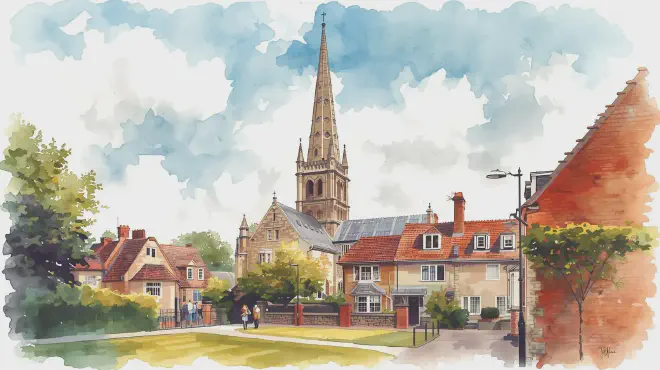
The city’s defining symbol is, without question, Salisbury Cathedral. Built in an astonishing thirty-eight years during the thirteenth century, it boasts the tallest spire in Britain, reaching 123 metres into the sky. A masterpiece of Early English Gothic architecture, its remarkable stylistic unity leaves visitors in awe.
No account of this place is complete without mentioning Stonehenge. The World Heritage megalithic monument stands just thirteen kilometres to the northwest. Salisbury is a place where ancient mysteries, medieval faith, and modern life quietly coexist.
The city also wears the face of a water town. Rivers flow through its heart, feeding parks like Queen Elizabeth Gardens, where visitors can wade into the gentle current in summer. Winter brings the threat of flooding, but that too is part of the history of a town that has always lived alongside its rivers.
About ninety minutes by train from London Waterloo, this is a place where time moves slowly. And so I set out on a two-night, three-day journey.
Day 1: The Cathedral and the Quiet of the Riverbank
I caught the train just after nine in the morning. Through the window, gentle hills and pastures rolled by—the quintessential English countryside.
Stepping off at Salisbury station, I learned the town centre was about a twenty-minute walk away. I set off along Fisherton Street, a modest road lined with small shops. After about five minutes, a bridge over the River Avon came into view, and just before it stood a clock tower the locals call “Little Ben.” Once part of a prison, it now serves as a landmark welcoming travellers to the town.
Crossing the river and turning right, I soon came upon a medieval church—St Thomas and St Edmund’s. Pushing open the door and stepping inside, I noticed vivid murals preserved on the walls. The fervour of medieval faith seemed to reach across the centuries.
Before noon, I made my way through High Street toward the cathedral grounds. The Close, as it’s called—the precinct surrounding the cathedral—is a realm of tranquillity protected by high walls. Lawns spread wide, and eighteenth-century townhouses line the pathways. I passed Mompesson House and slowly approached the cathedral.
And then, the moment it appeared before me, I stopped in my tracks. The spire reaching heavenward. The delicate stone carvings. It seemed impossible that this was built between 1220 and 1258—it remains so powerful, so beautiful.
Entering through the main door, I was first greeted by the cloisters and courtyard. Each carving on the pillars seemed to hold the soul of its craftsman. Moving into the nave, the high ceiling and light streaming through stained glass windows filled the entire space with sacred presence.
I made my way to the Chapter House. Here, an original copy of Magna Carta from 1215 is on display. Only four survive today, and this one is the best preserved. Gazing at the ancient letters on parchment, I thought of how this document would go on to influence the British constitution and the American Declaration of Independence.
Leaving the cathedral, it was time for lunch. I ducked into a nearby café, a small place busy with locals. I ordered a sandwich and tea. The bread had a satisfying chew, generously filled with cheese and ham. The tea was brewed strong, and when I added milk, it turned just the right colour.
In the afternoon, I decided to wander the town at leisure. Passing through Fish Row, I found a market set up behind the Guildhall. This was the regular market held on Tuesdays and Saturdays, its history stretching back to 1227. Vegetables, flowers, and local crafts were laid out, and people browsed the stalls.
I paused before Poultry Cross, a stone monument from the fifteenth century that once marked the market. It remains the sole surviving structure of its kind in the town centre. The flying buttresses, restored in 1852, quietly speak of the bustle of centuries past.
As evening approached, I walked along the River Avon. In Queen Elizabeth Gardens, the water flowed gently. I sat down by the bank and watched the surface of the river. Birdsong drifted from somewhere distant. Now and then, someone passed by on a stroll, but otherwise, stillness reigned.
For dinner, I found a pub by the river. The place was lively with locals, and I ordered fish and chips. The freshly fried white fish was crispy on the outside, tender within. The mushy peas on the side were rich with butter. At the next table, an elderly couple who seemed to be regulars ate in quiet contentment.
Walking back to the hotel, I saw the cathedral spire illuminated against the night sky. Lit up, it possessed a grandeur different from its daytime appearance.
Day 2: Stonehenge and Layers of History
After breakfast at the hotel, I headed to the station. The bus to Stonehenge departs from just outside. I purchased a combined ticket that included the cathedral and boarded.
After about thirty minutes of gentle rocking, the megaliths appeared across the vast plain. Stonehenge. A Neolithic monument believed to have been built between 3000 and 2000 BCE. As we drew closer, the sheer scale of it astonished me.
At the visitor centre, I borrowed an audio guide and walked toward the stones. They are arranged in a circle, the heaviest weighing some twenty-five tonnes. How did people transport and erect such massive stones? The audio guide presented various theories, but the mystery only deepened.
Under an overcast sky, I walked slowly around the stones. The wind was strong, sweeping across the plain. What was this place for? An observatory? A site for religious rituals? No one knows for certain. But what is certain is that people of ancient times once stood here and looked up at the same sky.
I returned to Salisbury early in the afternoon and had a late lunch. At a small café near the marketplace, I ordered soup and bread made with local ingredients. The soup was warm, a gentle blend of potato and leek.
In the afternoon, I decided to visit Old Sarum. The same bus that goes to Stonehenge stops there as well. Perched on a hill about three kilometres north of present-day Salisbury, it is the site of the original cathedral.
Standing atop the hill, Salisbury Plain stretched out below. The green fields, and in the distance, the spire of the current cathedral. I began to understand why, in 1220, the clergy left this hill and built a new city by the river. This had been a military stronghold, and relations between the clergy and soldiers were not always amicable.
Now only the foundations of buildings and parts of the ramparts remain, but traces suggest this was once a thriving town. Walking across the expansive grounds, I thought of those who carried stones from here to build the new cathedral.
In the evening, I returned to The Close. East of the cathedral stands a small church—St Osmund’s. Osmund was an early bishop of Salisbury, involved in compiling the Domesday Book. The church door was open, and stepping inside, I was met with silence.
I passed Arundells, a nearby mansion where former Prime Minister Edward Heath spent his later years. I had heard the English garden was beautiful, but it was past closing time. Through the wall, I could glimpse part of the garden, where well-tended flowers were in bloom.
That night, I chose a more refined restaurant. It was a place specialising in British cuisine with local ingredients, and I ordered roast beef. The Yorkshire pudding on the side was crisp on the outside, soft inside. The meat was tender and paired perfectly with the gravy. For dessert, I chose a traditional trifle. Layers of sponge cake, custard, and cream melted sweetly on my tongue.
After dinner, I walked along the river once more. The town was quiet at night, with only the murmur of the water audible. I sat on a bench and watched the current flow. The thought that my time in this town would end tomorrow made me feel a little wistful.
Day 3: Farewell and What Remains
On the final morning, I woke early and walked along the river. In the morning mist, the cathedral spire was hazy. A few ducks swam on the water. No one else was about. I wanted to commit this moment to memory.
After checking out of the hotel and leaving my luggage, I decided to visit the cathedral one more time. To see it from a different angle, I walked across the lawns of The Close. The view from the garden of Mompesson House was especially beautiful.
Inside the cathedral, I stopped before the world’s oldest working mechanical clock. Made in 1386, it still keeps time. It has no dial; the hours are announced by the ringing of a bell. That simplicity somehow made it feel all the more powerful.
Before noon, I had my final meal at a café on High Street. I ordered a Ploughman’s Lunch—cheese, bread, pickles, and chutney. A simple combination, but each ingredient had a distinct, honest flavour that grew richer with every bite. Sipping tea, I reflected on the past three days.
The cathedral spire. The megaliths of Stonehenge. The hill of Old Sarum. The quiet of the riverbank. Brief conversations with locals at the pub. Laughter drifting from a café. All of it remained in my heart as something that had truly happened.
The time came to catch the afternoon train back to London. Walking toward the station, I turned back one last time. Beyond the town, the cathedral spire was visible. Standing 123 metres tall, reaching toward the sky for nearly eight hundred years, it still stands, unchanged.
The train began to move. Watching the countryside pass by the window, I realised this journey was ending. But I also knew the memory of this journey would not end. Because this city—Salisbury—had been indelibly inscribed within me.
Something Imaginary, Yet Undeniably Felt
This journey was imaginary. I have not actually walked the cobblestones of Salisbury. I have not looked up at the cathedral spire, nor touched the waters of the River Avon. I have not truly tasted the fish and chips or felt the warmth of the pub.
And yet, the memory of this journey exists. Through words, through research, through imagination, I shared time and place with somewhere called Salisbury. I gazed upon Magna Carta, pondered the mysteries of Stonehenge, and spent quiet moments by the river.
Travel is not only about physical movement. When the heart stirs, when imagination expands, when an unknown place becomes known—that process, too, can be called a journey.
Someday, I may actually visit Salisbury. When that day comes, I will discover how this imagined memory aligns with or differs from reality. But until then, these fictional two nights and three days will continue to exist within me as a journey that truly was.
Salisbury. A city of water and spires. Where ancient and medieval worlds converge. I will visit you someday. With that thought in my heart, I turn my eyes toward the next journey.