
The Jewel of the Carpathians
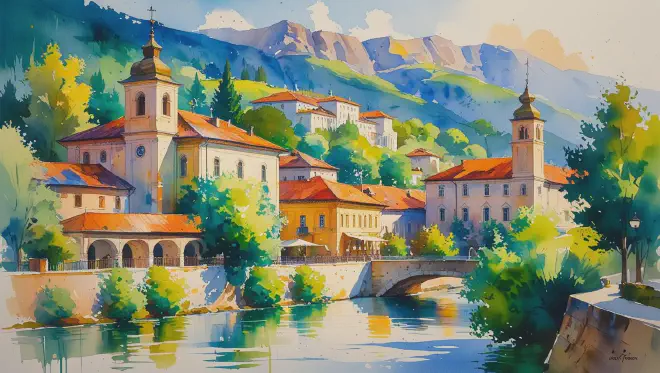
When I first heard the name Sinaia, there was something magical in its sound. This small town nestled at the foot of the Carpathian Mountains in southern Romania flourished as a summer retreat for Romanian royalty in the late 19th century—a beautiful mountain resort town.
Situated at an elevation of 800 meters, Sinaia reveals different faces through each season. In spring, wild cherry blossoms and wildflowers bloom profusely; summer brings refreshing breezes; autumn paints the beech and oak forests in golden hues; and winter transforms the mountains into a fairytale landscape draped in snow. At the heart of the town stands Peleș Castle, a 19th-century Neo-Renaissance palace whose intricate decorations and elegant presence continue to captivate all who visit.
This land, which began with a Romanian Orthodox monastery, eventually developed under royal patronage. The legacy of Carol I, a king of German origin who loved this place, still lingers here—the fragrance of European aristocratic culture remains strong. Cobblestone paths, timber-framed houses, the sound of church bells echoing through the silence. A place removed from modern chaos, where time flows slowly. That is Sinaia.
Perhaps I decided to visit this place because I had grown weary of hectic days in the city and yearned deep within my heart for tranquility and beauty. What encounters and discoveries awaited me in this small town embraced by the Carpathian Mountains? With such expectations filling my chest, I boarded the train from Bucharest to Sinaia.
Day 1: Arrival in the Mountain Kingdom
The train departing from Bucharest’s Gara de Nord made its way slowly through the Romanian countryside. Vast plains reflected in the window, scattered villages, and gradually the silhouette of the Carpathian Mountains emerged. The roughly two-and-a-half-hour journey was precious time that gently guided my heart from urban noise toward nature’s quietude.
Stepping onto the platform at Sinaia Station, the mountain air’s freshness caressed my cheeks. On this late October afternoon, the sunlight was warm, yet an autumn coolness dwelt in the breeze. The road leading from the station to the town center was a gentle slope, beautifully adorned on both sides by colorful autumn foliage. The small pension I had reserved, Casa Montana, was a family-run inn in a residential area about fifteen minutes’ walk from the station.
The proprietress, Elena, was a gentle woman in her sixties who greeted me in fluent English. “Welcome to Sinaia. What lovely weather today. You must be tired, yes? Why don’t you rest in your room first, then take a short walk around town in the evening?” She received me with the warmth of a mother. My room was a corner room on the second floor, with windows overlooking the magnificent Bucegi Mountains. White lace curtains, handcrafted wooden furniture, Romanian folk crafts hanging on the walls. Everything was filled with handmade warmth.
After resting a while, I ventured out to explore the town. Walking from the pension toward the center, I passed local residents along the way. An elderly woman carrying shopping bags, children returning from school, an old gentleman walking his dog. Everyone wore peaceful expressions and exchanged greetings of “Bună ziua” (good day). This warmth of simple, kind people defined my first impression of Sinaia.
The Holy Trinity Church in the town center was a beautiful Romanian Orthodox sanctuary built in 1846. White walls with a blue roof, golden domes gleaming in the evening sun. In the small square before the church, local elders sat on benches, conversing quietly. Watching their serene expressions, I realized that time flows completely differently here than in the city.
I took dinner at Restaurantul Peleș, a traditional restaurant in the town center. Inside the stone building, it was dimly lit, with candlelight creating a warm atmosphere. On the recommendation of the waiter, Andrei, I ordered mititei (small spiced sausages), a representative Romanian dish, along with mămăligă (cornmeal porridge). The mititei were crisp on the outside, juicy inside, with complex spice aromas spreading through my mouth. The mămăligă was creamy with a rustic flavor that balanced the richness of the meat. Savoring them with local red wine, the fatigue of travel pleasantly melted away.
When I stepped outside after dinner, the peculiar silence of a mountain town enveloped everything. Street lamps provided minimal light, and a canopy of stars shone in the sky. I stood transfixed for a while by the beauty of stars one could never see in the city. On my way back to the pension, I heard church bells ringing in the distance. Their sound echoed through the mountains, evoking something sacred. Back in my room, I drank the mint tea Elena had prepared, and fell asleep with anticipation building for tomorrow’s visit to Peleș Castle.
Day 2: Through the Castle and the Whispering Forest
I awoke to birdsong drifting through my window. Mountain mornings are invigorating, the air pristine. The breakfast Elena prepared consisted of homemade bread, local cheese, honey, and a salad of tomatoes and cucumbers from her garden. The bread had been baked the night before, still slightly warm. “This honey comes from a beekeeper nearby. It’s made from the nectar of Sinaia’s flowers, so you can taste this land in it, can’t you?” Elena explained with a smile. Indeed, the honey seemed to carry the rich fragrance of mountain blossoms.
After breakfast, I finally set off for Peleș Castle. The walk from the pension to the castle was about twenty minutes, along a small path winding through the forest. Walking beneath the shade created by towering beech and oak trees, I felt as though I had wandered into a fairytale world. Along the way, I spotted squirrels leaping from tree to tree and colorful mushrooms peeking from the bases of trees.
Emerging from the forest, my view suddenly opened, and the full magnificence of Peleș Castle appeared before me. In that moment, I couldn’t help but murmur, “Beautiful…” This castle, built in the late 19th-century Neo-Renaissance style, truly deserves to be called a work of art. Stone and brick walls, decorations applied to the finest details, flags fluttering atop the towers. This castle, beloved by Carol I, is said to possess beauty unrivaled in Europe, and seeing it in person confirmed that such praise is no exaggeration.
Joining the interior tour, I was overwhelmed by its grandeur. This castle, with its 160 rooms, was equipped with the latest technology of its time, including electric lighting and central heating. The music room, library, armory—but what impressed me most was the ceiling painting in the great hall. Depicting Romanian history and mythology, these paintings transport viewers into a medieval world. The guide, Maria, explained, “This castle is not merely a royal residence but a symbol of Romanian culture”—words that stayed with me.
After touring the castle, I also visited the adjacent Pelișor Castle (the annex of Peleș Castle). This one had a more intimate atmosphere, allowing me to feel closer to the daily life of the royal family. The private rooms of Queen Marie, in particular, featured delicate feminine decorations that evoked her personality.
In the afternoon, I strolled around the castle grounds. The gardens were impeccably maintained, with a beautiful geometric design centered on a fountain. Sitting on a garden bench gazing at the castle, I could imagine the lives of late 19th-century European aristocracy. What conversations did people of that era share in this beautiful setting? What dreams did they hold?
After spending the afternoon in the gardens, I returned to the town center for a late lunch. At a small family-run restaurant called Restaurantul Tradițional, I ordered sarmale (stuffed cabbage rolls), a traditional Romanian dish. Rice and meat wrapped in cabbage, slow-cooked in a tomato-based sauce—simple yet deeply flavorful. The țuică (traditional Romanian distilled spirit) I ordered alongside was a clear liquor made from plums, refreshingly clean despite its strong alcohol content.
Later in the afternoon, I visited Sinaia Monastery. Built in 1625, this monastery is the sacred site from which the town takes its name. Entering the monastery courtyard, a silence completely removed from worldly noise prevailed. One of the monks, Brother Daniel, explained the monastery’s history. “This monastery began when it received holy relics from Saint Catherine’s Monastery on Mount Sinai. For 400 years, a life of prayer and meditation has continued in this place.” True to his words, the monastery was permeated with a timeless sacred atmosphere.
On my way back to the pension in the evening, I purchased some local ingredients at the town market. Mushrooms gathered from the mountains, handmade cheese, and local honey. Each had a fresh, pure flavor unavailable in cities. The elderly woman selling them told me proudly, “These mushrooms were picked by my son in the mountains. They can only be harvested at this time of year—they’re precious.”
I took dinner once again at Restaurantul Peleș. Wanting to try a different menu from the previous night, I ordered tocitură moldovenească (Moldavian-style pork stew). Pork slow-cooked with onions and paprika warms you from within when eaten with mămăligă. For dessert, I ordered local plum tart, which was exquisite. The sweet-tart plums matched perfectly with the buttery crust.
That night, I sat in the pension’s garden drinking tea and talking with Elena. “Sinaia has long been called a place of healing. Even the royal family came here to restore their tired hearts and bodies.” Listening to her words, I realized that over these two days, my own heart had indeed grown lighter. The distant sound of wind, the voices of insects, and occasional church bells—all harmonized to bring deep peace to my soul.
Day 3: What the Morning Mist Revealed
The final morning was the most beautiful yet. Mist hung in the mountain valleys, and the morning sun cast golden light through it. The view from my pension window was as fantastical as an Impressionist painting. I stood by the window for a while, wanting to burn this beauty into my memory.
Elena prepared a special final breakfast. Alongside the usual bread and cheese, she had set out homemade jam and walnuts preserved in honey. “This jam was made from berries picked in the garden this summer. The walnuts were gathered in the mountains. Please remember the taste of Sinaia,” she said with the warmth of someone sending off family. Her kindness filled my heart, and I was overwhelmed with gratitude beyond words.
After breakfast, I packed my bags and went out for one last walk. I wanted to take different paths through town and discover small charms I might have missed. Walking along narrow streets in the residential area, I found a small privately-owned bakery. Though it was early morning, the scent of freshly baked bread already filled the air. The elderly proprietor called out, “You’re a traveler, aren’t you? Would you like to try some fresh-baked cozonac (traditional Romanian sweet bread)?”
Cozonac is a sweet bread rich with eggs and butter, filled with raisins and walnuts. Eaten while warm, its gentle sweetness spreads through your mouth. “This is a special bread we eat at Easter and Christmas. But they say it brings good luck to travelers departing, so please take it with you.” With those words, the old man handed me a cozonac wrapped in a small package. In this simple kindness, I felt the richness of heart that Sinaia’s people possessed.
I returned to the town center and visited the Holy Trinity Church one last time. In the morning’s silence, I entered the church to find candlelight quietly illuminating the icons. I could see several local people offering prayers in silence. Following their example, I offered my own prayer of gratitude for safe travels and beautiful encounters. Beyond religious boundaries, this quiet space held the power to calm people’s hearts.
Leaving the church, I happened to meet Maria (the guide from Peleș Castle). “Leaving already? How did you find Sinaia?” she asked. “It was a wonderful experience. I definitely want to come back,” I replied. “Sinaia will always be waiting for you. Those who fall under this town’s spell always return,” she said with a smile. Her words deepened my attachment to this small town even further.
On my way to the station, I turned back to confirm I could still see the roof of Peleș Castle through the trees. The castle I had viewed as a tourist attraction just yesterday had now become part of cherished memories. Waiting for the train in Sinaia Station’s waiting room, I reflected on the events of these three days. Beautiful architecture, wonderful cuisine, and above all, encounters with warm people. The experience woven from all of this was something beyond mere sightseeing.
When I boarded the train to Bucharest, Elena had come to the station to see me off. “Please come again. And next time, stay longer. There’s still so much more I want to show you in Sinaia.” Hearing her words, I waved through the window. As the train began to move, the townscape of Sinaia gradually grew smaller. The last thing I saw was the beautiful silhouette of the Bucegi Mountains wrapped in morning mist.
Watching the scenery flow past the window, I realized the magnitude of what I had gained in these three days. It was not something material like photographs or souvenirs, but peace and warmth carved deep within my heart. Even after returning to the chaos of the city, the quiet time spent in Sinaia would surely remain a support for my soul.
What Felt Real Despite Being Imaginary
This journey is an imaginary story woven within my imagination. Yet in every word penned here, I feel a certain texture, fragrance, and warmth. The charm inherent to the land called Sinaia, the richness of Romanian culture, and the kindness of its people—all of these truly exist, and by touching them through imagination, memories have taken root in my heart as though I had actually experienced them.
The essence of travel does not lie solely in visiting new places. Encounters with the unknown, liberation from daily life, and dialogue with oneself—these are all experiences that can be completed within one’s heart. The fictional three days spent in Sinaia offered a pure and ideal experience that perhaps could not be obtained through actual travel.
Perhaps it was precisely because this was an imaginary journey, freed from reality’s constraints, that every encounter felt warm, every landscape beautiful, every meal delicious. Yet this is not escapism. Rather, through the experience of an ideal journey, one can cultivate eyes to discover the same richness in real travels.
Elena’s kindness, Andrei’s thoughtfulness, the baker’s generosity, Maria’s knowledge and passion. These encounters with people are fictional, yet somewhere in the world, people with equally warm hearts surely exist. And the beauty of Peleș Castle, the magnificence of the Bucegi Mountains, the rich flavors of Romanian cuisine—these are real charms that await anyone who actually visits Sinaia.
If readers have been able to share a similar experience through this imaginary travel journal, I would be delighted. And should you someday have the opportunity to actually visit Sinaia, I hope these imagined memories will enrich your real experience. For travel can be undertaken not only with one’s feet, but also felt with one’s heart and soared upon with imagination.
Sinaia, the small town embraced by the Carpathian Mountains. The fictional three days I spent there continue to exist within my heart. And those memories will never fade with time, remaining as a special place that heals my weary heart in daily life.