
Introduction
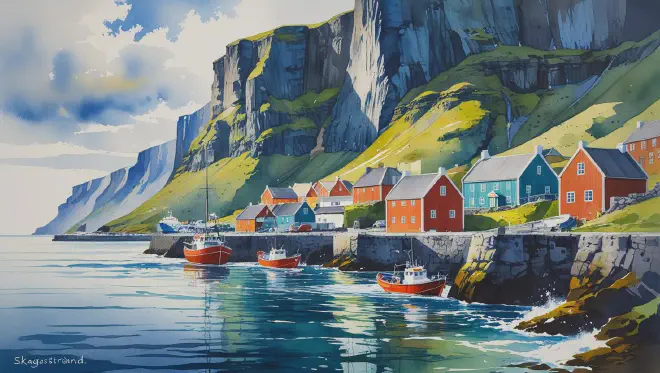
Skagaströnd is a small fishing village facing Húnaflói Bay in northwestern Iceland. With a population of only around 400, the town’s name means “Skagi’s shore” in Icelandic. Skagi, it is said, was a Norwegian settler who made this place his home in the 9th century.
The greatest charm of this land lies in the seals that visit the bay from June through September. The calm waters of the bay provide an ideal environment for mother seals raising their pups. For generations, the townspeople have coexisted with these seals, cultivating deep knowledge and affection for marine life through years of observation.
Rugged mountains surrounded by fjords, moss-covered earth, and the long white nights that come from being so close to the Arctic Circle. Skagaströnd felt like a place where Iceland’s primal beauty had been distilled into its purest form. There are no large hotels here, no lines of tour buses. What remains is a true “hidden place” where nature and people quietly live side by side.
Day 1: Waves Echoing Through a Silent Harbor Town
It was past two in the afternoon when I arrived in Skagaströnd after a three-and-a-half-hour drive from Reykjavík along winding mountain roads. The moment Húnaflói Bay spread out before me, I stopped the car and took a deep breath. White clouds reflected on the blue surface of the sea, and distant mountains faded into shades of pale purple. That view alone was enough to wash away the weariness of the long journey.
The town center was remarkably small—walking the main street took no more than five minutes. Colorful wooden houses dotted the coastline, with small fishing boats moored between them. Afternoon sunlight illuminated the building facades, making the green, red, and blue paint glow vividly. Every window held flowers, a quiet testament to the residents’ love for their daily lives.
My accommodation was a small guesthouse called “Guesthouse Seals.” The ground floor housed a café and gift shop, with guest rooms on the second floor. The owner, Sigrid, was a woman in her sixties who had been born and raised in this town. During check-in, she spoke to me in fluent English about the town’s history and the best spots for seal watching.
“This time of year, you can see seals even from the harbor breakwater. But if you come early tomorrow morning, I can show you a place where you can observe them much closer,” she offered with a kind smile. The room was simple but clean, and from the window, I could see the entire bay. The view through white lace curtains looked like a painting.
In the evening, I strolled around the harbor. A few boats were moored in the small fishing port, and fishermen were tending to their nets. Each one paused to call out “Hello.” Their words were few, but their warmth reached my heart.
I sat on the harbor breakwater, gazing at the quiet bay. Sure enough, a seal’s head bobbed up from the water. Curious eyes watched me for a moment before disappearing beneath the surface again. Watching this simple rhythm, I lost track of time.
Dinner was at the guesthouse café. The menu was simple, centered on fresh fish dishes. The day’s recommendation was grilled “plaka,” a small fish. According to Sigrid, this fish was commonly caught in the local bay. The delicate white flesh was prepared with herbs and butter, allowing the natural flavor to shine. The accompanying potatoes were small Icelandic varieties with a wonderfully fluffy texture.
While eating, I listened to Sigrid’s stories about the town. “Fishing used to be much more active here, but now tourism and farming are the main industries. Still, the town’s charm hasn’t changed. It’s the seals and this beautiful nature,” she said with evident pride.
Back in my room that night, I looked out the window. At this time of year, so close to the summer solstice, the sky remained bright past ten o’clock. Soft orange light illuminated the mountains, and its reflection shimmered on the sea. In this dreamlike scene, I could faintly hear the calls of seals in the distance. They sounded like a lullaby, gently guiding me into deep sleep.
Day 2: A Special Encounter with the Seals
At six in the morning, Sigrid woke me. “Now is the best time,” she said, and true to her words, the outdoors was wrapped in a mystical morning mist. After a quick breakfast, I followed her to a secret spot deeper in the bay.
After about ten minutes by car, we arrived at a small inlet. This place, she told me, was known only to locals and appeared in no guidebooks. In the shallow waters of the quiet inlet, about twenty seals were lounging peacefully. Some were mother-and-pup pairs, while others basked alone in the sun.
“Don’t get too close, and observe quietly,” Sigrid whispered in my ear. Hidden behind rocks with binoculars, I could clearly see the seals’ expressions. Their round eyes, whisker-like fur, and occasional endearing gestures. They seemed wary yet accepting of our presence.
What moved me most was watching a mother seal teach her pup to swim. At first, the young seal was frightened and refused to enter the water. The mother gently coaxed it toward the sea, then swam alongside, teaching it how to move safely through the water. The scene was filled with the same love you might see between any parent and child.
After about two hours of seal watching, we returned to town for a proper breakfast. The “skyr” served at the guesthouse café—a traditional Icelandic yogurt—was rich yet refreshing. Topped with blueberries and honey, it filled me with energy from the core.
Later that morning, I visited the small museum, the “Skagaströnd Marine Center.” Here, I learned about the region’s marine life and fishing history. Particularly fascinating was the exhibit on the history of coexistence between seals and humans.
Icelanders have treated seals as sacred animals, never hunting them more than necessary. They also predicted weather changes and fish migrations by observing seal behavior. Even today, the people of this town regard seals as cherished neighbors.
The museum curator, Einar, was a former fisherman in his seventies. “Seals have been here since I was a child. They’re guides of the sea. Wherever seals gather, there’s always a rich ocean,” he said, gesturing toward the water.
In the afternoon, I attempted a light hike up Mount Skagafell behind the town. Though only about 300 meters high, the view from the summit was magnificent. I could see all of Húnaflói Bay, and in the distance, icebergs off Greenland were visible.
The mountain path wound through moss-covered lava fields. “Iceland moss” spread at my feet, soft as cushions when stepped on. Occasionally, herds of wild Icelandic horses appeared in the distance, their manes beautiful as they flowed in the wind.
I had lunch at the summit. The sandwich prepared by the guesthouse—smoked salmon and dill on rye bread—was simple, but tasted extraordinary in that setting. Surrounded by nature in every direction, I felt how small I was in the world.
After descending, I stopped by the town’s small pool. Iceland has geothermal pools throughout the country, and Skagaströnd has a small one for residents. Few tourists were there; local children were swimming happily. Soaking in the warm water, around 38 degrees Celsius, I eased the fatigue from my hike.
Dinner was at a small restaurant called “Fisherman’s Table.” Their specialty was “hákarl,” a fermented shark dish. At first, I hesitated at the distinctive smell, but encouraged by locals, I gave it a try. Surprisingly, it had a deep, cheese-like flavor that was quite pleasant when eaten with rye bread. “Anyone who eats this is practically an Icelander,” laughed a local woman sitting next to me.
That night, still bright due to the white nights, I took a walk. At the harbor, people were enjoying evening fishing, and cheers went up whenever someone caught a fish. The sound of waves, birdsong, and people’s laughter blended together, and peaceful time flowed on.
Day 3: A Morning of Farewells Etched in Memory
My final day began with a special experience. Sigrid told me, “This morning, you can join a boat tour.” Bjarni, a local fisherman, was taking out his small boat for seal observation.
At seven in the morning, I boarded the small fishing vessel “Nordic Seal.” Bjarni was a quiet man in his sixties who became talkative when it came to the sea. “The tide conditions are perfect today. The seals should be quite active,” he said with anticipation in his voice.
The boat moved quietly through the bay. The engine noise was kept to a minimum to avoid startling the seals. After about fifteen minutes, we reached a small reef in the back of the bay. Even more seals than I had seen the previous day had gathered there.
From about five meters away on the boat, I observed their lives up close. Some sunbathed on rocks, others dove after fish, and some curiously approached our boat. One young seal swam right up beside us and stared at me with large eyes. In that moment, an emotion beyond words filled my heart.
“They’re not afraid of humans. For generations, they’ve lived peacefully alongside the people of this town,” Bjarni explained. Indeed, while the seals remained cautious, they showed no hostility. Rather, they seemed to be observing us.
The boat tour lasted about an hour before we returned to harbor. “You’re lucky,” Bjarni said with a satisfied smile. “It’s rare for so many seals to gather like this.” This experience became the most memorable moment of my journey.
After returning to the guesthouse for breakfast, I packed my bags and prepared to check out. “I look forward to seeing you again,” Sigrid said, presenting me with a small handmade seal figurine. “Whenever you look at this, remember Skagaströnd.” Her words warmed my heart.
Before leaving, I walked through the town one more time. Though my stay had been brief, this place had already taken on special meaning. The fishermen mending nets at the harbor, the shop owner waving through the café window, the local children I met on the street. Everyone gave me a warm send-off.
Finally, I looked up at Mount Skagafell, which I had climbed the day before. The view from there, the wind I felt, the birds I heard. All remained vivid in my memory. Iceland’s magnificent nature and the warmth of its people were engraved deep in my heart.
As I drove away from Skagaströnd, I kept glancing back at the town in my rearview mirror. The small fishing village gradually receded, but the time I spent there would remain in my heart forever. The blue waters of Húnaflói Bay, the endearing expressions of the seals, the kindness of the local people. All of it had become irreplaceable treasure.
On the road back to Reykjavík, the Icelandic landscape outside my window looked different than before. Perhaps the true beauty of this country lies not only in its famous tourist sites but in small towns like Skagaströnd. There, I found an ideal relationship where nature and humans live in harmony.
What Felt Real Despite Being Imaginary
This journey was imaginary. Yet, in the small town of Skagaströnd that actually exists in northwestern Iceland, seals truly do coexist with the people. And the warmth of those who live there, the beauty of the short Nordic summer—all of this is grounded in truth.
Though an imaginary journey, the emotions and discoveries I felt remain real in my heart. Sigrid’s kind smile, Bjarni’s deep love for the sea, the innocent eyes of the seals. These encounters were products of imagination, but the respect for culture and nature behind them was genuine.
Perhaps travel does not necessarily require physical movement. By opening our hearts and using our imagination, we can connect with people and animals in distant lands. These two nights and three days in Skagaströnd taught me the wonder of such journeys of the heart.
Someday, I hope to actually visit this small fishing village. I want to see for myself what the people and landscapes I met in my imagination really look like. I am certain they will be more beautiful and warmer than I could ever imagine.