
Longing for the Pottery Capital
When I first heard the name Stoke-on-Trent, there was something familiar in its sound. This industrial city in Staffordshire, central England, sitting on the banks of the River Trent, has been affectionately known as “The Potteries” since the 18th century as the heart of the ceramics industry.
This is the birthplace of world-renowned pottery brands—Wedgwood, Royal Doulton, Spode, and Minton. Riding the waves of the Industrial Revolution while keeping the spirit of handcraftsmanship alive, the city has nurtured a distinctive culture. The landscape once dominated by brick bottle kilns has transformed into green parks and cultural facilities, yet traces of old kilns and factory buildings scattered throughout the city still speak of its proud history as the pottery capital.
Most travelers who visit this city are likely drawn by an interest in ceramics. But what attracted me was rather the quiet presence of the land itself and the breath of culture rooted in people’s daily lives. Could I truly touch the essence of this city in just three days and two nights? With such expectations and uncertainties in my heart, I opened the door to the pottery capital.
Day 1: In the City Where Kiln Smoke Once Rose
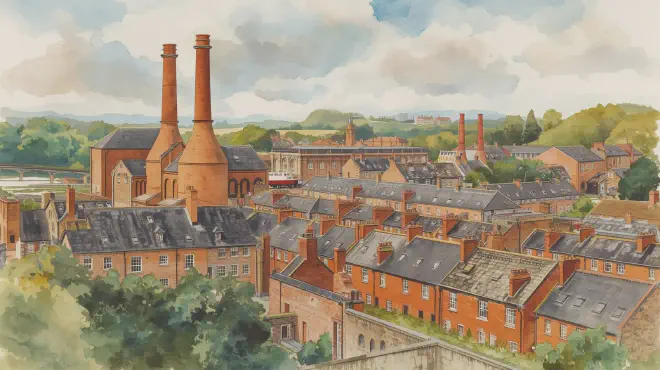
After an hour and a half drive south from Manchester Airport in a rental car, the cityscape of Stoke-on-Trent spread before me in the afternoon light. Leaving the M6 motorway and entering the city center, the first thing that caught my eye was rows of red brick buildings. Terraced houses built as residences for pottery workers stood in orderly lines, with several chimney stacks visible beyond them, quietly testifying to the city’s industrial past.
My accommodation was a B&B in a converted Victorian mansion, warm and welcoming. Upon entering, I noticed beautiful vintage tiles on the floor, and the proprietor, Margaret, proudly explained, “These were made in local kilns too.” From my room’s window, I could see a small garden dotted with ceramic planters filled with colorful flowers. Already, I was captivated by how naturally ceramics were woven into daily life here.
After dropping off my luggage, I headed straight to the city center. My first stop was the Spode Works Visitor Centre, a symbol of the city. Located in the old Spode factory site, which was founded in 1770, this facility allows visitors to observe the pottery manufacturing process up close. Watching the craftsmen at their potter’s wheels was like witnessing magic—lumps of clay transforming into beautiful vessels in their hands, making me lose track of time.
“This technique has been passed down through generations, and the basic processes remain unchanged from 200 years ago,” explained Tom, an elderly craftsman. His hands had taken on a distinctive shape from years of work, yet the pieces he created were surprisingly delicate and beautiful. Listening to him speak, I couldn’t help but feel the depth of culture woven from technique and tradition.
At dusk, I strolled through Hanley district in the city center. This area flourished as the heart of “The Potteries,” and even now, many pottery shops and antique stores line the streets. In one of them, an established pottery shop called “Pottery Corner,” I had a long conversation with Frank, the proprietor.
“For the people of this city, ceramics aren’t just products. They’re the very culture that our grandparents, and their grandparents before them, have continued to create.”
Frank’s words were filled with deep affection for this land. The shop was packed with everything from new works to antiques, yet each piece seemed to carry something more than mere merchandise.
I had dinner at a local pub called “The Green Man,” an establishment that has been running since the 18th century. The interior makes generous use of locally produced ceramic tiles. I ordered Staffordshire oatcakes—a flat pancake-like local specialty—with a pint of Guinness. The oatcakes had a rustic flavor, but the cheese and bacon harmonized exquisitely, soothing my travel fatigue.
The pub’s patrons all seemed to be locals, and listening to their conversations, I could sense the warmth and pride of the city’s people. Particularly memorable was a conversation with an elderly couple at the next table. They had lived in the city for over fifty years and spoke in detail about its transformation.
“There used to be more chimney stacks, and the sky was black with soot. But now there’s more greenery, and it’s become a better place to live.”
In the old man’s eyes as he spoke, I glimpsed complex emotions. The decline of industry had brought quiet to the city, but surely much had been lost as well.
Walking back to the B&B at night, I gazed at the brick streetscape illuminated by streetlights. The city showed a different face from daytime—somehow melancholic and beautiful. Thinking I wanted to touch more deeply into this city tomorrow, I drifted off to sleep wrapped in the quiet night.
Day 2: Tracing Memories of Clay and Fire
The morning began with an English breakfast prepared by Margaret. Grilled tomatoes, bacon, sausages, baked beans, and freshly toasted bread with butter—all beautifully arranged on floral ceramic plates. When these were served, I again realized how deeply ceramics permeated every corner of life in this city.
“This plate has been in use since my grandmother’s time—over eighty years now,” Margaret explained. As I gazed at the delicate painted decoration on the plate’s rim, I felt the high quality of English ceramics that remained beautiful despite the long years.
In the morning, I visited the Gladstone Pottery Museum in the northern part of the city. This facility is an actual pottery factory preserved as a museum, perfectly maintaining the atmosphere of a 19th-century factory. Standing before the massive kilns, I could almost hear the breathing of those who once worked here.
Particularly striking was the exhibit recreating the working conditions of female laborers. Called “printers,” they were specialists who applied decorations to pottery. Their meticulous work was worthy of being called art, clearly showing that these women of the past were true craftspeople, not merely laborers.
Among the detailed explanations by Emily, the curator, what stayed with me most was the story of the workers’ lives.
“Life for those working in pottery factories wasn’t easy, but they had deep pride in their work. That pride is still carried in the hearts of the people here today.”
In the afternoon, I drove a bit further to Tunstall, one of the six towns that make up Stoke-on-Trent. Here stands the Wedgwood factory, and the attached visitor center allows tours of parts of the still-operating facility.
Wedgwood is famous as the brand where Josiah Wedgwood revolutionized the world of ceramics with innovative techniques and aesthetic sense in the 18th century. Seeing the actual production site firsthand, I could feel the weight of that tradition. Particularly, the production process of the distinctive blue pottery called “Jasperware” was truly the creation of art itself.
After the factory tour, I had afternoon tea in the attached tearoom. Naturally, the cup and saucer were Wedgwood products, and I was once again moved by their light feel and beautiful form. When the afternoon tea’s scones with clotted cream and several types of jam were brought out, beautifully arranged on small ceramic plates, I felt this was the pinnacle of Britain’s elegant culture.
On the way back to the city in the evening, I walked along a path beside the River Trent. Though not a large river, it’s an important presence that gives the city its name. The setting sun reflected on the water’s surface, and wild waterfowl rested on the banks. Despite being an industrial city, perhaps one of Stoke-on-Trent’s charms lies in possessing such natural beauty as well.
Along the river was a newly developed park dotted with ceramic sculptures. Created by local artists, they showed a magnificent fusion of traditional techniques with contemporary design. Sitting on a bench and contemplating these works, I couldn’t help but feel the cultural depth of this city.
Dinner was at a city center restaurant called “The Potters Wheel,” which serves modern British cuisine using local ingredients, with the interior effectively featuring local ceramics. The lamb chops I chose for the main dish had an exquisite aroma of rosemary and garlic, and the accompanying local vegetables were fresh.
While dining, I overheard a family at the next table discussing a local ceramics festival. Held every summer, this event attracts ceramicists from around the world for exhibitions, sales, and workshops. Unfortunately, it didn’t coincide with my stay, but learning that traditional culture was being passed to the next generation through such events warmed my heart.
Before returning to the B&B at night, I went to see the nightscape of Hanley district. The streetscape showed a different expression from daytime, fantastical in the streetlight glow. The atmosphere created by the old brick buildings felt as if time had stopped, conveying the weight of over 200 years of history as the pottery capital.
Returning to my room and reflecting on the day while gazing out at the quiet cityscape, I felt I was beginning to glimpse how people in this city continued to preserve their traditions while coexisting industrial heritage with modern life.
Day 3: Morning of Departure, Ceramic Fragments in My Heart
On the final morning, I woke a little earlier than usual. Outside the window, birds were singing, and in Margaret’s garden, flowers glistened beautifully with morning dew. Thinking that this quiet morning time would soon end made me feel a little melancholic.
After breakfast, I had a brief chat with Margaret in the garden. She had lived in this city for over seventy years and had experienced its transformation firsthand.
“In the old days, the smoke from the chimneys would dirty the laundry, which was troublesome, but looking back now, even that landscape feels nostalgic. Still, it’s certainly more livable now—quieter and more beautiful.”
From her words, I could sense the richness of heart among the city’s people, who accepted change while never losing love for their hometown.
For my final morning visit, I chose the Emma Bridgewater factory. Though a relatively new brand, it’s gaining attention as a workshop that continues to make ceramics using traditional methods. What’s distinctive is their use of a technique called “sponging,” applying patterns with sponges to all products, giving each piece a slightly different character.
During the workshop tour, I got to try sponging myself. What looked simple was actually quite difficult—the pressure and pattern placement required great skill, making me appreciate the craftspeople’s expertise anew. The small bowl I made was clumsy, but I decided to take it home as a precious memory of this city.
“It doesn’t have to be perfect. The warmth of handmade work is what makes our products special,” said Sarah, the craftsperson guiding me. Encouraged by her words, I completed my own piece. Though technically crude, it became my special vessel, imbued with the time and experiences I’d had in this city.
Lunch was at a small café in the city center called “Clay Café.” Run by local artists, everything from the interior to the tableware was coordinated with locally produced ceramics. The menu centered on simple but delicious dishes using local ingredients, and the quiche made with Staffordshire cheese was exquisite.
While eating, I reflected on the people I’d met over these three days. Tom from the Spode factory, Frank from the pottery shop, Emily from the museum, and Margaret from the B&B. All were people with deep affection and pride for this city and its culture. Without meeting them, I couldn’t have truly understood this city’s real charm.
In the afternoon, I used my last hours before departure to walk through Hanley district once more. This time, not as a tourist but with a feeling of having become part of this city, I observed the streetscape. The brick buildings, cobblestone roads, and ceramic decorations visible everywhere—all had become familiar landscapes to me.
My final stop was a small antique shop. There I found a small 19th-century Spode teacup. Though it had a small chip on the rim, even that felt endearing as proof of history. The elderly shopkeeper told me, “This was treasured by a woman who worked at the factory.” Whether true or not, the cup certainly seemed to hold long years and many people’s thoughts.
In the evening, while packing at the B&B, I organized my thoughts from this brief stay. Stoke-on-Trent wasn’t merely an industrial city. Here was a unique world where technique and tradition, past and present, people’s lives and culture harmonized beautifully.
When saying goodbye to Margaret, she gave me homemade scones.
“Please come back again. This city will always be waiting for you.”
Hearing those words, I was certain that this city had become not just a travel destination, but one of my spiritual homes.
Getting into the car and leaving the city, I gazed intently at the brick streetscape reflected in the rearview mirror. That landscape, dyed in the setting sun, was beautiful like an old painting, and would be forever engraved in my heart.
What Was Felt, Though Imagined
The three days and two nights in Stoke-on-Trent were brief in terms of time, but the density of experiences that remained in my heart was immeasurable. What I felt in this city went beyond mere tourist pleasure—it was something much deeper.
In this city that developed around the single industry of ceramics, there was a culture where the spirit of craftsmanship and people’s lives merged beautifully. Craftspeople who preserve tradition while continuing to create new value, people who carefully pass down that technique and history, and residents who accept change while never losing love for their hometown. Through encounters with them, I realized that culture isn’t merely a relic of the past, but something continuously created each day by the hearts and hands of people living in the present.
The brick buildings and chimneys seen while walking through the city, the flow of the River Trent, and the beauty of ceramics scattered everywhere—all these harmonized to create a landscape that brought deep peace to my heart. Particularly striking was the pride and affection people held for their own culture. It wasn’t showy, but rather a quiet, warm emotion naturally alive in daily life.
Through this journey, I began thinking about the true meaning of travel. The value of visiting new places and touching different cultures isn’t just about broadening one’s knowledge. It’s about reexamining one’s own values and life perspective, and acquiring a richer viewpoint. The time spent in this small city of Stoke-on-Trent was a precious experience that gave me such realizations.
In truth, this journey is a product of imagination. I have never actually visited Stoke-on-Trent, and the encounters with people described here, the meals experienced, the landscapes seen—all are based on imagination. However, through the process of researching and imagining the city’s history, culture, and people’s lives, I gained a sensation as if I had truly been there.
If an imaginary journey can produce genuine emotion and insight, perhaps that’s proof of imagination’s power. We can travel in our hearts without physically going anywhere. And such journeys can possess richness and meaning no less than actual travel.
Concluding this imaginary journey to Stoke-on-Trent, I’ve gained one certainty: the value of travel isn’t measured by distance or time, but by what you feel, what you learn, and what you realize there. And a true traveler is someone who can find new discoveries and emotions wherever they are.
If this imaginary travel narrative can bring some discovery or insight to readers, there would be no greater joy. And hopefully, someday I’ll truly visit Stoke-on-Trent and overlay this imagined experience with reality. At that time, I’m certain there will be new discoveries in how imagination and reality blend together.