
A Harbor Town Beneath the Southern Cross
Sydney is called the pearl of the Southern Hemisphere. This harbor city, cradled by the Pacific Ocean, began as a British colony established in 1788 on sacred land where Aboriginal peoples had lived for tens of thousands of years. The intricate inlets and peninsulas of Port Jackson Bay create one of the world’s most beautiful natural harbors, unmatched anywhere else.
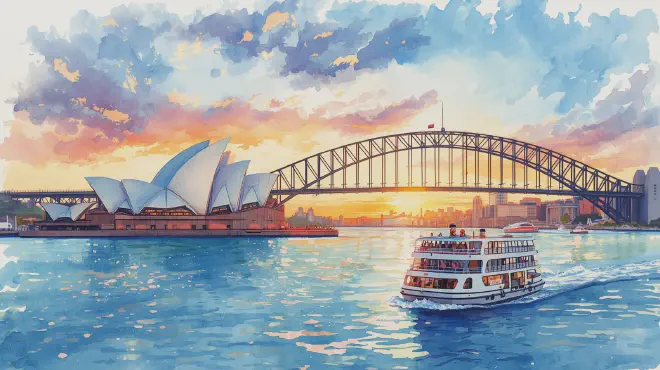
At the city’s heart, that iconic Opera House and Harbor Bridge float between sky and sea, while venture to the outskirts and you’ll encounter Australia’s unique nature woven from eucalyptus forests and wildflowers. Diverse immigrant cultures intermingle here—Italian, Chinese, Lebanese, Vietnamese—cuisines and traditions from around the world combining like pieces of a mosaic.
Now in late June, the Southern Hemisphere is entering winter. Yet Sydney’s winter is as mild as autumn in Japan, with daytime temperatures around 15 to 18 degrees Celsius, rarely dropping below 10 degrees even at night. The dry air and clear blue skies accentuate the charm of this season.
Day 1: Embraced by the Harbor
After a nine-hour flight from Narita, I landed at Sydney Kingsford Smith Airport just after 8 AM local time. Australia’s characteristic dry air wrapped around my skin, and sunlight streaming through the airport’s large windows fell at an angle distinctly different from Japan. It was the moment I truly felt I was in the Southern Hemisphere.
The train from the airport to Circular Quay takes about thirteen minutes. The contrast of red-tiled roofs and blue sky in the residential areas visible from the window was beautiful. The clothing of people on the train was light and airy, with an openness that didn’t feel like winter. Sydney’s people are truly diverse. Asian, European, Middle Eastern, African, and Indigenous people naturally share the same space.
Emerging from Circular Quay station, the scene before me was straight out of a postcard. The Harbor Bridge’s enormous arch carved across the sky, with the Opera House’s white shell-like roof gleaming beyond it. The harbor’s surface in the morning light was mirror-calm, with small ferries slowly crossing back and forth. In that instant, the fatigue of the long journey evaporated completely.
My hotel was a small boutique establishment in The Rocks area. Converted from a 19th-century sandstone building, the room’s window looked out onto the base of the Harbor Bridge. After checking in and dropping my luggage, I headed out into the city around 11 AM.
First, I walked toward the Opera House. Threading through the greenery of the Royal Botanic Gardens, I heard various bird calls. Rainbow lorikeets in brilliant colors flitted among the trees, and ibises ambled leisurely across the lawns. I was amazed that such rich nature remained preserved within the city.
I arrived at the Opera House just past noon. Up close, the complexity and beauty of the architecture was overwhelming. This building, designed by Danish architect Jørn Utzon, is actually not a single shell but composed of various “shells” of different sizes. The white tiles change expression with the angle of the sunlight, almost as if alive.
I had a light lunch at a café near Circular Quay. A flat white (an Australian-born coffee) and meat pie—a quintessentially Sydney combination. The meat pie was spicier than I expected, with the beef inside meltingly tender. I spent leisurely time gazing at the harbor view from the café’s terrace seating.
In the afternoon, I decided to walk across the Harbor Bridge. The pedestrian walkway is free to use, and the view from the bridge is exceptional. Below my feet, cars and trains cross back and forth, while the entire harbor spreads out beneath. Looking back from the northern side at North Sydney, the Opera House and Sydney CBD’s high-rise buildings are beautiful like a single painting.
After crossing the bridge, I peeked into Luna Park, a small amusement park. Opened in 1935, this retro park has a distinctive large smiling face entrance. I rode the Ferris wheel for a panoramic view of the harbor, feeling like I’d returned to childhood.
In the evening, I returned to The Rocks and browsed the weekend Rocks Market. Handicrafts by local artists, Aboriginal art accessories, Australian honey and macadamia nuts—there were many things that would make good souvenirs. The market atmosphere was warm, and the vendors cheerfully struck up conversations.
For dinner, I ate at a harborside restaurant. Sydney Rock Oysters, locally sourced, and grilled barramundi, a white fish. The oysters were small but richly flavored, and squeezing lemon released ocean aromas that filled my mouth. The barramundi had moist flesh with an elegant taste.
After the meal, I walked slowly while viewing the harbor’s nightscape. The Opera House and Harbor Bridge were lit up, showing a different, fantastical beauty from daytime. Light reflected on the harbor rippled and swayed, and a ferry’s whistle sounded in the distance. It was a serene and beautiful night, fitting for the end of the first day.
Day 2: Nature’s Breath and Culture’s Fragrance
I woke at 6 AM. Partly due to jet lag, but the pleasant morning light streaming through the window naturally opened my eyes. Stepping onto the hotel’s small balcony, the sun was rising beyond the Harbor Bridge. The air was crisp, and birds’ chirping gently broke the city’s silence.
I had breakfast at a small café in Paddington. This area is a residential district where 19th-century Victorian terrace houses are beautifully preserved, with distinctive cafés and boutiques dotting narrow lanes. I ordered smashed avocado on toast and, of course, a flat white. The avocado toast had a different flavor from what I’d eaten in Japan, with lime, feta cheese, and chili flakes providing exquisite accents.
After breakfast, I headed to Bondi Beach. About an hour from the city by train and bus. One of Sydney’s most famous beaches, yet the winter ocean in June had few tourists, with mainly locals jogging or walking their dogs.
Arriving at the beach, the first thing that struck me was the beautiful crescent-shaped shoreline. The contrast of white sand and blue sea was breathtaking even in winter. The waves were moderately high, with surfers in wetsuits enjoying the surf. I realized that for Australians, surfing is part of daily life regardless of season.
I drank coffee at a beachside café while gazing at the ocean for a while. Before the vastness of the Pacific, I felt my own smallness while being moved anew by the beauty of planet Earth. Head west from here and you reach Japan; east and you find South America. It was a place where I could truly feel the world’s expanse connected by ocean.
In the afternoon, I returned to the city and visited the Art Gallery of New South Wales. Founded in 1871, this gallery is a treasure house of Australian art. Particularly striking was the collection of works by Aboriginal artists. The “Dreaming” stories painted with dot techniques speak to the depth of the world’s oldest continuing culture, spanning over 50,000 years.
In the contemporary Australian art section, I was captivated by Sidney Nolan’s “Ned Kelly” series. This series depicting the legendary 19th-century outlaw seemed to express Australian identity itself.
After the gallery, I strolled through Hyde Park. Located in Sydney’s heart, this park was named after London’s Hyde Park. June afternoon sunlight filtered through the trees, and the sight of locals eating lunch on the grass was heartwarming. At the Anzac War Memorial in one corner of the park, an elderly man was laying flowers. It was a scene that conveyed how deep the memory of war runs for Australians.
In the evening, I headed to Chinatown. Sydney’s Chinatown is the largest in the Southern Hemisphere, with Chinese restaurants and shops lining Dixon Street. Walking around, I heard conversations mixing Cantonese, Mandarin, and English. It’s an emblematic place of multicultural Australia.
For dinner, I ordered mapo tofu and mala soup noodles at a small Sichuan restaurant. The authentic spiciness numbed my tongue, but the deep umami that followed was truly delicious. The laobǎn (proprietor) was from Chengdu and told me, “I’ve been in Australia for 30 years, but it took 15 years to recreate my hometown’s flavors.” I felt deep respect for people who continue preserving their hometown tastes in a foreign land.
At night, I walked near the casino at Darling Harbour. Enormous monuments were lit up, and people chatted on restaurant terraces. Sydney at night shows a different face from daytime. Despite being a weekday, the city was lively, and people seemed to genuinely enjoy their evening hours.
Day 3: Sentiments on a Morning of Parting
I greeted my final morning on the hotel’s rooftop terrace. In this place overlooking the entire Sydney Harbour, I spent quiet time drinking coffee. The Opera House and Harbor Bridge hazy in morning mist, and the Pacific visible in the distance. The landscapes I’d encountered over two days came back to life in my mind.
After checkout, I headed out for a final stroll. First, I went to the historic streets of The Rocks district. This area, where 19th-century buildings line cobblestone lanes, is a place where you can feel Sydney’s history with your skin. This was once the land where British settlers and convicts first set foot.
At the Museum of Sydney, I could learn the city’s history in detail. How Aboriginal people called this place (Warrane—meaning harbor), how dramatically European arrival changed everything, and the path leading to today’s multicultural city were carefully exhibited. I was impressed by the honest stance of looking at both light and shadow of history simultaneously.
For lunch, I ate seafood at the Fish Market. The Sydney Fish Market is the Southern Hemisphere’s largest fish market, abundantly stocked with fresh seafood. King prawns, mud crabs, and a Sydney Rock Oyster platter. Everything was fresh, allowing me to fully savor the Pacific’s bounty.
After lunch, I walked across the Harbor Bridge again. Gazing at the city from a different angle than the first day, I etched two days of memories into my heart. The harbor view from the bridge never grows tiresome no matter how many times you see it. Ferries leave white wakes as they cross, and seagulls dance on the wind.
The last hours of the afternoon I spent at Mrs Macquarie’s Chair. This is the location of a stone chair where Mrs Elizabeth Macquarie, wife of the early 19th-century Governor of New South Wales, is said to have sat while thinking of her homeland England. The view from here is one of Sydney’s most beautiful photo spots, where the Opera House and Harbor Bridge fit perfectly into frame.
As evening approached, people of various backgrounds, each carrying thoughts of their homelands, build new lives in this beautiful harbor city. The richness of that layered history and culture might be Sydney’s true charm.
On the train to the airport, gazing at the scenery flowing past the window, I organized my thoughts about this brief journey. Sydney was certainly a beautiful city. But that beauty wasn’t merely the beauty of a tourist destination—it was the beauty of a living city created together by diverse people.
Waiting in the departure lounge for boarding, I wrote today’s record in my notebook. Sydney’s clear air, the Pacific’s blue sea, diverse people’s warm smiles, and the stone buildings evoking historical weight. Everything is vividly etched in memory.
What Felt Real Despite Being Imaginary
This journey is an imaginary one, not actually experienced. Yet through words, walking Sydney’s streets, feeling the harbor wind, and encountering local people, a genuine sense of having “traveled” remains. Perhaps this demonstrates that travel is not merely physical movement, but also the experience of encountering new worlds within the heart.
Sydney’s multifaceted character—the fusion of beautiful nature and modern city, the coexistence of diverse cultures, old history and hope for a new future—all of this resonated deeply in my heart, even if imaginary. The sound of whistles echoing in the harbor, the smell of coffee in cafés, the power of art felt in galleries, and above all, the richness of daily life for people living in this city.
Travel is not only about going to new places, but also about meeting new versions of ourselves. Through this imaginary 2-night, 3-day journey, I realized this anew. Though I physically never left home, my heart was certainly under Sydney’s sky. And now, that memory has undeniably become part of me.
The world remains vast, with unknown cities waiting for us. Both actual travel and imaginary travel are precious experiences that enrich life. Which city shall I visit next? With such thoughts, I close this imaginary Sydney travel journal.