
An Ancient City Embraced by Two Seas
Syracuse, situated on the southeastern coast of Sicily, is a place where Mediterranean light takes on a special quality. Founded by Greek settlers in the 8th century BC, this city once rivaled even Athens in its glory, and it was here that Plato came dreaming of realizing his ideal state. The old town of Ortygia is a small peninsula jutting into the Ionian Sea, where Baroque architecture and ancient ruins exist side by side in a distinctive landscape. Limestone buildings gleam white under the sun, and laundry flutters in the narrow alleyways. Modern Syracuse is a city where layers of time have folded upon one another—the glory of ancient Greece, the Middle Ages, and the Baroque era all compressed into what feels like geological strata of history.
Blessed with the bounty of the sea, the cuisine here is particularly rich in seafood, even by Sicilian standards, with distinctive flavors influenced by Arab and Spanish traditions. The early summer breeze carries the scent of salt, and cats nap on the cobblestone streets. I had no particular reason for visiting this city. I simply wanted to see, with my own eyes, the light that ancient poets had loved. That was all.
Day 1: Touching the Memory of Stone
The city of Syracuse came into view around ten in the morning, after an hour’s bus ride from Catania Airport. Through the window, orange groves stretched endlessly, and beyond them, the blue sea glittered. When I stepped off the bus, the May sun was already strong enough that I couldn’t keep my eyes open without sunglasses.
I had chosen a small B&B in the old town of Ortygia for my lodging. The building dated from the 16th century, and climbing the stone staircase, I found a high-ceilinged room furnished with antiques. Opening the window, the building across the narrow alley was close enough to touch, and I could hear someone preparing lunch in their kitchen. I set down my luggage and headed straight out into the city.
Ortygia is small enough to explore on foot, with maze-like alleys running in every direction. I passed the ruins of the Temple of Apollo and made my way to the Piazza del Duomo. The Syracuse Cathedral, facing the square, is a remarkable structure built atop a 5th-century BC Temple of Athena. Behind its Baroque façade, Doric columns still remain. A pagan temple became a Christian church, was rebuilt multiple times, and eventually took its present form. When I touched the stone wall, it felt cool, as if thousands of years had been sealed within.
I took lunch at a small trattoria near the square. There were only two tables set outside, and the menu was written on a hand-scrawled blackboard. I ordered pasta con le sarde—a traditional Sicilian dish made with sardines, wild fennel, pine nuts, and raisins. The balance of sweetness and salt, reflecting Arab influence, was exquisite and paired wonderfully with white wine. The owner, an older gentleman, didn’t seem to think twice about me dining alone. He simply asked, “Buono?” When I nodded, he smiled with satisfaction and retreated to the kitchen.
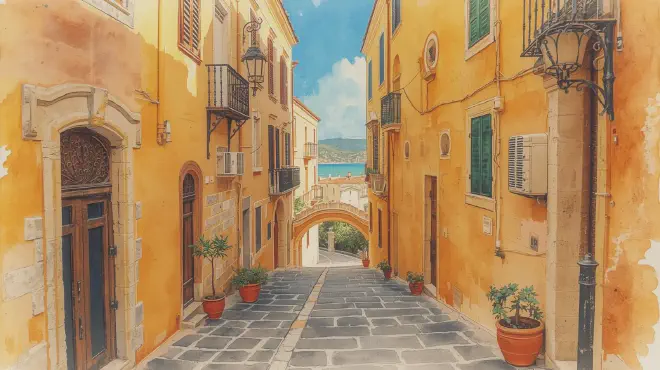
In the afternoon, I walked slowly through the alleys. Every corner of Ortygia is picturesque—yellow and orange walls, wrought-iron balconies, stone archways. Emerging from a narrow lane, the sea would suddenly appear, and I’d catch sight of fishermen mending their nets. At the tip of the island lies the Fountain of Arethusa, a mysterious place where papyrus grows, nourished by freshwater springs. In Greek mythology, the nymph Arethusa transformed into this fountain. Seeing it in person, I understood how such myths could be born—the place has an unmistakably mystical atmosphere. The geographical miracle of freshwater rising so close to the sea must have seemed like divine work to ancient peoples.
At dusk, I walked along the seaside promenade. The Ionian Sea was calm, and the horizon was turning orange. Local people strolled by—young couples nestled together on benches, an elderly man gazing out at the sea alone. Deciding to have dinner a bit later, I stepped into a gelateria. I chose lemon and pistachio, and the clerk laughed, “Siciliano!” Indeed, these are two of Sicily’s signature flavors. The lemon was intensely sour and refreshing; the pistachio, rich with nutty depth.
For dinner, I visited a seafood restaurant near the harbor. The morning’s catch was displayed on ice, and you could choose whatever you liked and specify how it should be prepared. I chose spada—swordfish, grilled. Prepared simply with olive oil, lemon, and salt, the fish was tender and sweet. The side of caponata—a stewed eggplant dish—was served at a temperature somewhere between warm and cold, with complex layers of flavor. At the next table, a large family was eating noisily, children running about while a grandmother gently scolded them.
I returned to the B&B past ten at night. The stone room still held the day’s heat, and when I opened the window, a breeze drifted in from the sea. In the distance, church bells rang, and someone’s laughter echoed through the alley. Lying in bed, I thought back on everything I had seen that day. The columns of an ancient temple, the curves of Baroque architecture, the blue of the sea, the white of the stone. Syracuse is a city where layers of time have folded upon one another in intricate patterns, and this is what gives it such richness. Thinking these thoughts, I drifted into sleep without realizing it.
Day 2: The Archaeological Park and an Afternoon by the Sea
I had breakfast in the small dining room of the B&B. The owner, a signora, had baked cornetti—crescent-shaped croissants—and served them with espresso and orange juice. Sicilian oranges are deeply colored, with a wonderful balance of sweetness and acidity. In halting English, the signora asked, “Where are you going today?” When I answered, “The Neapolis Archaeological Park,” she said, “It’s very beautiful. But it’s hot, so don’t forget your hat,” pointing to her own straw hat.
I crossed from Ortygia to the mainland and took a bus for about fifteen minutes to reach the Neapolis Archaeological Park. Ancient Greek ruins are scattered across a vast site here. The first thing that caught my eye was the Greek Theatre. Built in the 5th century BC, its semicircular seating was carved directly from the rock, and ancient plays are still performed here in summer. Sitting in the seats, I could see the sea beyond the stage, the wind blowing through. To think that people 2,500 years ago watched the tragedies of Aeschylus and Euripides here—my sense of time grew hazy.
Near the theatre is the Ear of Dionysius, a massive artificial cave. Twenty-three meters high and sixty-five meters deep, this cavern was once used as a quarry. The acoustics inside are astonishing—even a whisper carries throughout the entire space. Legend has it that the tyrant Dionysius built it to eavesdrop on prisoners, though in reality it was simply a stone quarry. Still, the fact that such a dramatic story could arise simply because the cave resembles an ear feels very Italian.
Walking through the park, I encountered a group of local schoolchildren on a field trip. The children ran around the Roman amphitheater while their teacher shouted, “Quiet!” When one boy fell and started crying, the girls rushed over to comfort him. It was somehow heartening to see such everyday scenes unfolding in this solemn place of ancient ruins.
I left the park before noon and had a light lunch at a nearby bar. Arancini—Sicilian rice croquettes—and a cappuccino. Arancini means “little oranges,” and beneath their golden crust lies rice seasoned with tomato sauce and a small piece of cheese. Fresh from the fryer, piping hot, crispy on the outside, chewy within. Eating at the standing counter, I listened to the locals’ conversations. The Sicilian dialect is quite different from standard Italian—I could barely understand it, but the rhythm was pleasant all the same.
In the afternoon, I returned to Ortygia and decided to spend some time by the sea. On the southern side of the island, there’s a small rocky beach where locals swim. I hadn’t prepared for swimming, so I sat on the rocks and watched the sea. The Ionian Sea in May is remarkably clear—I could see small fish darting between the rocks. A young man dove in and stayed underwater for so long that I began to worry. When he finally surfaced, he was holding something—a sea urchin. He climbed ashore, split it open with a knife, and ate the orange flesh right there. “Want some?” he asked, but I politely declined. He shrugged and laughed, then dove back into the sea.
Toward evening, I visited the mercato—the market. A small market in the heart of Ortygia, it sells fish, vegetables, fruits, and cheese. At the fish stall, the vendor called out loudly to customers while cutting massive chunks of tuna. At the vegetable stands, bright red tomatoes, glossy eggplants, and heaps of zucchini flowers were displayed. When I lingered in front of the figs, the fruit seller, an older woman, said, “It’s too early—wait until summer.” Instead, she gave me a small apricot. I ate it on the spot—sweet, juicy, the juice dripping down.
That evening, I had made a reservation at a ristorante by the sea, splurging a little. From the terrace, I could see the illuminated Castello Maniace. I ordered raw sea urchin pasta as an appetizer and branzino—sea bass—baked in a salt crust as the main course. The sea urchin pasta was rich, filling my mouth with the taste of the ocean. The salt-crusted fish came with a performance—the waiter cracked open the salt shell at the table, revealing fish that was unbelievably tender inside. I chose Grillo, a Sicilian white wine with good minerality that paired well with the seafood.
At the next table sat an elderly Italian couple. They conversed quietly throughout the meal, occasionally holding hands. They must have been together for decades. Watching them, I felt both the freedom of traveling alone and a small twinge of loneliness. But it wasn’t an unpleasant feeling. Traveling alone is precisely what allows me to savor such scenes at leisure. Thinking this, I took another sip of wine.
Walking back to the B&B, I got lost in the alleys. As I pulled out my phone to check the map, a voice called down from above: “Where are you going?” Looking up, I saw a middle-aged woman leaning out from a balcony. When I told her the name of my lodging, she said, “Ah, Anna’s place,” and gave me directions. In this town, everyone knows everyone. Feeling the warmth of this small community, I found my way back. In my room, a crescent moon was visible through the window. Tomorrow would be my last day. The thought brought a touch of wistfulness.
Day 3: Farewell in the Light
On my last morning, I woke earlier than usual. I wanted to go out while the city was still quiet, to walk in the morning light. At six o’clock, the alleys were still dim, with only a few people sweeping. From a bakery window came the fragrance of fresh bread. When I reached the seaside promenade, the sun was just rising slowly above the horizon.
Morning on the Ionian Sea is quiet. Only the regular rhythm of waves, and fishing boats heading out of the harbor. The sky shifted from orange to blue, and the white walls of buildings began to glow as they caught the morning sun. I sat on a bench and watched for a while. Someone had told me the light in Syracuse is special. Indeed, there is something sacred about this morning light. I could understand why ancient poets were captivated by it.
After breakfast, I used the time before checkout to visit the Piazza del Duomo once more. The square in the morning was nearly empty of tourists—locals read newspapers, walked their dogs. I stood before the cathedral and looked up again at those Doric columns. A Greek temple became a Christian church, collapsed in earthquakes, was rebuilt, adorned with Baroque ornamentation. This single building is the history of Syracuse itself.
At ten o’clock, I checked out, left my luggage, and went for one last walk. I headed to the Bellini Gardens, a small park on the mainland side across from Ortygia. In the shade of trees, elderly men played chess on benches. I sat on a bench too, watching the light filter through the leaves. I like spending quiet moments like this at the end of a journey—not thinking about where to go next, but simply reflecting on the time I spent here.
For lunch, I returned to the trattoria I had visited on the first day. I sat at the same table and this time ordered pesce spada involtini—swordfish rolls. Thin slices of swordfish wrapped around breadcrumbs, raisins, and pine nuts, then baked—another dish that showed Arab influence. The owner remembered my face. “You came back,” he said with a smile. “I won’t be here tomorrow,” I replied. “Then next year,” he said lightly. I love this easy lightness of Italians.
At two in the afternoon, before catching my bus, I went to see the sea one more time. I stood before the Fountain of Arethusa and gazed at the blue sea beyond the papyrus thickets. It had been only two nights and three days, but I would not forget this city. Ancient memories and modern life blend naturally here, and people live quietly. It is a tourist destination, yet not only that. Syracuse has this balance.
On my way to the bus stop, I bought one last gelato. This time, almond and orange blossom. Almonds are a Sicilian specialty—slightly bitter and fragrant. Orange blossom has a delicate scent, as if the air of spring were spreading through my mouth. For the ten minutes until the bus arrived, I ate my gelato and watched the people passing by. A businessman in a suit, a housewife carrying shopping bags, children returning from school. For them, this was an ordinary afternoon. But for me, it was my last moments in Syracuse.
The bus arrived. I loaded my luggage and took my seat, and the bus slowly pulled away. Through the window, the buildings of Ortygia gradually receded. White walls, blue sea, cobblestone streets. By the time the bus crossed the bridge onto the mainland, the whole island looked small. I kept watching out the window. As if reluctant to say goodbye. But at the same time, I felt certain I would return. Syracuse is that kind of place. Once you visit, you’ll want to come back.
On the bus to Catania Airport, I scrolled through the photos on my phone. The columns of the Duomo, the Fountain of Arethusa, the evening sea. But so much didn’t appear in photographs. The trattoria owner’s smile, the market woman’s voice, the sound of my footsteps on the cobblestones, the smell of the sea breeze, the cold of the gelato. These remain only in memory. And that, I thought, is as it should be.
What This Imaginary Journey Left Behind
The two nights and three days in Syracuse were not something I actually experienced. This was an imaginary journey. And yet, as I wrote these words, I felt as though I had truly walked those streets. I touched the stone of the Duomo, felt the wind from the Ionian Sea, tasted the complex flavors of pasta con le sarde. Perhaps it was an illusion, but isn’t that what travel is, at its heart?
Travel is not only about physically going somewhere. Reading books, looking at photographs, listening to someone’s stories, constructing landscapes in your mind—the mental images created this way can sometimes be more vivid than real scenery. Because they are colored by your own imagination and sensibility.
Of course, if I could visit the real Syracuse, that would be wonderful. Actual light, a real sea, encounters with living people. Nothing can replace those things. But even if I cannot go right now, I can travel in my imagination like this. And perhaps this imaginary journey will someday open the door to a real one.
Syracuse is a place where layers of time have accumulated. The glory of ancient Greece, medieval conflicts, Baroque prosperity, and the quiet rhythms of modern daily life. All of it is inscribed in this small city. Perhaps what draws me is the sense of continuity in human endeavor. We do the same things people did thousands of years ago—gaze at the sea, eat delicious food, live our days.
I would be happy if this imaginary travel essay could plant a seed of travel for those who have read it. Perhaps you’ll visit Syracuse someday. Perhaps you’ll travel somewhere else entirely. Or perhaps you’ll simply picture a foreign landscape in your mind. Whatever form it takes, travel opens small windows in our daily lives. And the light that streams through those windows makes our everyday existence a little richer. That is what I believe.
I will not forget the morning light of Syracuse. Even if it existed only in my imagination.