
Introduction
Tashkent, the capital of Uzbekistan, is a city that has flourished as a crucial crossroads on the ancient Silk Road. Today, it stands as Central Asia’s largest metropolis with a population of approximately 2.5 million, creating a distinctive landscape where Soviet-era architecture coexists with traditional Islamic culture.
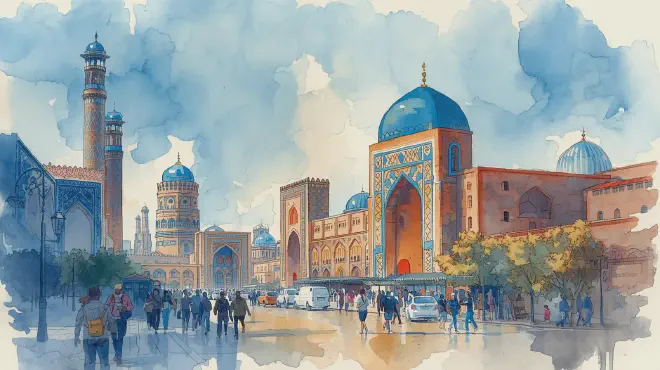
The name “Tashkent” means “stone city,” and true to its name, it developed as a historic city surrounded by formidable walls. Nestled at the foothills of the Tian Shan Mountains, despite its dry continental climate, the city maintains a verdant character thanks to the Chirchiq River flowing through it. Walking through the streets, one encounters a unique beauty woven from East and West, tradition and modernity, where blue-domed mosques harmonize with white marble contemporary buildings.
The rich culture, influenced by Uzbek, Russian, and Persian languages, manifests itself in the cuisine. Central Asian nomadic food culture has merged with various regional cooking methods transmitted along the Silk Road, giving birth to distinctive dishes such as plov (pilaf) and lagman (hand-pulled noodles).
Though my stay would be brief at just two nights and three days, I set out hoping to catch even a glimpse of this venerable city’s charm.
Day 1: First Steps in the Stone City
The moment I stepped off the plane at Tashkent International Airport, a dry wind caressed my cheek. On this October afternoon, the sky was a clear blue, and mountains in the distance traced a pale purple silhouette. The airport building was more modern than I’d expected, its glass facade reflecting the afternoon sunlight.
During the taxi ride to the hotel, I was captivated by the cityscape visible through the car window. Between clusters of utilitarian Soviet-era apartment blocks, minarets of mosques decorated with blue tiles jutted skyward. The plane trees lining the streets had turned golden, and the people walking on the sidewalks wore diverse clothing. Women in traditional Islamic dress walked alongside young people in Western attire.
My accommodation was a small hotel near the old town. The reception area featured beautiful blue and white geometric tiles arranged on the walls. After checking in and taking a moment to breathe in my room, I headed out for an evening walk through the city.
About a ten-minute walk from the hotel stood Chorsu Bazaar, known as Tashkent’s kitchen—a massive marketplace. Under the green dome-shaped roof, colorful goods were packed into every available space. The aroma of spices tickled my nose, and merchants’ calls rang out as they sold dried fruits.
When I stopped in front of a stall piled high with pomegranates, the merchant called out “Tashmanmi?” (It’s delicious!). When he offered me a taste, sweet and tart juice filled my mouth. Though we couldn’t speak the same language, his gentle smile warmed my heart.
Deep in the bazaar, I found an artisan baking traditional non bread. His face, illuminated by the flames dancing in the tandoor oven, was utterly focused, and his movements as he pressed dough against the oven’s inner walls were almost artistic. The freshly baked non had a crisp surface with a soft, fluffy interior. The aroma of wheat filled my mouth.
As the sun began to set, I decided to have dinner at a nearby chaikhana (tea house). Sitting at a low table, I first received a serving of Uzbek green tea. The tea, poured into a small piala (tea bowl), had a subtly sweet fragrance.
For my main dish, I ordered plov, the region’s representative dish. This rice pilaf cooked with lamb, carrots, and onions had an appetite-whetting saffron aroma. Each grain of rice was plump and well-cooked, the lamb tender and slow-braised. With every spoonful, complex spice flavors danced on my tongue.
After dinner, I walked through nighttime Tashkent. The white marble exterior of the Navoi Theatre, illuminated by streetlights, was beautiful, radiating a palace-like dignity. In the square before the theater, a young couple sat on a bench, talking. This universal scene, unchanged across countries, eased some of the loneliness that comes with travel.
On my way back to the hotel, the scent of bread drifted from a corner bakery. At this small shop open late into the night, I bought a piece of non for tomorrow’s breakfast. When the middle-aged shopkeeper realized I was a foreigner, she added a small cookie to the bag as a bonus.
Back in my room, after showering and lying in bed, the day’s events raced through my mind. Though there was a language barrier, I had felt the people’s warmth on my skin. From outside the window came the distant sound of the adhan. This first night in a foreign land became something special, a mixture of anticipation and uncertainty.
Day 2: Where History Breathes on Every Corner
At 6 a.m., the call to prayer woke me. When I opened the curtains, the eastern sky was just beginning to lighten. After a simple breakfast of the non I’d bought last night and black tea brewed at the hotel, I confirmed today’s plans.
I decided to spend the morning touring the historical district of the old town. About fifteen minutes on foot from the hotel was the Hazrat Imam Complex, known as Tashkent’s religious center. This architectural ensemble, built in the 16th century, creates a beautiful contrast with its blue tiles and cream-colored stonework.
My first stop was the Barak Khan Madrasah. A madrasah is an Islamic theological school, with study rooms arranged around a central courtyard. Entering through the arched doorway, I found a fountain in the center courtyard surrounded by corridors. Verses from the Quran, inscribed in beautiful Arabic calligraphy, adorned the blue tiles covering the walls.
As I stood for a while in the silence, an elderly man approached and spoke to me. He was a local, born and raised in this district, and in halting English he explained the building’s history. There was deep pride in his words: “This place hasn’t changed in 500 years.”
At the adjacent Tillya Sheikh Mosque, morning prayers were underway. Tourists were permitted to observe quietly, and I was moved by the sight of believers offering their prayers with single-minded devotion. Though this was my first time traveling in an Islamic cultural sphere, I could feel the power and beauty of faith.
The complex’s library houses one of the world’s oldest Quranic manuscripts, the “Uthman Quran.” Standing before this precious text, said to have been written in the 7th century, I felt the weight of 1,400 years.
In the afternoon, I used the Tashkent Metro to tour the city. Built during the Soviet era, each station is decorated as beautifully as a museum. At Alayskiy Bazar station, I marveled at the luxurious interior combining blue tiles and chandeliers. At Kosmonavtlar station, mosaic paintings with a space theme decorated the ceiling, creating the illusion of being inside a spacecraft.
I got off at Mustaqillik Maydoni (Independence Square) station and visited the Uzbekistan Independence Monument. A white memorial tower soared 104 meters high, with a globe monument symbolizing “independence” at its base. In the square, families strolled while children played around the fountains in a heartwarming scene.
For lunch, I went to a home-style restaurant near the square. When I ordered lagman, a hand-pulled noodle dish, a warm noodle soup filled with vegetables and lamb meat was brought to my table. The noodles were thick with a firm texture, and the tomato-based broth had a gentle flavor. The tangy pickled cabbage that came with it refreshed my palate.
As I ate, a family at the next table struck up a friendly conversation. The father spoke English and enthusiastically explained Uzbek culture. His words—“Family is treasure for Uzbek people”—rang true as I watched three generations dining together in a truly beautiful scene.
Late in the afternoon, I visited Amir Timur Square. The equestrian statue of Timur at the center exuded dignity, conveying to the present day the legacy of the hero who ruled this land in the 14th century. The buildings surrounding the square incorporated the cotton flower—featured in Uzbekistan’s national emblem—into their designs.
At dusk, I returned to Chorsu Bazaar. Exploring the market from a different angle than yesterday brought new discoveries. Watching a woman weaving traditional carpets, I was mesmerized by the way intricate patterns gradually took shape. When she noticed me, she smiled and showed me her work. Though we exchanged no words, perhaps my respect for the craftsmanship came through, as she seemed pleased.
For dinner, I enjoyed a course of traditional Uzbek cuisine. The appetizer salad, finely chopped tomatoes, cucumbers, and onions, burst with fresh vegetable flavors. The main course, shurpa—a lamb soup—had a deep flavor from long simmering and warmed me from the core.
For dessert, I had halva, a sweet confection made from sesame and nuts. Savored with green tea, its subtle sweetness permeated my tired body.
Nighttime Tashkent revealed a different face than during the day. Illuminated buildings floated in the night sky, enveloping the entire city in a fantastical beauty. In front of the Navoi Theatre, young artists performed impromptu music, their beautiful melodies carried on the night breeze.
On my way back to the hotel, I rested for a bit on a bench in a small park. Trees illuminated by streetlamps cast shadows, beyond which the silhouette of mountains was beautiful. In this moment, I felt the depth of Tashkent as a city. A place where various elements—history and modernity, East and West—harmonize in exquisite balance. Tomorrow would be my last day, but I found myself wishing to spend more time in this city.
Day 3: Thoughts in a Morning of Farewell
On my final morning, I woke earlier than usual. At 7 a.m., I gazed once more at the cityscape visible from my room window. Tashkent wrapped in morning mist appeared somehow fantastical and beautiful. As morning light touched the distant mountains and the entire city slowly awakened, a sense of sadness welled up at the thought of this journey ending.
I decided to have my last breakfast at a small café near the hotel. Inside the shop, bustling with locals, the aroma of freshly baked samsa (meat pies) filled the air. When my order arrived, samsa wrapped in flaky pastry and filled generously with lamb and onion was set before me. Biting into it while still hot, juicy meat broth spread through my mouth.
After breakfast, I set out for a final walk through the city. Retracing the paths I’d taken, I tried to etch three days of memories into my heart. At the entrance to Chorsu Bazaar, I encountered again the woman I’d seen weaving carpets yesterday. She seemed to remember me, smiling and waving. Then she handed me a small embroidered handkerchief—surely her own handiwork.
As I wandered leisurely through the bazaar for the last time, an elderly spice seller called out to me. Before him, colorful spices were beautifully displayed. Cumin, coriander, saffron, and spices I’d never seen before. As he let me smell each one, he explained their properties. As a souvenir, I bought a small amount of Uzbekistan’s specialty saffron. The saffron in its small bag was a beautiful golden color reminiscent of Tashkent’s sunlight.
For my final morning visit, I returned once more to the Hazrat Imam Complex. Unlike when I first set foot here three days ago, this time I could observe with deeper understanding. Listening to the sound of the fountain in the courtyard, I felt the weight of this place having been a site of prayer for hundreds of years.
For lunch, I had plov again at the chaikhana I’d visited on the first day. Having the same dish after three days of experience, I could enjoy its flavors more deeply. The umami of lamb soaked into each grain of rice, the sweetness of vegetables, and the complex aroma of spices—all harmonizing to create a singular taste.
Stepping outside after the meal, afternoon sunlight illuminated the city. Tashkent’s blue sky stretched clear to the horizon. These three days spent beneath this blue sky had become irreplaceable time for me.
In the afternoon, I toured folk craft shops to buy souvenirs. Traditional ceramics, vibrantly colored carpets, elaborate woodwork—all beautiful pieces showcasing artisan skills. I ultimately chose a small plate decorated with blue tile patterns and a tablecloth embroidered with traditional Uzbek designs. Looking at these would surely bring back memories of Tashkent.
In the evening, before heading to the airport, I took one last walk. The time spent in the square before the Navoi Theatre, watching local people’s daily scenes, was perhaps the most luxurious moment of this journey. An old man playing chess, children playing around the fountain, lovers walking hand in hand—all beautiful, all universal aspects of human life.
In the taxi to the airport, the driver asked in halting English, “How was Tashkent?” When I answered, “It was a very beautiful city,” he smiled proudly. To his words, “Please come again,” I replied from my heart, “Yes, definitely.”
After checking in at the airport, I drank my last cup of Uzbek tea in the departure lounge. The green tea poured into a small piala was the familiar taste I’d drunk every day for three days. I would never forget this flavor.
As the plane took off and I looked down through the window, the city of Tashkent gradually grew smaller. The city illuminated by the setting sun looked like a jewel shining in gold. The Tian Shan Mountains also lay on the horizon as a pale purple silhouette.
Though my stay was brief, the city of Tashkent and the warmth of the people I met there were deeply engraved in my heart. The beauty of humanity that transcends language barriers, the charm of a city where history and modernity coexist, and above all, each small discovery and moment of wonder felt during this journey seemed to have enriched me as a person.
Epilogue
Looking back, these two nights and three days in Tashkent became a mysterious experience that, while an imaginary journey, felt as if it had truly happened. The smiling faces of people I met at the bazaar, the beauty of historic buildings, and most of all, the warm hospitality of the Uzbek people—all of these live vividly in my memory.
Travel is not merely about visiting new places. It’s also about encounters with people, understanding different cultures, and time spent facing one’s own inner self. The city of Tashkent offered all of these.
This ancient city, which flourished as a crossroads of the Silk Road, continues to welcome many travelers even now, surely giving each person special memories. As one of them, I departed for home with precious memories of this beautiful city held close to my heart.
Hoping that someday I might visit this “stone city” of Tashkent again.