
A Lakeside Town Where Fire and Water Remember
Taupo is a quiet town nestled on the shores of Lake Taupo, located in the near-center of New Zealand’s North Island. This lake, the largest in Oceania, was born from a massive volcanic eruption approximately 26,500 years ago, forming a caldera that still shows active geothermal activity today. For the Māori people, Lake Taupo is sacred water, and according to their legends, the great navigator Ngātoro-i-rangi summoned the volcanic gods to this land.
The town has a population of about 25,000, yet it welcomes travelers throughout the year. The reason is clear. This small town contains concentrated natural blessings: a lake of exceptional clarity, the otherworldly landscapes of geothermal areas, the thundering Huka Falls, and skies full of stars. Located about three and a half hours by car from Auckland and roughly an hour from Rotorua, it has become an essential stop for those traveling the North Island.
I chose Taupo because I was drawn to the landscape where volcano and lake—two contrasting elements—coexist. The violent workings of the earth, and the water’s surface that quietly receives it all. I wanted to stand at that boundary.
Day 1: Clouds Drifting Across the Lake’s Mirror
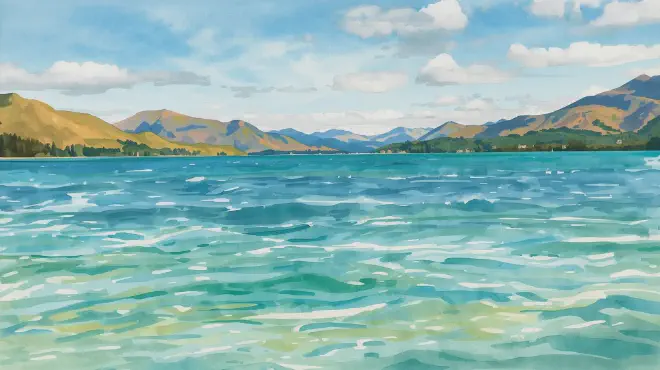
On the drive south from Auckland, the landscape gradually transformed into something pastoral. Sheep dotted gentle hillsides, and in the distance, silhouettes of snow-capped mountains appeared. Just past eleven in the morning, when Lake Taupo came into view, I instinctively eased off the accelerator at the sight of its blueness. The lake’s surface, reflecting the clear sky, stretched endlessly calm and vast.
My accommodation was a small motel facing the lakefront. After checking in, I gazed at the lake from my room’s window. Across the water, Mount Tongariro, also sacred to the Māori, appeared hazily in the distance. I left my luggage and decided to walk through town.
Taupo’s center proved surprisingly compact, with cafes, restaurants, and souvenir shops lining Tongariro Street. The afternoon sun felt pleasant, and I passed locals walking in short sleeves. The Southern Hemisphere was welcoming early summer. Walking along the lakeside promenade, I spotted people enjoying water sports. The sound of jet boats echoed from afar.
For lunch, I chose a cafe overlooking the lake. A pie filled with local lamb and a flat white. The pie contained tender, herb-scented meat wrapped in flaky pastry—a perfect combination. While lamb appears regularly on New Zealand tables, there’s no gamey taste; instead, a gentle richness unfolds. Outside the window, seagulls glided just above the water’s surface.
In the afternoon, I headed to Huka Falls, north of town. This waterfall forms where the Waikato River, flowing from Lake Taupo, passes through a narrow gorge. A five-minute walk from the parking lot, and already the roar reached my ears. Standing at the viewing platform, I witnessed an incredible volume of water plunging forcefully downward. This fall, dropping 220,000 liters per second, may be only about 11 meters high, but its power was overwhelming. The water’s color was milky blue, appearing almost emerald depending on the light. “Huka” means foam in Māori, and true to its name, violently frothing water continued carving into the rock.
After surrendering myself to the waterfall’s sound for a while, I walked slowly back along the riverside trail. Midway, a suspension bridge offered another beautiful view of the river. The water’s clarity was such that in places I could see clearly to the riverbed stones. Along the path, New Zealand’s native ferns grew thick, their shade offering coolness.
In the evening, before returning to the motel, I stopped at a supermarket. A store locals use daily, stocked with vegetables, meat, and dairy products. New Zealand’s supermarkets all seem clean and orderly. I picked up simple ingredients to prepare a light dinner in my room. Tomatoes, avocado, cheese, and crackers. That was sufficient.
At night, I walked along the lakefront. The sun had completely set, and a faint twilight still lingered in the sky. The lake’s surface was mirror-quiet, distant shore lights flickering across it. A dog barked somewhere far away. I walked to the end of an empty pier and gazed at the lake for a while. Almost no wind, the air cold and clear. I felt I hadn’t experienced such a quiet night in a long time.
Returning to my room, I took a warm shower and got into bed. Leaving the window open just a crack, a gentle breeze from the lake drifted in. In the distance, a water bird called out.
Day 2: Earth’s Breath and Memory of Hot Springs
Morning came with sunrise over the lake. The clock showed only 6:30. Opening the curtains, I found the lake’s surface painted orange. Thinking I couldn’t miss such a morning, I dressed and went outside. Along the lakeside path, a few joggers and dog walkers appeared here and there. When I offered greetings, everyone smiled in return. New Zealanders speak readily even to unknown travelers.
After returning to the motel for breakfast, I set out for my day’s destination: the Wai-O-Tapu Geothermal Area. About a 50-minute drive from Taupo toward Rotorua. New Zealand’s volcanic region, like Japan, shows active geothermal activity, with hot springs and thermal areas scattered throughout.
I arrived at Wai-O-Tapu around 10 a.m. Parking the car, I paid the entrance fee at the visitor center. A staff member carefully explained the highlights. “Make sure to see Champagne Pool. And Devil’s Bath is quite interesting too.” Map in hand, I began walking the trail.
First to appear was a small pool from which the scent of sulfur drifted. Steam rose from the water’s surface, the surrounding earth stained yellow, white, and orange. With each step forward, the landscape took on otherworldly colors. Green pools, mud-boiling holes, ground violently venting steam. Few places let you feel so directly that the earth is alive.
Then I reached Champagne Pool. This hot spring, approximately 65 meters in diameter and 62 meters deep, glowed a pale blue-green like a giant champagne glass. Small bubbles continuously rose from the surface, creating exactly the effervescence of champagne. This color, I learned, comes from mineral-rich water welling up from deep underground, reflecting light. Around the walkway, travelers from across the world gazed at its beauty, seemingly lost for words.
I spent about three hours completing the Wai-O-Tapu circuit. The last sight, “Devil’s Bath,” was a vivid orange hot spring that looked almost like lava. Walking through a geothermal area is close to peering into the earth’s interior. Born in a volcanic country myself, I felt something familiar in this landscape.
On the way back to Taupo, I had lunch in a small town. A meat pie and sausage roll from a local bakery, eaten in the car. New Zealand’s pie culture is wonderful—you can’t go wrong wherever you buy.
I had booked an afternoon activity on Lake Taupo. A cruise to see the Māori Rock Carvings. This massive sculpture, carved into the cliff face on the lake’s southwestern shore, was created in the late 1970s by Māori carver Matahi Whakataka-Brightwell, standing about 10 meters tall. Boarding a motorboat, we headed across the lake. The wind felt pleasant, spray touching my face.
After about thirty minutes, the cliff face came into view. There, powerfully carved, was the face of Ngātoro-i-rangi, the legendary Māori navigator. Despite exposure to wind and waves, the expression remained proud, radiating a sacred atmosphere. The boat stopped its engine before the carving and rocked quietly for a time. When the guide offered a prayer in Māori, everyone present naturally fell silent.
In the evening, returning to town, I decided to have dinner at a lakeside restaurant. I ordered grilled trout caught locally and a New Zealand white wine. Lake Taupo is known as a mecca for trout fishing, home to abundant rainbow and brown trout. The trout on my plate had crispy skin and tender flesh. Squeezing lemon over it, one bite released a delicate yet rich flavor.
Outside the window, the sun was setting over the lake. The sky turned pale pink and orange, clouds slowly changing shape. At the next table, an elderly couple quietly sipped wine. Time flowed slowly. Perhaps that’s the charm of this town called Taupo.
At night, I soaked in the motel’s hot spring. In New Zealand, many accommodations feature geothermally-heated springs. From the small outdoor bath, I could see a sky full of stars. The Southern Cross shone clearly. Sinking into the water, gazing at the stars, I reflected on the day. The morning feeling earth’s pulse, the afternoon touched by Māori prayer, the quietly fading evening. Everything was engraved in my heart gently yet certainly.
Day 3: A Morning of Farewell and Reasons to Return
On the final morning, I woke a bit early. Before packing, I wanted to see the lake once more. In the still-dim light, I headed to the shore. The eastern sky began to pale, morning mist settling over the water. Walking to the pier’s end, mountain silhouettes floated vaguely through the fog.
After a while, the mist began to clear. The sun showed its face, and the lake’s surface suddenly blazed with light. Water birds took flight, calling. I thought I would not forget this scene.
After checking out of the motel, I had my last breakfast at a town cafe. In the shop bustling with locals, I ordered eggs benedict and a long black. Breaking the poached egg, yolk flowed richly over the English muffin. Simple, but a carefully prepared breakfast.
In the morning, I stopped at the Taupo Museum. Though small, it displays Māori history, the region’s volcanic activity, and European settler life. Particularly interesting was the exhibition on the 1886 Mount Tarawera eruption. This eruption near Rotorua claimed many lives and transformed the landscape completely. Looking at photographs and artifacts from that time, I was reminded how small humans are before nature’s power.
After leaving the museum, I walked the lakefront once more. A different place, a different angle from yesterday. The same lake changes expression completely with time, weather, and light. Perhaps that’s this lake’s appeal.
Past noon, the time came to leave Taupo. Feeling reluctant, I drove the car northward. The lake in the rearview mirror gradually grew smaller.
On the return journey, I stopped the car partway and looked back. Lake Taupo visible in the distance. The two nights and three days spent on that lake’s shore were not long, yet strangely fulfilling. Intense geothermal activity and quiet water. Māori prayers and modern travelers. A place where fire and water, past and present, intersect. That was Taupo.
Driving toward Auckland, I was already thinking of my next journey. Queenstown on the South Island, or perhaps Fiordland? New Zealand holds many unseen landscapes. But someday I’ll return to Taupo. Next time I want to try fishing, and challenge the famous Tongariro Alpine Crossing hiking trail.
Travel is a series of farewells. But it’s also about finding reasons to return. Taupo gave me that reason.
What Felt Real Though Imagined
This journey is an imaginary record, one that doesn’t actually exist. Yet the land called Taupo, Māori culture, New Zealand’s nature, and the people living there do exist. While writing this, I studied maps, gazed at photographs, read travel accounts, and imagined the air of that place.
Even an imaginary journey gains tangible texture by carefully depicting specific place names, real landscapes, truly available cuisine, and people’s lives. If anyone reading this feels a longing for Taupo, I believe this imaginary journey has succeeded.
When the day comes to truly visit Taupo, I’ll taste the moment when this imagined memory overlaps with real experience. That too is one of travel’s pleasures.
The lakeside town where fire and water’s memories sleep, Taupo. I hope this imaginary journey becomes the beginning of someone’s future travels.