
Introduction
A paradise of stillness, woven from Caribbean blue and ancient Maya stone. Tulum, on the eastern coast of Mexico’s Yucatán Peninsula, is a place that deserves exactly such words.
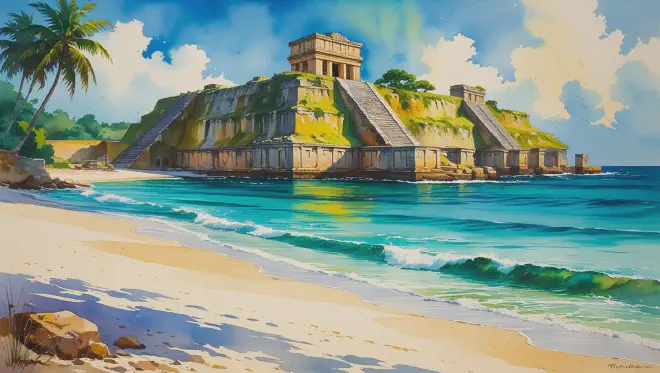
The name Tulum means “wall” in the Maya language. This ancient city, which flourished from the 13th to the 15th century, was built atop cliffs overlooking the Caribbean Sea, its ancient fortifications still standing with quiet dignity against the backdrop of the blue ocean. Legend has it that when Spanish conquistadors first laid eyes on this place, the white walls illuminated by the morning sun were so beautiful they called it “the city of dawn.”
Modern Tulum captivates travelers from around the world as a rare place where ancient ruins and untouched nature exist in harmony. Crystal-clear cenotes (natural sinkholes), pristine beaches, and eco-lodges committed to sustainable tourism are scattered throughout the region. In this land that cherishes Maya spirituality while embracing modern comforts, I was about to experience a journey of deep healing and discovery over just two nights and three days.
Day 1: An Afternoon Arrival Wrapped in Sea Breeze
The journey from Cancún Airport to Tulum takes about two hours. Gripping the steering wheel of my rental car, I headed south across the flat terrain of the Yucatán Peninsula. Low shrubs lined both sides of the road, and occasional signs for cenotes hinted at the mysterious underwater world spreading beneath this land.
Around two in the afternoon, I finally arrived in the town of Tulum. The small town maintained a calm atmosphere that seemed unlikely for a tourist destination. Small restaurants and shops run by locals lined the main street, and conversations blending Maya words with modern Spanish drifted through the air.
My eco-lodge was located along the beach, about fifteen minutes by car from the town center. After checking in, a staff member named María showed me around the property in fluent English. “Our lodge is a modern interpretation of traditional Maya architecture,” she explained with evident pride. Indeed, the thatched-roof bungalows harmonized beautifully with the surrounding nature, possessing an organic beauty as if they had grown from the earth itself.
I set down my luggage in the room and headed straight for the beach. Passing through the lodge grounds, a breathtaking scene unfolded before me. A beach of powder-fine white sand, and an impossibly clear sea. The gradient of colors so characteristic of the Caribbean—shifting from emerald to turquoise blue—sparkled under the afternoon sun.
The beach was sparsely populated with tourists, and silence reigned. Only the sound of waves and occasional birdsong served as music in this paradise. Walking barefoot along the sandy shore, I imagined whether the Maya people who had lived here long ago had gazed upon this same sea.
As evening approached, the sky began its gradual transformation. Tulum’s sunset doesn’t sink into the Caribbean but rather descends into the jungle behind, which lends it an almost mystical beauty. I sat in a beach chair and quietly watched as the sky shifted from orange to pink, then to deep purple.
That night, I tasted Yucatecan cuisine for the first time at the lodge restaurant. The cochinita pibil—pork slow-cooked with spices—was prepared using the traditional method of wrapping in banana leaves and steaming underground, its distinctive aroma and deep flavor leaving a lasting impression. The combination with the side of frijoles (stewed black beans) and handmade tortillas was simple yet profoundly nourishing.
After dinner, I read on the lodge balcony, listening to the distant calls of an owl. With the facility’s lighting kept to a minimum, the star-filled sky was vividly clear. Already I was experiencing the luxury of being released from urban noise and surrendering to nature’s rhythm.
Day 2: Ancient Memories and Subterranean Mysteries
At half past five in the morning, I was awakened by a chorus of birds. Outside the window it was still dim, though the eastern sky was beginning to show the faintest hint of light. Making the most of the opportunity, I decided to watch the sunrise at the Tulum ruins.
The ruins normally open at eight in the morning, but through special arrangement with a local guide named Carlos, early entry was possible. “For the Maya people, the direction of the rising sun signified rebirth and new beginnings,” he told me. Indeed, the ruins shrouded in morning mist exuded a sacred atmosphere entirely different from their daytime appearance.
The main temple, known as El Castillo (The Castle), stands majestically at the cliff’s edge. According to Carlos, this building was constructed based on astronomical calculations, designed so that on the spring and autumn equinoxes, the sun illuminates the exact center of the structure. I was struck anew by the advanced knowledge and skill of the Maya people.
As the sun began rising from the horizon, the entire site was bathed in gold. Light streaming from across the sea illuminated the limestone walls, creating the illusion that the ancient city had been revived in the present day. The chance to experience this moment in quiet solitude became one of the most precious memories of my journey.
After breakfast, I set out to explore the underground world. Dozens of cenotes are scattered around Tulum, and I visited Gran Cenote, said to be among the most beautiful. Cenotes are natural pools formed by the collapse of limestone ground, and the Maya people revered them as sacred springs.
The moment I stepped into Gran Cenote, I was speechless with wonder. The clear freshwater allowed visibility all the way to the bottom, where stalactites and stalagmites created a fantastical underwater landscape. The water temperature remains around 24 degrees Celsius year-round, offering the pleasant sensation of a natural hot spring.
Donning snorkeling gear, I slowly entered the water. The underwater space was more expansive than I had imagined, like a subterranean cathedral. Sunlight filtering through the ceiling refracted in the water, creating mystical curtains of light. Small freshwater fish swimming between the rays of light resembled living works of art.
A diver I encountered underwater pointed toward the depths of the cave using hand signals. There, I was told, traces remained of offerings that the ancient Maya had presented to Chaac, the rain god. To think that this cenote, now a place of recreation for us moderns, was once a site of sacred ceremony—the thought was humbling.
In the afternoon, I wandered through the local market. Unlike typical tourist markets, Tulum’s market offers glimpses into the daily lives of local people. Colorful chili peppers, unfamiliar tropical fruits, and handmade crafts were crowded together in every corner.
At the market, I met Doña Concepción, who despite being over seventy years old, sells her handmade tamales (corn dough wrapped around filling and steamed in corn husks) every day. Her tamales were exceptional—the combination of chicken and green sauce was perfect. “The recipe was passed down from my grandmother,” she said proudly. Her dedication to preserving traditional flavors filled me with deep respect.
In the evening, I returned to the beach. Timing my visit for when the strong afternoon sun had softened, I enjoyed swimming in the sea. The Caribbean seawater was warmer than I had expected, and its high buoyancy made it as comfortable as a natural pool. Floating in the water while gazing at the sunset sinking toward the horizon, my sense of time grew hazy.
For dinner, I ate at Hartun, a restaurant where local young people gather. Here, traditional Yucatecan dishes are served with a modern twist. The ceviche—raw fish marinated in lime—was particularly memorable. Fresh white fish caught locally was dressed with lime, red onion, cilantro, and habanero, achieving a perfect balance of bright acidity and heat.
Over dinner, I enjoyed conversation with a local family at the neighboring table. They had lived in Tulum for three generations and spoke of cherishing traditional ways of life even as tourist development progresses. “Tulum’s true beauty lies in its nature, its culture, and the warmth of its people,” they said—words that resonated deeply.
Day 3: A Final Morning Etched in Memory
On my last morning, I woke early to join a yoga class, hoping to create a special memory. Morning yoga on the beach, with the sound of waves as background music, was a luxurious experience. The instructor, Ana, incorporated ancient Maya breathing techniques, explaining, “This breathing method has been passed down since ancient times to heighten one’s sense of unity with nature.”
As the morning sun slowly rose, stretching my body with deep breaths, I could truly feel myself as part of the greater natural world. During the meditation, every beautiful moment from these two days came flooding back, and I was enveloped in a deep sense of fulfillment.
After breakfast, I decided to visit the Tulum ruins one last time. This time alone, walking slowly and contemplating the history of this ancient city. Gazing at the Maya glyphs carved throughout the site, I reflected on the sophistication and mystery of this civilization.
At the Temple of the Wind, I listened to the sound of sea breeze passing through gaps in the stone. That sound seemed like the prayer voices of ancient people. For the Maya, this place was not merely a dwelling but a site for dialogue with the gods.
The Caribbean Sea viewed from the highest point of the ruins was as beautiful as ever. Knowing that Maya people had gazed upon this same view hundreds of years ago stirred a strange sense of connection across time.
For lunch, I stopped at a small seaside restaurant called La Posada. Their specialty is fish seasoned with achiote, a traditional Maya condiment. Achiote, a red spice made from annatto seeds, has a distinctive flavor and beautiful red color. Fish prepared with this seasoning was as pleasing to the eye as it was deeply flavorful.
For dessert, I ordered a dish combining local mango with chile piquín (small hot peppers). The exquisite balance of sweetness and heat felt like the very essence of Mexican cuisine.
In the afternoon, I browsed local artisan handicraft shops while picking up souvenirs. Traditional Maya textiles, accessories made from natural stones, hand-carved wooden items—all possessed the warmth of handmade goods.
Particularly memorable was the workshop of Doña María, a Maya textile artisan. Using a traditional backstrap loom, she weaves vividly colored huipiles (traditional Maya women’s garments). “It takes three months to complete one piece,” she told me. Her meticulous handiwork and technique passed down through generations moved me deeply.
As evening approached and checkout time drew near, my reluctance to leave Tulum grew. I walked the beach one final time, imprinting in my heart every beautiful moment from these two nights and three days.
Before heading to the airport, I enjoyed a final meal in town. I chose Don Pedro, a small family-run restaurant. The pozole (a corn-based soup) I ordered there was something truly special among all the dishes I had tasted on this trip. The slow-simmered soup, filled with corn, pork, and various vegetables, had a gentle flavor that soaked into my weary body.
The elderly owner, Don Pedro, told me, “Tulum is not simply a beautiful place. Here, there is life that continues from ancient times to the present, and there is culture. If you have felt that, it brings us the greatest joy.” True to his words, I realized that this journey had given me deep cultural experiences that ordinary tourism could not provide.
That night, in the car heading to Cancún Airport, I gazed at the passing scenery through the window and reflected on how much I had gained from this brief journey. The wisdom of the ancient Maya, the beauty of the Caribbean Sea, the warmth of the local people, and a sense of unity with nature. All of these were being woven together in my heart into one grand story.
Closing
These two nights and three days in Tulum were a transcendent experience, beyond the ordinary concept of time. The weight of history felt at the ancient Maya ruins, the mystical beauty of the cenotes, the transparent blue of the Caribbean Sea, and above all, the heartwarming exchanges with local people—all combined to create an unforgettable travel memory.
Interestingly, this entire journey was experienced completely within imagination. Yet strangely, I have a tangible sense of having actually visited that place, breathed that air, and touched that culture. Why does a story woven only from words and imagination feel so real?
Perhaps it is because of the wonderful power of human imagination and our universal longing for culture and nature. Thoughts of beautiful places that exist somewhere in the world, the lives of people there, and the traditional cultures passed down through generations emerge as rich reality in our hearts, transcending actual experience.
This imaginary journey, constructed from information about the real place called Tulum and its cultural background, is also a path toward a real trip I hope to take someday. This experience, imaginary yet felt so certainly, has nurtured my longing for travel, deepened my understanding of different cultures, and cultivated gratitude for nature.
Perhaps the true value of imaginary travel lies not in mere escapism, but in enriching our hearts, nurturing curiosity about the world, and making the real journey we may someday take all the more profound.