
A Gateway to Golden Earth
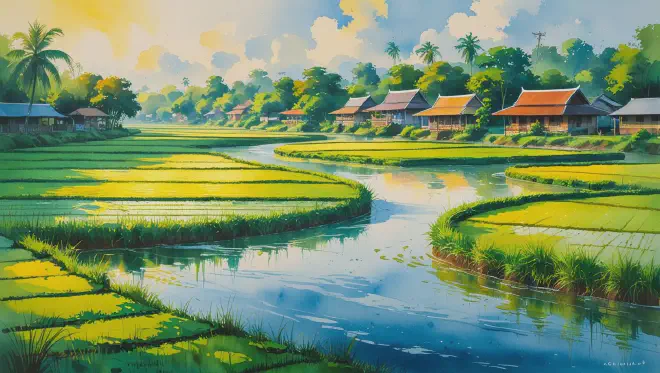
Ubon Ratchathani. When I first heard this name—meaning “City of the Lotus King” in Thai—something stirred quietly within me. Known as an ancient city of the Isan region in northeastern Thailand, this place rests in the fertile plains carved by the Mekong River, where Khmer and Thai cultures have blended into something uniquely its own.
The remnants of the Khmer Empire that once ruled these lands still stand with dignity, weathered yet unbroken by time. Stone sanctuaries built between the eleventh and thirteenth centuries share architectural lineage with Angkor Wat, yet bear expressions shaped by Isan’s dry earth. The interplay of red sandstone and yellow laterite glows gold under morning and evening light.
The Mun River flows through the city, eventually joining the Mekong to form the border with Laos. This blessing of water has sustained life here since ancient times, nurturing a rich culture. Markets overflow with river fish and vegetables, temple bells ring for almsgiving rounds, and above all, time moves slowly here. Far from the chaos of Bangkok, this is a place where one can touch the true heart of Thailand. That is Ubon Ratchathani.
Day 1: A City Where Ancient Memories Dwell
The overnight train from Bangkok glided into Ubon Ratchathani Station at half past six in the morning. Carrying memories of the mist-wrapped rice fields I had watched from the window, I shouldered my heavy backpack and stepped onto the platform. The station building was small, filled with a somehow nostalgic atmosphere. Beyond the gates, the air was already humid, and the dusty scent particular to Isan’s dry season clung to my skin.
A tuk-tuk driver called out to me in broken English. “Hotel?” I told him the name of my guesthouse in the city center, and he nodded with a broad smile. Settled into the back of his three-wheeled vehicle, I watched the morning city rush past. The streets were still quiet, with people sweeping their storefronts and monks walking to their almsgiving rounds.
The guesthouse was an old wooden building, and the woman at the front desk welcomed me warmly. My room was on the second floor, with a window overlooking the roof of the temple across the street. After a shower and getting dressed, the clock had already passed nine.
I decided to have breakfast at a nearby market. The morning face of Talat Night Bazaar was entirely different from its nighttime character—voices hawking vegetables and fish echoed around me as I ordered khao tom at a small stall. The warm rice porridge with pork and egg soothed the weariness of travel. An elderly man sitting beside me smiled at my clumsy attempts at Thai and asked, “Sabai mai?” Are you well?
I spent the morning walking through the city center. The Ubon Ratchathani National Museum offered a window into the region’s history and culture. Khmer-era stone statues and bronze Buddha images stood in quiet display, their dignified expressions preserved across a thousand years. What struck me most was an eleventh-century Khmer-style Bodhisattva, its compassionate face seeming to calm all who gazed upon it.
For lunch, I visited a local restaurant recommended by the townspeople and tried the Isan staples: som tam—green papaya salad—and gai yang, grilled chicken. The refreshing sourness and heat of the som tam danced on my tongue while the fragrant aroma of the gai yang stirred my appetite. The owner taught me that the traditional way is to eat it by hand with khao niao, sticky rice.
In the afternoon, I made my way to Wat Thung Si on the outskirts of town. This temple’s main hall, built in the eighteenth century, showcases the distinctive Ubon Ratchathani architectural style. The contrast between red-tiled roofs and white walls was striking, and inside, murals depicted daily life and Buddhist tales in vivid color. Particularly impressive was a series of paintings illustrating the Ramakien—Thailand’s version of the Ramayana—with battle scenes and court life rendered in meticulous detail that held me captive.
In the temple grounds, a young monk sat meditating beneath a bodhi tree. Watching his still form, I felt as though time had stopped. The afternoon sun cast long shadows across the compound, and only the sound of leaves rustling in the wind could be heard.
In the evening, I walked along the promenade by the Mun River. The river was wider than I had imagined, and the greenery on the far bank glowed gold in the setting sun. People were fishing, children playing by the water’s edge—I could see how vital the river was to local life. Food stalls began lining the promenade, preparing for dinner.
That night, I ate moo ping—grilled pork skewers—and khao lam, sticky rice cooked in bamboo tubes, at a riverside stall. The moo ping was sublime, glazed in sweet-savory sauce, while the gentle sweetness and coconut fragrance of the khao lam warmed my heart. The stall lights shimmered on the water’s surface, and somewhere, the strains of mor lam—traditional Isan music—dissolved into the evening silence.
Walking back to the guesthouse, I passed a small temple where people had gathered for evening prayers. Candlelight illuminated a Buddha image, and the sound of chanting drifted on the night breeze. In that moment, I sensed how deeply woven Buddhism was into the daily lives of this city’s people.
Day 2: The Eternal Path Carved in Stone
I woke to the sound of bells for the morning almsgiving. Outside my window, monks in orange robes walked in procession. People emerged from their doorways to place rice and dishes in the monks’ bowls—a beautiful glimpse of the Buddhist culture rooted in this land.
Today was for exploring the ruins outside the city. I rented a bicycle from the guesthouse and set off for Prasat Si Khao Pun Awang, about twenty kilometers to the south. I had hoped to leave in the cool of morning, but the sun was already fierce, and sweat poured down as I pedaled through country roads. The rice paddies on either side were brown and dry in the dry season, though the distant mountains still held their green.
Prasat Si Khao Pun Awang is an eleventh-century Khmer site, and the sight of its three prangs standing in a row was breathtaking. Built of red sandstone, the structures glowed warmly in the morning light. The central prang was the tallest, its apex adorned with exquisite carvings. The doorway reliefs depicted Hindu deities and dancers, and I marveled at the skill of artisans who worked a thousand years ago.
An elderly caretaker explained in halting English and Thai that this site was dedicated to Shiva and was built to display the glory of the Khmer Empire that ruled the region. Inside the dim sanctuary, a stone linga—symbol of Shiva—was enshrined. To think that people prayed here a millennium ago filled me with a sense of timeless sanctity.
Frangipani trees bloomed around the ruins. Their white petals with yellow centers are considered symbols of purity in Buddhism. The flowers’ sweet fragrance drifted through the morning air, a beautiful harmony between ancient stone and living nature.
For lunch, I joined locals at a small eatery near the ruins for pad krapao—basil stir-fry on rice. Simple but deeply satisfying, topped with a fried egg, it revived me from the day’s fatigue. The woman running the place smiled and asked, “Beautiful, the Khmer ruins, aren’t they?” I understood then that for these people, the ruins are not merely a tourist attraction but a precious cultural heritage passed down from their ancestors.
In the afternoon, I headed farther out to Prasat Khao Phra Wihan National Park. This mountaintop ruin near the Cambodian border requires an hour’s climb up steep mountain paths. Judging a bicycle impractical, I took a local songthaew—a shared pickup taxi.
The road wound upward, the scenery shifting with altitude. Threading through dense tropical vegetation, we finally reached a parking area near the summit. From there, it was another twenty minutes on foot. The ancient stone steps made each step feel like walking through history.
Prasat Khao Phra Wihan was constructed between the ninth and twelfth centuries, and its scale and beauty exceeded anything I had imagined. Stretching north to south along a mountain ridge, the temple complex comprises four levels. From the uppermost sanctuary, the view was breathtaking—Cambodia’s plains extending to the horizon below.
The ruins were remarkably well preserved, with wall carvings still clearly visible. Apsaras in dance, scenes from Hindu mythology—all rendered with vivid life. Most impressive was the Garuda carved at the main sanctuary’s entrance, its powerful expression and intricately detailed feathers overwhelming to behold.
The mountain breeze was pleasant, and wandering among the ruins, I lost track of time. With few other visitors, I felt as though I were reliving the silence of ancient kings and monks who once offered prayers here. Gazing at the compassionate face of a Buddha carved in stone, I could not help but feel both the permanence and the fragility of human endeavor.
By the time I descended in the evening, the western light was beautiful, the stone ruins glowing gold. The sunset view from the songthaew window was extraordinary—the silhouettes of mountains floating against the sky like a painting. The driver told me, “This is why everyone comes here.”
Back in town, the night market was already in full swing. Tonight I splurged a little, ordering pla nueng manao—steamed fish with lime—at a riverside restaurant. The refreshing tartness of lime and fragrant herbs made for an exquisite dish that washed away the day’s fatigue. From the terrace, I could see the Mun River and the lights on the opposite bank reflected beautifully on the water.
After dinner, while walking along the river, I came upon a group of young locals playing guitar and singing. Their voices carried on the night wind, blending Isan folk songs with pop music as people stopped to listen. Music truly knows no borders.
Day 3: Bells at Dawn, Farewell in the Heart
On my final morning, I woke especially early to watch the almsgiving. At half past five, when the sky was barely brightening, I stepped outside. Standing on a street corner, I heard the distant sound of bells. Soon, a procession of a dozen monks came slowly walking.
The monks in orange robes ranged from elderly to young boys. The expression on the old monk at the front was serene, his deep wrinkles seeming to hold the light of wisdom earned through long years of practice. People emerged one after another from their homes, placing offerings in the bowls—rice, dishes, fruit, sometimes sweets. Each gave what they could, accumulating merit.
One little girl, led by her mother’s hand, placed rice in a monk’s bowl with her small fingers. The monk laid a hand on her head and spoke a blessing; the girl smiled with joy. Witnessing this everyday act of faith, I felt I had glimpsed the essence of Thai Buddhism’s beauty.
For breakfast at a small noodle shop in the market, I chose ba mee nam—egg noodle soup—as my last Thai meal. The gentle pork bone broth held wontons and greens. Simple but deeply flavorful, it reminded me once more of the depth of Thai home cooking. Savoring it amid the lively voices of the market, I found myself cherishing every remaining moment in this city.
In the morning, I visited Wat Pa Nanachat, a temple I had not yet seen. This forest meditation temple, set in quiet woods away from town, is also known as an international meditation center. Stepping onto the grounds, the noise of the city seemed like a distant dream.
Beneath a great bodhi tree, lay practitioners in white sat in meditation. Drawn by the stillness, I sat in the shade and tried to meditate myself. Closing my eyes, I heard leaves rustling in the wind, birdsong, and the distant chanting of sutras. My mind gradually settled, and the faces of people I had met and scenes I had witnessed on this journey rose before me.
In the temple library, there were Buddhist texts in English. A Western monk approached and asked, “Have you learned anything here?” He was German and had been practicing at this temple for over ten years. “Ubon is a quiet place, ideal for meditation,” he said with a smile. “Away from the rush of cities, you can truly face yourself.”
After lunch, while packing, I reflected on these two nights and three days. The solemnity of the Khmer ruins, the warmth of the local people, the simple deliciousness of Isan cuisine, and above all, the slow pace of time in this city. I felt I had touched the true heart of Thailand—something impossible to find in great cities like Bangkok.
I spent my last hours in a park by the river. Watching the Mun flow by, I sat on a bench and wrote in my journal. Children flew kites, their colorful shapes dancing in the blue sky. Elders played chess; young mothers chatted while minding their children. Here, I realized, were countless small happinesses woven into daily life.
The time for my evening train drew near. When I said goodbye to the woman at the guesthouse, she waved and said, “Please come again.” On the way to the station by tuk-tuk, every passing scene felt precious—the market, the temples, the river, the people. All of it was etched deeply in my heart.
Waiting on the platform at Ubon Ratchathani Station, I savored all I had experienced here. Something in me had surely changed since I arrived. It was not simply that I had seen new places; I had lived in a different rhythm of time, touched the values of the people who live here.
When the train pulled in, the sunset through the window was one last gift from this journey. Watching the city lights recede into the distance, I made a silent vow to return someday. Ubon Ratchathani had become more than a destination—it had become a kind of spiritual home.
What Felt Real, Though Imagined
This travel journal is an imagined journey—I have never actually set foot in Ubon Ratchathani. And yet, as I wrote these words, I felt as though I truly walked the city’s streets, touched the stones of Khmer ruins, savored the flavors of Isan cuisine, and shared moments of understanding with the local people.
Though imagined, this journey exists within me. The sound of almsgiving bells at dawn, the color of the setting sun on ancient ruins, the murmur of the Mun River, and the warm smiles of the people I met—all of these are inscribed in my memory. Perhaps this is the strange power of words, a moment when imagination transcends reality.
True travel may not always require the body to move. When the heart is stirred, when it touches a new world and learns something from it—then even an imagined journey becomes a precious experience that enriches one’s life.
Ubon Ratchathani has become, for me, a place that will always hold special meaning. Someday, carrying these imagined memories, I hope to visit for real. How imagination and reality will overlap then—that, too, is something to look forward to.