
An Ancient City Where Nordic Intellect Breathes
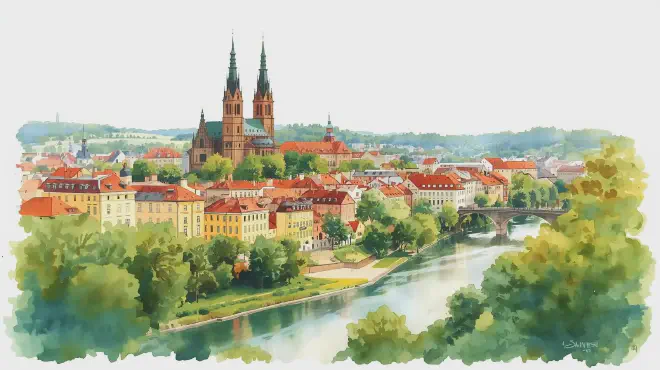
About 40 minutes north of Stockholm by train lies Uppsala, Sweden’s fourth-largest city, which has flourished since ancient times as a center of learning and faith. Uppsala University, founded in the 15th century and the oldest in the Nordic countries, has produced great scholars like Linnaeus and Celsius, and still educates over 20,000 students today. At the city’s heart stands the imposing Gothic cathedral, the largest in Northern Europe, its twin spires greeting visitors from beyond the green trees.
Though modest in size, this city possesses a unique atmosphere where the weight of history coexists with youthful intellect. Cobblestone streets that retain their medieval character, colorful wooden houses lining the Fyris River, and pastoral countryside spreading beyond the city limits. In autumn, Uppsala transforms as the trees turn golden and the clear Nordic light softly envelops the entire city.
I chose to visit this place because I longed for quiet time away from the bustle of life. Not a major tourist destination, but a place where genuine culture and history have taken root. During my brief three-day, two-night stay, I would come to experience Uppsala’s serene charm.
Day 1: Setting Foot on Cobblestones
I boarded the Uppsala-bound train from Stockholm Central Station just after 10 AM. Through the window, lakes and forests appeared in turn, gradually giving way to flat farmland. Sweden’s autumn is brief, and the trees were already transitioning from yellow to brown. The sky stretched high above, with thin clouds spreading across it. The train carried commuters, students, and what appeared to be tourist families.
Arriving at Uppsala Station, I was slightly surprised by how small the station building was. Yet this simplicity seemed to reflect the city’s honest character. I began walking straight down Bangårdsgatan from the station. On both sides of the street stood bookstores, cafés, and clothing shops for students, and despite being a weekday afternoon, there were many young people about. It had the vitality characteristic of a university town.
After about fifteen minutes, I reached my hotel. A small hotel near the old town, where the receptionist greeted me in fluent English. The room was simple but clean, with a window overlooking the courtyard of the neighboring apartment building. I dropped off my luggage and immediately set out to explore the city.
My first destination was Uppsala Cathedral, the city’s symbol. Construction began in the 13th century and took over 150 years to complete. This cathedral, with its twin towers reaching 118 meters high, is one of the largest Gothic structures in Northern Europe. As I approached, I caught my breath at its overwhelming presence. The red brick exterior walls had taken on deep hues with the passage of time.
Opening the heavy doors and stepping inside, I was greeted by cool air and silence. The ceiling was higher than I had imagined, and light filtering through narrow windows illuminated the stone pillars. Moving deeper inside, I found the tomb of King Gustav Vasa. This 16th-century king had dissolved the Kalmar Union and led Sweden to become an independent nation. Next to his tomb lay that of botanist Carl von Linné. He had established the binomial nomenclature system for naming the world’s flora and fauna, and had been a professor at Uppsala University.
Leaving the cathedral, I noticed a yellow building next door—Gustavianum. Built in the 17th century as Uppsala University’s oldest building, it now serves as a museum. On the top floor is an anatomical theater where one can glimpse the nature of medical education in those times. The circular theater was small, with steeply tiered seating where students must have leaned forward to observe dissections.
As the afternoon wore on and I began to feel hungry, I entered a small café near the cathedral. Called “Café Linné Hörnan,” it seemed to be beloved by locals. Looking at the menu, I saw open-faced sandwiches and soups. I ordered a smoked salmon open sandwich and coffee. On dark bread lay generous amounts of salmon, dill, and lemon. Simple, but the ingredients had robust flavor and it was delicious. Sitting by the window, I slowly ate my meal while watching people pass by on the street.
After leaving the café, I decided to walk along the Fyris River. The river flows gently through the city center, with colorful wooden houses lining both banks. Pink, yellow, red, green—like a scene from a picture book. Several small bridges crossed the river, and from them people gazed at the water’s surface, joggers ran past, and others walked their dogs. Autumn dusk comes early, and after 4 PM the light began to soften.
Walking upstream along the river, I eventually saw Uppsala Castle come into view. Built on a hill by King Gustav Vasa in the 16th century, it now serves as a museum and the county governor’s residence. From the castle’s front courtyard, I could see all of Uppsala spread below—the cathedral’s twin towers, university buildings, and forests in the distance. The wind had grown slightly colder.
For dinner, I chose a small restaurant in the old town called “Domtrappkällaren.” Located in a basement, this historical restaurant featured a stone-arched ceiling that created a wonderful atmosphere. The menu offered Swedish dishes, and I selected reindeer steak. It came with lingonberry sauce, mashed potatoes, and seasonal vegetables. The reindeer meat was more tender than I expected, and the sweet-tart lingonberries complemented it perfectly. I ate slowly and had just one Swedish beer.
Returning to the hotel, it was completely dark outside the window. I showered and lay down on the bed. The first day had been tiring with travel and walking, but it was a pleasant fatigue. A quiet city, gentle people, and the weight of history. My first impression of Uppsala was warmer than I had imagined.
Day 2: Linnaeus’s Garden and the Students’ City
In the morning, I had a simple Scandinavian breakfast in the hotel’s breakfast room. Rye bread, cheese, ham, boiled eggs, and coffee. Looking out the window, the sky was still dim, but the city was already in motion. Students cycling to class, an elderly man entering a bakery, people waiting for buses.
This day, I had planned to visit places associated with Carl von Linné. First, I headed to the Linnaeus Garden. The university’s botanical garden had been used by Linnaeus as teaching material during his professorship. After paying the entrance fee, I stepped inside to find the autumn garden spread before me. Summer’s brilliance had passed, but late autumn flowers bloomed quietly here and there.
The garden was neatly divided into sections, each planted with different species. These were descendants of plants Linnaeus had collected from around the world. Information boards displayed scientific names and classifications. The binomial nomenclature system he established is still used worldwide today. I was moved by how one scholar’s work has been carried forward for so long.
At the back of the garden stood the house where Linnaeus had lived, preserved as it was. A yellow wooden building, inside which period furniture and furnishings were displayed. His study held old books and specimens, and I could picture Linnaeus immersed in research here. Through the window, the garden was visible—he too must have gazed at his plants through this window. I felt a connection across time.
Leaving the garden, I next headed to the Linnaeus Museum. This was the estate where he spent his later years, located in a quiet area somewhat removed from the city center. Inside were displayed his personal effects, letters, and specimen collections. Particularly striking were records of field work he conducted with students. Walking through forests and wetlands around Uppsala, collecting and classifying plants. That patient accumulation of work laid the foundation for modern biology.
By the time I left the museum, it was past noon. Though early, I decided to have lunch and headed to a student cafeteria in the university district. Uppsala University has cafeterias open to the public where Swedish food can be enjoyed at reasonable prices. The day’s menu featured meatballs with mashed potatoes and lingonberry jam—a Swedish staple. The creamy sauce-covered meatballs had a simple, homestyle deliciousness.
Students sat in groups throughout the cafeteria, conversing in Swedish. Occasional laughter could be heard, creating a lively atmosphere. Eating among them, I felt a strange sensation, as if I too had become part of this university.
In the afternoon, I visited the university library, Carolina Rediviva. Built in the 17th century, this library is famous for housing the “Silver Bible,” known as the Codex Argenteus. A 6th-century Gothic Bible manuscript written in silver ink on vellum. Seeing the actual artifact in the exhibition room took my breath away. Letters written over 1,400 years ago still gleaming there.
I was also allowed to tour the library’s reading room. High ceilings, wooden shelves, students studying at long tables. In the silence, only the sound of turning pages echoed. This space was filled with reverence for learning that had continued for hundreds of years.
Leaving the library, I strolled through the campus. Uppsala University’s campus is scattered throughout the city, with historic and modern buildings mixed together. Students traveled by bicycle, sat on lawns deep in conversation, drank coffee in cafés. Everyone seemed natural and relaxed.
In the evening, I walked along the Fyris River again. This time in the opposite direction from yesterday, heading downstream. Along the river were small parks with people sitting on benches reading books or gazing at the water. I too sat on a bench and watched the flowing water. The evening sun reflected on the river’s surface, shining golden. The wind was cold but pleasant.
For dinner, I wanted something more casual and entered a seafood restaurant called “Hambergs Fisk.” This is a popular fish restaurant in Uppsala. I ordered a set of fried white fish with potatoes and remoulade sauce. The freshly fried fish was crispy, and the remoulade’s acidity was just right. I savored it slowly with a local beer.
On my way back to the hotel, I saw the illuminated cathedral emerging from the darkness. It had a solemn beauty different from daytime. The cobblestone streets were quiet, with only the occasional footsteps of passing people echoing. The second night deepened as I felt Uppsala had become more familiar than the first day.
Day 3: A Morning of Farewell and What I Carry Home
On the final morning, I woke a bit early. Outside the window, the world was still in twilight. That afternoon I would need to board the train back to Stockholm. Though my stay had been brief, I wanted to experience as much of Uppsala as possible before leaving.
After breakfast, I used the time before checkout to walk through the old town once more. The early morning city was quiet, with few shops yet open. I walked the cobblestone streets, passed by the cathedral, and proceeded along the riverside path. Though I had walked these same routes yesterday and the day before, they showed me different expressions each time.
I happened to notice a small bakery that was open. “Güntherska,” an old café and bakery established in 1850. Entering, the aroma of freshly baked bread filled the air. In the display case sat cinnamon rolls, cardamom rolls, princess cakes, and other traditional Swedish pastries. I ordered a cardamom roll and coffee and sat at a small table inside.
The cardamom roll was fluffy and sweet, with cardamom’s fragrance filling my mouth. The coffee was dark roasted, perfectly complementing the pastry. Outside the window, the city was gradually waking up. People buying breakfast at the bakery, walking dogs, commuting to work. An ordinary yet certain daily life unfolding there.
I returned to the hotel, packed my luggage, and checked out. I still had time before my train, so there was one more place I wanted to visit. Gamla Uppsala—“Old Uppsala.” A Viking-era site located a few kilometers north of the city center.
Taking a bus for about 20 minutes through peaceful rural scenery, I arrived at Gamla Uppsala. Here stood three large burial mounds where Swedish kings from the 6th and 7th centuries are said to be buried. The mounds looked like small hills covered in grass, with no fences or barriers around them. They simply existed there, quietly.
I climbed one of the hills. From the top, I could see green pastures and forests spreading out. The wind was strong, making the grass undulate. Here, nearly 1,500 years ago, Nordic people had lived, fought, prayed, and died. This was before Christianity arrived, when the gods of Norse mythology were believed. Now tourists were sparse, and only silence remained.
Near the mounds was a small museum displaying artifacts and details of life from that era. Weapons, ornaments, everyday tools. They too had lived, loved, and worried just as we do. Times change, but human nature remains constant. Thinking such thoughts, I left the museum.
Returning to Uppsala’s center, I had my final lunch before heading to the station. At a café near the station, I ordered a Swedish-style meat pie and soup. Simple but warm food. Outside the window, trains were arriving and departing. The journey’s end was approaching.
Just after 2 PM, I stood on the platform at Uppsala Station. The Stockholm-bound train pulled in. Doors opened, passengers disembarked. I boarded the train and took my seat. As the train began moving, the city of Uppsala slowly receded. The cathedral’s spires were visible between the trees. Eventually even that disappeared, and only forests and fields filled the window.
Though only a three-day, two-night stay, Uppsala had given me much. The weight of history, reverence for learning, the beauty of quiet daily life, and the gentleness of its people. This city, not a major tourist destination, possessed genuine charm. Not flashiness, but depth. Not superficial enjoyment, but experience that quietly permeated the heart.
The train continued toward Stockholm. I rested my forehead against the window, gazing at the passing scenery while ruminating on my time in Uppsala.
Certain Memories from Within Imagination
This journey never actually took place. I never walked Uppsala’s cobblestones, never stood enveloped in the cathedral’s silence, never gazed at plants in the Linnaeus Garden—all of it exists only in imagination.
Yet through the process of imagining this journey, Uppsala became real within me. The Nordic region’s oldest university, the Gothic cathedral, colorful houses along the Fyris River, Linnaeus’s legacy, and Viking-era burial mounds. These are all actual places, actual history.
Travel is not merely moving from place to place. It is feeling a land’s atmosphere, touching its history, tasting its culture, and confronting oneself. Even if only in imagination, by imagining sincerely, researching, and feeling, a journey becomes real within the heart.
Someday I may truly visit Uppsala. When that time comes, what I felt during this imaginary journey will overlap with actual experience, bringing deeper understanding. Or perhaps I will never actually visit. Even so, this imaginary journey will remain within me.
The boundary between imagination and reality is perhaps more permeable than we think. What matters is not whether we physically stood in a place, but whether we truly tried to understand and feel it. In that sense, this journey to Uppsala was undoubtedly real—a journey that happened within my heart.