
A Quiet Town in Western Serbia
I first heard the name Užice while studying a map of the Balkan Peninsula. This small town in western Serbia, near the border with Bosnia and Herzegovina, nestles at the foot of the Dinaric Alps like a secret waiting to be discovered.
The name Užice comes from a Slavic word meaning “narrow place.” Indeed, the town developed along a deep gorge carved by the Đetinja River, surrounded by verdant hills on all sides. With a population of about 80,000, Užice has grown as an industrial city in Serbia, yet it retains the charm of abundant nature and ancient history.
Particularly intriguing is its role during World War II as a partisan stronghold. Between 1941 and 1943, Tito’s Yugoslav Partisans established the “Republic of Užice,” a liberated territory in this region. What face would this town, marked by such turbulent history, show today?
But more than anything, I chose this place because it seemed to offer a glimpse into authentic Serbian life, untouched by heavy tourism. Unlike the major cities of Belgrade or Novi Sad, a quieter, gentler rhythm of time surely flows here.
Day 1: Embracing the Gorge
After a three-hour bus ride from Belgrade, the morning light painted the mountains in pale hues as our bus began its winding descent. The landscape outside gradually took on the character of a gorge, and soon a small town appeared, buildings dotting the riverside. That was Užice.
Stepping off at the bus terminal, cool mountain air brushed my cheeks. The late April morning was still chilly, and I was glad for my light jacket. In the small square near the station, elderly men sat on benches with morning coffee, exchanging gentle conversation. This scene seemed to speak volumes about the pace of time in this town.
Walking toward Hotel Pari, my accommodation, I passed through the town center. The main street wasn’t large, but beautiful 19th-century buildings lined the cobblestone road. The cream and pastel-colored facades, reminiscent of Austria-Hungary’s influence, glowed beautifully in the morning sun. Here and there, bullet marks and repair scars quietly told the story of this town’s complex history.
After checking in and dropping my luggage, I ventured out again. Wanting to grasp the town’s overall character, I asked locals for directions to the viewpoint on Šumarice hill. A gentle thirty-minute uphill walk from the center gradually opened up the surrounding landscape.
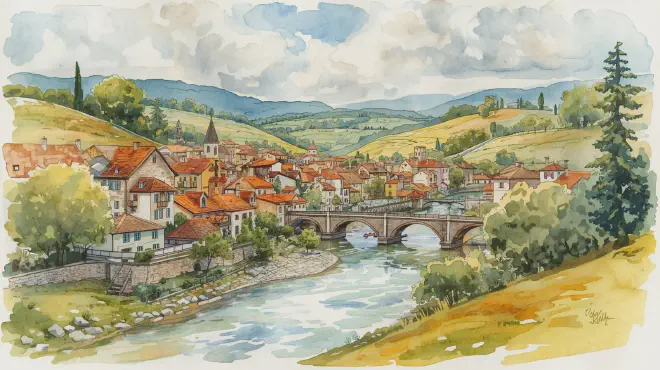
I reached the viewpoint just after noon. The vista of Užice spread below was more beautiful than I’d imagined, with the Đetinja River tracing an elegant S-curve through the valley. Red-roofed houses on both banks, green hills beyond, and mountains in the distance—a peaceful, pastoral landscape characteristic of Serbia’s interior.
I had lunch at a small restaurant near the viewpoint called “Kod Mile,” recommended by a local. Here I tried my first Serbian meal, ordering Ćevapi—small sausage-like grilled meat. The charcoal-grilled meat was aromatic, served with onions, paprika, and kaymak, a rich cream cheese-like condiment. Wrapped in somun, a flat bread, the simple yet deep flavors filled my mouth.
The owner, mixing in bits of English, enthusiastically explained the dish. “Ćevapi is the heart of Serbia,” he said. Indeed, this humble, warm taste seemed to reflect the character of the people here.
In the afternoon, I wandered slowly through the historic quarter. At the heart of the old town stood St. Mark’s Church (Crkva Svetog Marka), a beautiful Serbian Orthodox church built in the 19th century. Inside, the golden iconostasis radiated solemnity. The faces of saints illuminated by candlelight were serene yet mystical.
Near the church, I found the Museum of National Liberation (Muzej narodnooslobodilačke borbe). This museum, dedicated to the Yugoslav Partisans’ activities during World War II, revealed Užice’s turbulent history. The fact that this small town functioned as “free territory” from 1941 to 1943 was both fascinating and sobering. The displayed photographs, documents, and weapons conveyed the desperate resistance of those times.
In the evening, I strolled along the promenade by the Đetinja River. The river flowed more abundantly than I’d expected, its clear waters making a pleasant sound. Benches dotted the path where locals enjoyed the evening air. An elderly couple walking hand in hand, a family with a dog, a man with his fishing line—each scene was ordinary yet somehow heartwarming.
Walking along the river, I discovered a small café called “River Side.” From a terrace table overlooking the flowing water, I ordered Serbian coffee. The strong coffee in a small cup was meant to be savored slowly with sugar. At the next table, elderly local men played backgammon. Their laughter mixing with the river’s murmur made me feel the peaceful daily life of this town.
For dinner, I went to a homey restaurant near my hotel called “Zlatna Moruna.” I ordered Karađorđeva šnicla, a Serbian-style schnitzel. Pounded thin pork wrapped around kaymak and ham, then fried—it was hearty yet surprisingly light. The roasted potatoes and seasonal vegetables balanced the dish perfectly.
The restaurant owner spoke almost no English, but welcomed me warmly with gestures and smiles. The dessert palačinke—thin crepes filled with jam and walnuts—had a simple sweetness that touched my heart.
Late that night, I opened my hotel room window to let in the cool mountain breeze. In the distance, church bells marked the hour, and the town was wrapped in silence. On this first day, I’d already begun to feel this town’s special charm. Not flashiness or excitement, but a quiet, deep satisfaction—like small moments of happiness hidden within daily life.
Day 2: Wrapped in Nature and Tradition
On the second morning, I woke to birdsong. Outside the window, stars still faintly dotted the dim sky as the sun prepared to rise over the eastern mountains. Unlike last night’s coolness, today promised warmth.
I had breakfast in the hotel dining room. Serbian breakfast was simpler than I’d expected: bread with ham, cheese, and local plum jam. Particularly memorable was the rich flavor of kaymak. Spread on dark bread, it made a simple yet satisfying morning meal.
Today’s plan was to enjoy the nature around Užice. I took a local bus to the entrance of Drina River National Park. Inside the bus, locals’ daily conversations filled the air. Though I couldn’t understand Serbian, the sound had a welcoming quality.
The hiking trail along the Drina River was more beautiful than I’d imagined. The river was a deep emerald green, with forests on both banks reflected in the water. The April forest was still in its early green phase, young leaves vivid to the eye. Walking among beech and oak trees, I occasionally heard birdsong and sensed the presence of small animals.
A local hiker I met explained forest plants in broken English. “This flower is primrose, it announces spring’s beginning,” he said, pointing to small yellow flowers. His name was Miloš, and he hiked this forest every weekend. “City life is too busy. Coming here quiets my mind,” he said with a peaceful expression.
After about two hours of hiking, I had lunch at a small rest stop by the river. I ordered fish from the river—trout caught in the Drina, simply grilled with salt and herbs. The flesh was tender with a refined taste. All the accompanying vegetables were local, and the tomatoes and cucumbers had intense flavors that let me enjoy the ingredients’ natural taste.
In the afternoon, I visited a nearby village to see traditional crafts. The area around Užice has long been known for woodwork and textiles, with traditional techniques still practiced today. In a small workshop, an elderly craftsman made wooden spoons and plates by hand. His movements were smooth and confident, showing years of experience.
“This is the technique my grandfather taught me,” the craftsman said. “Machines work faster, but handmade things have a soul.” His creations indeed had warmth, showcasing the wood’s texture and grain beautifully. I purchased a small wooden bowl, feeling it held value beyond a mere souvenir.
At the textile workshop, women were embroidering traditional patterns. The geometric designs in red and white are also used on Serbian folk costumes, they explained. The sight of their careful stitching was beautiful, and the delicacy of the finished work left me mesmerized.
On the way back to town in the evening, I stopped at a small market. Fresh vegetables and fruits brought by local farmers, handmade cheese and honey filled the stalls. Particularly eye-catching were colorful bell peppers—vivid reds, yellows, and greens, all large and heavy. An elderly woman let me taste a pepper; it was sweet and juicy.
At the market, communication worked through gestures even without shared language. Point at an item to ask the price, and they’d show you on a calculator. The smiles when giving change and the exchange of “hvala” (thank you) revealed the warmth of communication beyond words.
For dinner, I went to “Konoba Stari Grad,” a traditional restaurant recommended by locals. The interior, converted from an old stone building, created a cozy atmosphere with warm lighting and wooden furniture.
I ordered Sarma, a representative Serbian stew. Cabbage leaves wrapped around rice and meat, then simmered—it had a gentle sourness and deep umami. One bite, and the warmth of home cooking spread through my mouth. I imagined this was a family recipe passed from mother to daughter.
For dessert, I ordered Lukma, small donut-like fried pastries. Served warm with syrup poured over them, they had a crispy outside and fluffy inside. The sweetness was moderate, pairing well with after-dinner coffee.
Leaving the restaurant, I found a small concert happening in the town center. A local music group was performing traditional Serbian music. The accordion, guitar, and voices created music with a somehow nostalgic sound. The audience, mainly locals, clapped along or sang together.
Watching this scene, I felt I’d touched a small part of this town’s life. What major cities lack—community bonds and cultural continuity—lived here. This wasn’t a show for tourists but part of their daily life.
Walking back to the hotel, I looked up at the night sky. Stars filled the heavens in a way impossible to see in cities. The Milky Way faintly visible, I truly felt the beauty of this mountain-ringed town’s night. Opening my room window to breathe the outside air, a refreshing breeze scented with forest entered. The day’s experiences of abundant nature and warm people resonated quietly in my heart.
Day 3: Morning of Farewell and What Remains
On the final morning, I woke earlier than usual. It was still before sunrise, but I felt a strong desire to etch this town’s landscape into my heart once more. After getting ready, I stepped outside to find the streets wrapped in silence. The early morning air was cold and clear; taking a deep breath, I felt pure air reaching deep into my lungs.
Walking along the Đetinja River promenade, I reflected on these two days. The quiet charm I felt on the first day had deepened through yesterday’s experiences. This town’s beauty wasn’t in grand tourist attractions but in small discoveries within daily life and modest human connections.
Sitting on a riverside bench, watching the slowly flowing water, I passed early morning joggers. Exchanging “Dobro jutro” (good morning), everyone returned warm smiles. Though we shared no common language, those momentary exchanges truly touched my heart.
After breakfast, I went out for a final walk with the remaining time. Exploring back alleys of the old town I hadn’t yet visited, I found old stone houses standing in rows. Colorful flowers decorated window sills, and laundry fluttered in courtyards. These everyday scenes conveyed the beauty of real life, different from the manufactured beauty of tourist destinations.
In a small alley, I saw an elderly woman sitting on her front steps, knitting. She noticed me and waved cheerfully. Approaching to greet her, she indicated through gestures that she was knitting a sweater for her grandson. Though it would take more time to finish, I could sense the love woven into every stitch.
On my way back to the town center, I found a small bookstore. Shelves were packed with Serbian books, but I also found a few in English. The owner, a young man, spoke to me in fluent English: “Thank you for taking interest in our town.”
According to him, because Užice sees few tourists, encounters with visitors are precious. “There’s a real Serbia here that you can’t experience in big cities,” he said proudly. Indeed, what I’d felt over these two days was an unspoiled simplicity and its resulting authentic charm.
For lunch, I returned to the “River Side” café I’d visited on the first day. This time I ordered Čorba, a traditional Serbian soup. This soup of simmered vegetables and meat had a gentle flavor that warmed the body. As my last meal, I wanted to imprint this town’s taste into my memory.
Eating while watching the river flow, I realized my feelings had changed from two days ago. On the first day, curiosity about an unknown land was strong, but now alongside the sadness of parting, I felt an attachment to this town emerging. Even a short stay can create an emotional connection to a place—I understood this viscerally.
In the afternoon, as the time for the Belgrade bus approached, I collected my luggage from the hotel and headed to the terminal. At checkout, the receptionist said in broken English, “Please come again.” Those words resonated in my heart.
At the bus terminal, several locals were saying goodbye to family and friends seeing them off. Watching these scenes, I felt as if I’d become part of this town too. When the bus arrived, I loaded my luggage and took my seat, the scenery outside the window feeling precious.
As the bus pulled away, the streets of Užice gradually grew smaller. The valley’s greenery, the river’s sparkle, the roofs of old buildings—all engraved themselves deeply into memory. Climbing the mountain road, I looked back to see the whole town appearing like a beautiful painting.
During the three-hour journey, watching the landscape flow past the window, I thought about what I’d gained from this trip. Beautiful nature, historic buildings, delicious food, and above all, encounters with warm people. All of these formed the charm of the town called Užice.
Particularly impressive was the experience unique to a place that’s not a tourist destination. I could touch a bit of locals’ daily lives and feel their lifestyle and culture more intimately. This was a raw experience that prepared programs cannot provide.
Through this journey, I realized that the value of travel doesn’t necessarily lie in visiting famous tourist sites. Even in small towns, the lives of people there and the culture and landscapes built over long periods have unique charm and value. Discovering and savoring these might be travel’s true pleasure.
By the time I arrived in Belgrade, twilight had already begun. The big city’s bustle returned, but Užice’s quietness remained in my heart. It would become a precious memory that would never fade.
What Was Felt Though Imaginary
This travel narrative is an imaginary journey not actually experienced. Yet, as I wrote, I felt a sensation as if the town of Užice truly existed and those three days and two nights really happened.
The small town of Užice in western Serbia. Located at the foot of the Dinaric Alps with the Đetinja River flowing through it, this town is a real place. The partisan history, beautiful nature, traditional cuisine and crafts, and warm people—all exist in reality.
Why does this imaginary journey feel so real? Perhaps it’s because the essence of travel lies in encounters with new places and cultures, and dialogue with one’s own inner self. Even without physically going, it’s possible through imagination to touch a land’s charm and recreate in one’s heart the experiences it might offer.
Moreover, through this imaginary journey, universal emotions emerged: longing for travel, expectations, and yearning for human connection. These emotions remain unchanged whether in actual or imaginary travel, and that’s why the imaginary feels tangibly real.
The journey to Užice ultimately became an inward journey to contemplate the meaning of travel itself. Longing for new places, curiosity about unknown cultures, desire for human connection—all of these are engraved in my heart as travel memories that feel real though imaginary.
If someday I truly visit Užice, I’d like to see how this imaginary journey overlaps with and differs from reality. Perhaps there will be moments when imagination exceeds reality, or reality might far surpass imagination.
Until then, I’ll cherish this imaginary journey’s memories in my heart. The murmur of the Đetinja River, the refreshing mountain breeze, the aromatic scent of Ćevapi, and the warm smiles of people I met. All feel as if they truly happened—irreplaceable travel memories.