
A Memory Carved by Cosmic Fire
In southern Germany, nestled within the Swabian administrative district of Bavaria, lies Wemding—a small town perched on the rim of the Ries Crater, a geological wonder formed fifteen million years ago when a celestial body struck the earth. The crater stretches approximately twenty-four kilometers in diameter, now transformed into a fertile basin cradling villages, farmland, and forests that have long forgotten the violence of their origins.
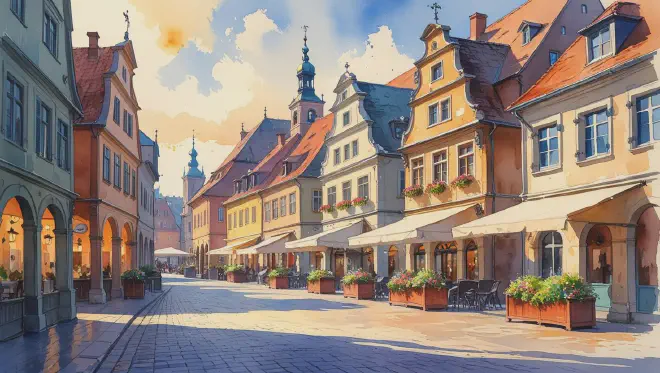
The town itself preserves the essence of medieval Bavaria. Half-timbered houses line cobblestone streets, their white-plastered walls crossed with dark wooden beams. With a population of roughly five thousand, Wemding remains untouched by the rush of modern tourism, holding fast to the quietude that has defined it for centuries. As autumn settles over the region, the surrounding forests turn to gold and amber, and the landscape—shaped by that ancient cosmic collision—becomes a stage for the season’s fleeting beauty.
About an hour by regional train from Augsburg, north of the Danube, this region is known as the Riesland—a name that speaks to its unique geological and cultural identity. The flat expanse of wheat fields and pastures bears witness to the crater’s legacy: soil enriched by the impact, supporting generations of farmers who have worked this land. Here, over the course of three days, I would find myself tracing the intersection of cosmic history and human life, discovering silence and small revelations in equal measure.
Day 1: Arrival and the Rhythm of the Town
The regional train pulled into Wemding station at half past eight in the morning. Stepping onto the platform, I was met by autumn air so clean it seemed to wash through me. In the distance, a church spire rose above the rooftops, and before the small station building, a few taxis and bicycles waited in the quiet. The walk to the town center would take no more than fifteen minutes.
The cobblestones underfoot clicked softly as I made my way through streets still wrapped in morning stillness. Sunlight fell across white walls and half-timbered facades, and windowsills displayed red geraniums in wooden flower boxes. An elderly woman passed me carrying a heavy shopping bag, offering a warm “Guten Morgen” and a gentle smile—the first of many small kindnesses I would receive.
By ten o’clock, I reached the square before the town hall. The building itself dated to the sixteenth century, its baroque facade bearing the town’s coat of arms. An old stone well stood at the center of the square, surrounded by benches where locals sat in quiet conversation. There were no tourists to speak of—only residents beginning their day, walking dogs or pausing to greet neighbors.
My lodging, the Gasthof zur Post, lay five minutes from the square. A family-run inn operating since the 1800s, the building itself seemed to breathe history. Frau Müller, the owner, greeted me in fluent English, her warmth immediate and genuine. Though check-in was hours away, she took my luggage and encouraged me to explore. My room on the third floor offered a view across the rooftops to the green hills beyond.
Lunch was taken at Zum Hirsch, a traditional Gasthaus facing the square. Heavy wooden tables filled the interior, and paintings of local landscapes hung on the walls. The menu featured Swabian specialties, and I ordered Spätzle with roast pork—the hand-rolled pasta soft and rich, the meat tender, the sauerkraut sharp enough to cut through the heaviness. A glass of local beer completed the meal. Herr Ernst, the proprietor, explained the recipe had been handed down from his grandmother, and spoke of it with quiet pride.
In the afternoon, I walked to the Church of St. Emmeram on the edge of town. Built in the twelfth century in Romanesque style, the interior held faded frescoes that seemed to glow in the dim light. The churchyard occupied a hill, and from there the whole of Wemding spread below—rooftops clustered around the church spire, and beyond, the gentle arc of hills marking the crater’s rim. Standing there, I felt the weight of fifteen million years pressing lightly against the present.
Returning to town as evening approached, I stopped at Bäckerei Schmidt, a small bakery where the scent of fresh pretzels and rye bread filled the air. The baker’s daughter explained their traditional Roggenbrot—a dense black bread made in this region for centuries. Its flavor was earthy and faintly sour, satisfying without butter or accompaniment. I bought a small loaf to keep.
After checking in properly, I found my room clean and simply furnished, the old wooden pieces lending a sense of calm. Opening the window, I heard the evening sounds of the town: church bells marking the hour, a dog barking somewhere distant, the murmur of voices from the street below. After years in cities, this quiet felt almost startling.
Dinner was served in the inn’s small restaurant. Frau Müller’s cooking carried the warmth of home—Sauerbraten, the beef marinated in vinegar until tender, served with boiled potatoes and cabbage. Simple ingredients, prepared with care. Afterward, she offered a small glass of Schnaps, the local fruit brandy. It burned gently going down, leaving behind a warmth that spread slowly through my chest.
From my window that night, I watched lamplight fall on cobblestones, and soft glows escape from curtained windows. The silence was not empty but full—full of centuries, full of lives lived quietly within these walls. Somewhere out there, the crater held the memory of fire and collision, now transformed into this peaceful basin where people had made their homes. The first night in Wemding passed slowly, and I was grateful for its unhurried pace.
Day 2: The Land’s Memory and the Warmth of Its People
Church bells woke me at half past six. Opening the window, I found the town wrapped in morning mist, the air cold and impossibly clean. I decided to walk before breakfast, while the streets remained empty.
My footsteps echoed on the cobblestones. Occasionally I passed a shopkeeper heading to work or someone walking a dog, but otherwise the town belonged to the mist and to me. The half-timbered houses emerged from the fog like images from an old painting, their outlines softened, their colors muted. It felt less like walking through a town than through a memory.
Breakfast at the inn was substantial: bacon and eggs, the black bread I had bought the day before, local butter and jam, and strong coffee that warmed me from the inside. Frau Müller mentioned that a harvest festival would be held at a nearby farm that day—a gathering of local families to celebrate the season. When I expressed interest, she offered to accompany me.
We set out at ten o’clock, walking east through fields that stretched golden under the clearing sky. Wheat and barley swayed in the breeze, and cattle grazed in distant pastures. The fertility of the Ries Crater basin was evident everywhere—this soil, enriched by ancient catastrophe, had sustained farming communities for generations. The walk took about thirty minutes, and by the time we arrived, the farm’s courtyard was already filling with people.
Long tables had been set up in the open air, and women were preparing traditional dishes in the kitchen. Herr Bauer, the farm’s owner, was a man in his seventies with a gentle manner. His family had worked this land for three generations, and he spoke of the crater’s soil with something approaching reverence. “The impact that made this place,” he said, “also made it possible for us to live here.”
The festival began with a blessing from the local priest, followed by traditional dances. The older men wore Lederhosen and felt hats; the women dressed in Dirndls, the bow of their aprons indicating marital status. Children in miniature versions of the same costumes imitated the adults’ steps, laughing when they stumbled. There was no performance in it—only the natural continuation of customs passed down through generations.
The midday meal was shared at the long tables: Schweinebraten, roasted pork with crackling skin; Knödel, the soft bread dumplings; and Rotkohl, braised red cabbage. Everything tasted of home cooking—unpretentious, deeply satisfying. Local Franconian wine was poured generously, its dry white character reflecting the region’s climate and soil. I ate slowly, watching families laugh and children run between tables, feeling the warmth of a community that had known each other for lifetimes.
In the early afternoon, Herr Bauer showed me around the farm. In the barn, brown Fleckvieh cattle stood placidly—a Bavarian breed known for quality milk and gentle temperament. He had named each one, he told me, as his father and grandfather had done before him. The continuity of care was evident in the animals’ calm.
Behind the farm, a low hill offered a view across the entire crater basin. The circular depression stretched to the horizon, its edges rising into gentle ridges that marked the rim. Herr Bauer recalled learning as a child that this landscape—so familiar, so ordinary to him—had been formed by a visitor from space. “It seemed impossible,” he said. “But then I understood: without that collision, none of this would exist. Not the soil, not the farm, not us.”
Walking back toward town in the late afternoon, I stopped at the Maria Hilf Church, a small baroque structure from the eighteenth century. Inside, white walls set off gilded decorations, and a statue of Mary stood at the altar. Evening light filtered through stained glass, casting colored patterns across the floor. The silence felt sacred—not oppressive but welcoming, like a held breath.
Outside the church, an elderly man sat alone on a bench. His name was Hans, and he had lived in Wemding all his life. He spoke of the war years, of times when the town had been quieter still, of neighbors who had known each generation of his family. “The young people leave for the cities now,” he said, a note of sadness in his voice. “But the beauty remains. The peace remains. I’m glad when visitors can feel it.”
Back at the inn, I told Frau Müller about my day. She smiled when I described the festival, the food, the conversations. “The real treasure of Wemding,” she said, “is not the buildings or the landscape. It’s the people who live here, and how they care for one another.”
After dinner, I walked through the town center once more. Night transformed the streets—lamplight on stone, laughter spilling from a restaurant window, the occasional figure crossing a square. Yet even these sounds seemed to belong to the quiet, absorbed into it rather than breaking it. In my room later, reviewing the day, I realized that the harvest festival had shown me something essential: Wemding was not a museum but a living place, where the weight of history and the warmth of community existed together, inseparable.
Day 3: Departure and What Remains
I rose before dawn on my final morning, determined to see the sunrise from the hill by St. Emmeram’s Church. At six o’clock the sky was just beginning to lighten, and I made my way through streets still sleeping. The path to the churchyard was familiar now, and I climbed it in near darkness.
From the cemetery, I watched the sun rise over the crater basin. The first light touched the distant hills, then spread across the valley, turning the morning mist to gold. The entire landscape seemed to glow—fields, forests, rooftops, all held in that brief perfection of early day. Birds began to sing, and at half past six the church bells rang, as they had rung for centuries, marking another morning in this small corner of the world.
On my way back, I passed Herr Schmidt opening his bakery. He remembered me and asked if today was my last. When I nodded, he wrapped a loaf of Roggenbrot and pressed it into my hands. “Remember this taste,” he said. The kindness caught me off guard, and I thanked him more than the gift required.
Breakfast was quiet. Frau Müller had prepared everything with particular care, as if knowing it was farewell. Afterward, I settled my bill and gathered my things. She handed me a small box of homemade cookies. “For your journey,” she said. “So you remember Wemding when you eat them.” Three days had passed, yet she had treated me like family. That warmth, more than any sight or meal, would stay with me longest.
Before leaving, I walked once more through the center of town. The square with its old well, the half-timbered facades, the church spire against the morning sky—everything had become familiar. It seemed impossible that only three days had passed; the town had settled into me as if I had known it far longer.
Near the station, I stopped at a small shop called Dorf-Laden. The owner, Frau Wagner, was in her eighties and had run the place for over fifty years. The shelves held everything from household goods to handmade crafts, arranged with a logic known only to her. She spoke at length about the town’s history, about the discovery of the crater’s origins, about changes she had witnessed over decades.
“What makes this place special,” she said, “is the stillness that came from something enormous. A meteorite fell, the earth changed, and people eventually made their lives here. Slowly, without rushing, following nature’s pace.” Her words stayed with me—a reminder that even catastrophe can become foundation, given enough time.
At eleven o’clock, I said goodbye to Frau Müller outside the inn. She wished me safe travels and repeated her hope that I would return. The walk to the station felt different from my arrival—each cobblestone, each flower box, each distant rooftop now carried meaning. The town had written itself into me, quietly and completely.
On the platform, waiting for the train, I looked back toward Wemding. The church spire rose above the houses, and beyond them the hills traced the crater’s ancient edge. It was an ordinary scene—a small German town under a pale autumn sky—yet it held fifteen million years of history and countless generations of human life. The train arrived, and I took a seat by the window. As it pulled away, the town grew smaller, but inside me it remained vivid and whole.
Waiting for my connection in Augsburg, I ate one of Frau Müller’s cookies. The taste of butter and simple sweetness brought back the breakfast table, her kind face, the quiet mornings. Taste, I realized, is the most reliable keeper of memory.
A Journey Imagined, Yet Somehow True
This three-day journey took place entirely within my imagination. I have not walked the cobblestones of Wemding, nor tasted Frau Müller’s Sauerbraten, nor watched the sunrise from St. Emmeram’s hill. And yet—the town exists. The Ries Crater is real, formed by an impact fifteen million years ago. The traditions of Bavaria continue in villages across the region. The warmth of small communities, where neighbors know each other’s names and histories, persists in places untouched by modern haste.
Travel is not only movement through space. When the mind engages, when curiosity leads to discovery, when something shifts inside us—that too is travel. In imagining Wemding, I found myself changed: more aware of how cosmic events shape daily life, more appreciative of communities that preserve tradition without performance, more attuned to the way time accumulates in old stones and familiar rituals.
Perhaps one day I will make this journey in the flesh—walk those streets, taste that bread, hear those bells. Until then, the imagined version remains vivid. The cobblestones, the morning mist, the harvest festival’s laughter, the baker’s gift of bread. These things live in me now, as real as any memory of a place I have actually been.
That, perhaps, is the truest testament to a journey that never was: it feels, somehow, as though it happened.