
The Country Called Armenia
Armenia. Just speaking this name warms something deep inside my chest. A small landlocked nation south of the Caucasus Mountains. Known as the first country in the world to adopt Christianity as its state religion, it is a land of ancient civilization that has inscribed thousands of years of history.
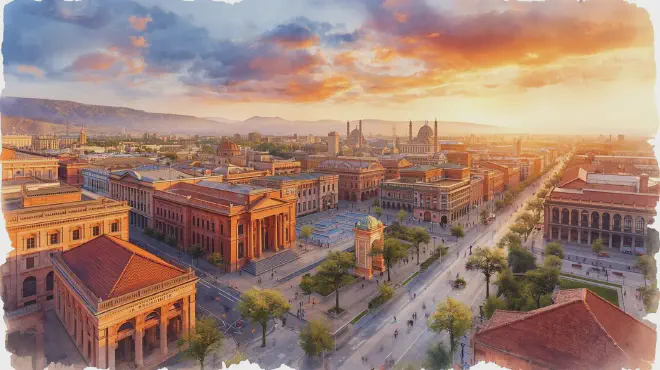
The capital, Yerevan, is said to have been established as a fortress city of the Urartian Kingdom in the 8th century BCE, and is counted among the world’s oldest cities. This city, spreading across a highland overlooking Mount Ararat, is characterized by buildings constructed from red and pink tuff stone, earning it the nickname “Pink City.”
Most Armenians carry in their hearts the memory of the 1915 genocide by the Ottoman Empire, yet they continue to carefully preserve their rich culture and traditions. The unique Armenian alphabet, beautiful church architecture, and above all, warm hearts that cherish family. I wanted to touch, even a little, the lives of the Armenian people. With that thought, I decided to visit Yerevan alone.
Day 1: First Steps into the Pink City
The moment I landed at Zvartnots International Airport in Yerevan, dry air brushed against my cheeks. It was an October afternoon, and though the sun was still high in the sky, the air already carried hints of autumn. Through the taxi window on the way to the city, I could see the magnificent form of Mount Ararat towering in the distance. The driver, Armen, told me in broken English, “Mount Ararat is the homeland of our hearts.” Currently within Turkish territory, it’s a mountain that Armenians can see but cannot climb. That complex emotion lingered beneath his voice.
After checking into my hotel, I first headed to Republic Square in the city center. The slanting evening light painted the surrounding buildings a beautiful rose color. The buildings encircling this square are all constructed from locally-sourced tuff stone, creating a beautifully unified landscape. The National History Museum, the National Gallery, and government buildings surround the square, with a large fountain at its center.
Around the fountain, families enjoying the evening cool, couples, and friends had gathered. Watching children reach out their hands to play in the fountain’s spray, I felt the warmth of everyday life that’s the same in any country. Though I couldn’t understand the conversations in Armenian, laughter and children’s voices are universal languages.
As night approached, a music and light show began at the fountain. The interplay of water and light dancing to classical music was more beautiful than I had imagined, stopping many tourists and locals in their tracks. An elderly woman sitting next to me smiled and said in fluent English, “This is our pride.” Her name was Ani. She had lived in France for many years but had recently returned to her homeland.
At Ani’s suggestion, we headed to a traditional restaurant nearby called “Taverna Yerevan.” Inside the stone building, decorated with Armenian carpets and traditional crafts, warm lighting enveloped the space. She recommended kebab and dolma, staples of Armenian cuisine. The kebab was completely different from what I’d had in Japan—spiced ground meat carefully grilled over charcoal, filling my mouth with the umami of meat and the aroma of smoke. Dolma, a dish of rice and ground meat wrapped in grape leaves, had an impressive refreshing taste with a pleasant sourness.
“The characteristic of Armenian cuisine,” Ani explained, “lies in its unique flavor born from our geographical position at the boundary between the Middle East and Europe.” Indeed, while the spices and herbs used evoked Middle Eastern influences, the cooking methods and presentation breathed with European refinement.
After dinner, I parted with Ani and walked the nighttime streets alone. Though the fountain show at Republic Square had ended, the cafes and restaurants around the square were still bustling. Armenians seemed to enjoy staying up late, as many people were still walking the streets past 10 PM. Watching this scene, I felt I was beginning to glimpse the rhythm of life in this city.
On my way back to the hotel, I passed a small church. The cross-shaped silhouette floating in the darkness looked divine, illuminated by the city lights. With its characteristic Armenian Apostolic Church architecture—a conical roof rather than a spire—it was a beautiful building. From the building’s presence, I could sense the deep faith of this country where Christianity has been rooted for over 1,700 years.
On this first night, I fell asleep enveloped in anticipation of tomorrow and a premonition of the profound charm this land holds.
Day 2: A Day Touching Faith and Art
In the morning, Mount Ararat, visible from my hotel window, glowed golden in the morning sun. The sacred mountain, standing 5,165 meters tall, is depicted on Armenia’s coat of arms—a symbol of the nation. While eating breakfast, I confirmed today’s plan: Etchmiadzin Cathedral in the morning, followed by the Matenadaran Institute of Ancient Manuscripts and Geghard Monastery in the afternoon.
Etchmiadzin was about 20 kilometers west of Yerevan—a 40-minute journey by minibus. The landscape from the window showed peaceful rural scenery with golden wheat fields and vineyards. I could feel the richness of Armenian soil.
Etchmiadzin Cathedral, built after Armenia adopted Christianity as its state religion in 301 CE, is known as the first church constructed in the country. The current building, reconstructed in the 7th century, functions as the mother cathedral of the Armenian Apostolic Church. Its heavy exterior of red tuff stone evoked the weight of 1,700 years of history.
Stepping inside the cathedral, I was enveloped in solemn silence. Beautiful frescoes adorned the high ceiling, and a gold-decorated altar shone divinely. It was morning prayer time, so the chants of monks in black vestments echoed through the hall. Though I was hearing Armenian liturgical chanting for the first time, its beautiful melody resonated in my heart beyond the barrier of language.
After prayers, I strolled through the cathedral gardens. In the quiet garden dotted with ancient gravestones, I found a stone monument inscribed with letters from over a thousand years ago. Feeling the flow of time, I was overwhelmed by the weight of history this place holds.
In the afternoon, I returned to Yerevan and visited the Matenadaran Institute of Ancient Manuscripts. This museum boasts one of the world’s largest collections of ancient manuscripts, housing approximately 17,000 manuscripts written between the 5th and 18th centuries. The beautifully decorated manuscripts written in Armenian script were truly works of art.
Particularly impressive was a 13th-century Gospel manuscript. The colorful illustrations on parchment still radiate beauty after more than 700 years. Though I couldn’t read the text, its beauty required no words. According to the curator’s English explanation, these manuscripts have played an important role in preserving Armenian national identity.
After the museum visit, I took a taxi to Geghard Monastery, about 40 kilometers from Yerevan. Built deep in a mountain gorge, this monastery, established in the 4th century, is an important holy site of the Armenian Apostolic Church. “Geghard” means “spear,” named after the Holy Lance that allegedly pierced Christ and was once kept here.
The road to the monastery was a winding mountain path, with sheer rock walls and deep gorges visible from the car window. The autumn afternoon sun illuminated the rock faces, painting beautiful gradations in the reddish-brown strata. After about an hour’s journey, the majestic form of the monastery built into the rock mountain suddenly appeared.
Part of the monastery building was carved directly from the rock. It’s a rare architectural style anywhere in the world, where natural bedrock and man-made structures harmonize beautifully. The interior of the main sanctuary is a space carved from rock, designed so that chants resonate beautifully through natural acoustics.
I was able to witness evening prayers. The monks’ chants reverberated off the rock walls, creating a mystical acoustic space. The sound seemed to possess a deep resonance, as if the earth itself were singing. During the prayers, sitting quietly with other worshippers, I felt a profound peace, far from everyday noise.
In the monastery courtyard stood ancient khachkars (cross-stones). These are uniquely Armenian stone crosses with intricate decorative carvings. Each bore different patterns, telling of the creator’s faith and artistic talent.
On the way back to Yerevan, the setting sun painted Mount Ararat red. The driver, Armen, said, “When I see this view, I always feel like I’ve come home.” Indeed, there was something in this landscape overlooking the mountain that brought peace to the heart.
For dinner, I ate at a home-cooking restaurant called “Aragats,” recommended by a local. I tried harissa (wheat porridge with chicken) and lavash (flatbread), representatives of Armenian home cooking. Harissa had a simple flavor, but the chicken slow-cooked for hours infused the wheat with umami, warming me from my core. Lavash was thin yet elastic, a versatile bread eaten with various dishes.
The restaurant’s proprietress told me, “Armenian cuisine is fundamentally home flavors passed from mother to daughter.” Indeed, I could feel warmth and love in every dish.
Day 3: Morning of Farewell and What Remains in the Heart
The final morning began at the Cascade, a stepped fountain park in central Yerevan. A massive stairway-like structure, it’s known for the beautiful city views from the top. In the quiet early morning hours, I climbed the more than 500 steps one by one.
Contemporary sculpture works are displayed along the stairs, allowing art appreciation while climbing. Particularly impressive was Fernando Botero’s “Black Cat.” The rounded cat sculpture looked charming in the morning light.
Reaching the top, I could overlook the entire city of Yerevan. Pink buildings glowed beautifully in the morning sun, and Mount Ararat displayed its dignified form in the distance. The view from this height possessed beauty befitting Armenia’s capital.
At the Cafesjian Center for the Arts atop the Cascade, I could view contemporary art collected by an Armenian-American businessman. It was a place where I felt the diversity of Armenian culture, where ancient traditions and modern art coexist.
The last stop of the morning was Vernissage, Yerevan’s famous weekend market. Being a Saturday morning, the market bustled with people. Armenian carpets, silverwork, woodcarvings, ceramics, paintings—various handicrafts crowded the stalls.
Particularly eye-catching were the traditional Armenian carpets. Complex geometric patterns based on deep reds and blues possessed beauty that made me lose track of time just looking. A carpet maker, an elderly man, explained the meaning embedded in each pattern. “This represents eternal life, this represents family bonds,” he explained in broken English, and I felt the craftsman’s pride and love in his manner.
I purchased a small khachkar carving at the market. A palm-sized stone bore an exquisite cross and decorations. The young sculptor who made it said, “Whenever you see this, I want you to remember Armenia.”
Lunch was at a small eatery near the market. Though the menu was only in Armenian, the proprietress explained the dishes through gestures. I ordered manti (a small dumpling-like dish) and Armenian salad. Manti consisted of thin-skinned dumplings filled with ground meat, eaten with yogurt sauce and garlic oil. One bite revealed the perfectly harmonized spiced meat umami and yogurt sourness, making me unconsciously murmur “delicious” in Japanese.
In the afternoon, I visited the Armenian Genocide Memorial (Tsitsernakaberd). This memorial is a facility commemorating the victims of the Armenian genocide carried out by the Ottoman Empire in 1915. The monument built on a hill features 12 stone pillars arranged in a circle, with an eternal flame burning at the center.
While viewing the memorial’s exhibits, I learned about the history of suffering the Armenian people have walked through. Yet what I felt there was not hatred, but a strong will for peace and a commitment to pass memories on to the next generation. The words “Never again” written at the end of the exhibit were deeply carved into my heart.
On the way back from the memorial, the taxi driver said, “We don’t forget the past. But we’re not controlled by hatred either. We walk toward the future.” I felt those words contained the strength and wisdom this people possess.
In the evening, I spent my last hours at Republic Square. Wanting to see the fountain show I’d watched on the first night once more, I sat on a bench in the square and waited. Unlike the weekday evening, the Saturday evening square bustled with families.
Walking around the square, I encountered a couple taking wedding photos. The bride and groom in beautiful traditional dress were happily photographing in the square illuminated by sunset. Watching that scene, I could feel the joys of life that are the same in any country.
When the fountain show began, many people gathered. The harmony of music, light, and water felt more beautiful than when I’d seen it on the first night. Perhaps this was because my understanding of Armenia and its culture had deepened over these two days.
My final dinner was at a traditional restaurant near the hotel. I ordered the kebab and dolma again, dishes that had left the strongest impression, savoring them slowly while reflecting on the two-day journey. The restaurant owner graciously served me a glass of Armenian brandy, “Ararat.” The amber brandy possessed deep flavor and aroma, a fitting glass to conclude this journey.
Returning to the hotel and packing my luggage, I organized what I’d felt during this brief trip. Armenia is certainly a small country, but the depth of its history and culture is immeasurable. And above all, I was moved by the warmth and pride of the people who live there.
Outside the window, Yerevan’s nightscape shone beautifully. Though I must leave this city tomorrow morning, the landscapes of Armenia and the smiles of its people are firmly carved into my heart.
What Was Felt Though Imagined
This 2-night, 3-day journey in Yerevan, Armenia was an experience that carved itself more deeply into my heart than I had imagined. The warmth of the people I met in this small country surrounded by the Caucasus Mountains, the weight of a Christian culture with over 1,700 years of history, and the charm of a city where modernity and tradition coexist—all of it was condensed into this brief time.
What remains most vivid is the scent of people’s lives I could feel wherever I walked. Families enjoying the evening cool at Republic Square, craftsmen proudly explaining their works at Vernissage market, people serving food with all their hearts at restaurants. The true face of Armenia existed in their everyday lives.
I cannot forget the presence of Mount Ararat. Currently within Turkish territory, it exists in Armenian hearts as “a homeland they can see but cannot touch.” Yet despite carrying this complex emotion, hope and pride dwelled in the expressions of people gazing up at the mountain.
What I learned most from this journey was the preciousness of peace and the importance of cultural transmission. The historical lessons learned at the genocide memorial, the power of faith felt at Etchmiadzin Cathedral, the transmission of knowledge witnessed at Matenadaran—all taught me the most beautiful aspects of humanity.
The flavors of Armenian cuisine are also unforgettable memories. Kebab, dolma, harissa, manti—all simple, yet dishes imbued with the warmth of home and a mother’s love. The depth of culture that can be felt through meals was an experience more valuable than any sightseeing tour.
And what I felt anew through this journey is that travel is not simply visiting new places, but also a journey of the heart—respecting the lives and cultures of the people who live there and trying to understand different values.
The way of life the Armenian people taught me—“cherishing memory while walking toward the future”—became a great lesson for my own life as well. The strength to move forward without losing hope while accepting the weight of the past. Perhaps this is wisdom this small country has cultivated through its long history.
Though this travel journal is based on imagination, the charm of Armenia and the wonderfulness of its people are very real. If I can truly visit this land someday, I will be able to experience the emotions I felt in this imaginary journey more deeply and more truthfully.
With such hope in my heart, I conclude this 2-night, 3-day imaginary journey to Yerevan, Armenia. The scenery of the Pink City carved into my heart and the smiles of people overlooking Mount Ararat will surely continue to shine within me for a long time to come.