
Mountain Culture Living at the Foot of the Tatras
Zakopane, located in southern Poland near the Slovak border, is a highland town at approximately 800 meters elevation, spreading at the foot of the Tatra Mountains. While it developed as a summer resort from the late 19th century and is now also known as a winter ski resort, the town’s true charm lies in the fact that “Góral culture”—a unique mountain regional culture—still breathes here today.
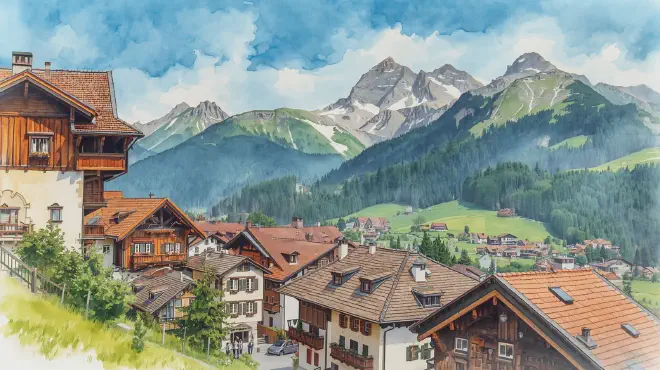
Walking the streets lined with traditional wooden houses, your eyes are drawn to buildings adorned with distinctive decorations. Under the eaves, geometric patterns and floral motifs are carved into the wood, while window frames are painted in vivid colors. This is called the “Zakopane Style,” a uniquely Polish architectural style systematized in the late 19th century by architect Stanisław Witkiewicz.
The descendants of the mountain people called Górals still live as shepherds today, wearing traditional folk costumes. Their music, cuisine, and language embody a unique culture cultivated in the harsh mountain environment.
I decided to visit this town because I wanted to find something away from the noise of the city, in the quietness of the mountains. I had no particular purpose. I simply wanted to spend time slowly in a small town surrounded by the peaks of the Tatras.
Day 1: Krupówki Street and the Shepherd’s Cheese
Two hours by bus south from Kraków. As I watched the landscape outside the window gradually become more mountainous and the coniferous forests grow denser, we arrived at Zakopane’s bus terminal. It was early November, a lull between tourist seasons—summer hikers and winter skiers were both still scarce. The air was crisp, but the sunlight was soft and pleasant.
After dropping my luggage at the guesthouse, I headed to the town center. Krupówki Street, the main thoroughfare, was lined with souvenir shops and restaurants, showing the liveliness of a tourist destination. Yet somehow, this bustle was restrained, not pushy. There were many wooden buildings, and the entire street was wrapped in warm brown tones.
For lunch, I entered a local cuisine restaurant. While perusing the menu, the word “oscypek” caught my eye. The server told me it was sheep’s milk cheese—a traditional Góral cheese, smoked and served grilled. When I ordered it, a spindle-shaped grilled cheese was brought out with cranberry jam.
One bite and I was surprised by its complex flavor. The smokiness, the rich saltiness characteristic of sheep’s milk, and the sweet-sour jam mingled in my mouth. The firm texture became more flavorful with each chew, evoking the wisdom of preserved foods that sustained mountain life. For the main course, I ordered “kwaśnica,” a sour soup, and “moskol,” a stewed mutton dish called moskol. Both were simple but had a deep umami.
In the afternoon, I visited the “Willa Koliba,” the Villa Koliba, a bit away from town—the home and atelier of the architect who established the Zakopane style, now open as a museum. Inside, a space enveloped in wooden warmth spread before me. Delicate carvings adorned the pillars and beams, and I could feel a unique aesthetic where folk art and fine art merged. Through the windows, the Tatra Mountains were visible, and I could physically feel the design philosophy that united architecture with nature.
In the evening, I returned to Krupówki Street and entered a small café. Sitting by the window, I ordered “grzane piwo,” a warm beer. Beer warmed with honey and spices—a winter drink that warmed me from the core. Outside, as the sky began to tilt toward evening, a musician in traditional costume was playing the violin. A melancholy melody drifted on the mountain wind.
That night, before returning to my guesthouse, I strolled the streets. The wooden architecture illuminated by streetlights showed a different expression than during the day. Tourists were sparse, and I could see locals quietly spending their evening. The Tatra peaks visible in the distance became silhouettes in the darkness, emanating a solid presence. It was a night when I truly felt anew that this town held a long history of living with the mountains.
Day 2: Cable Car to Gubałówka and Traditional Flavors
I had a light breakfast at the guesthouse and left early. Today, I planned to climb Gubałówka Mountain. Looking up from Zakopane, it’s a mountain with a gentle ridgeline, served by a cable car. From the 1,126-meter summit, they said you could enjoy a panorama including Rysy, the highest peak of the Tatra Mountains.
When I arrived at the cable car station, several people were already in line. Perhaps because it was a weekday morning, it wasn’t crowded. I boarded the gondola and slowly ascended. Below, the townscape of Zakopane spread out, and I could clearly see the roofs of wooden houses dotting the landscape. Passing through the coniferous forest, the view suddenly opened up, and the rocky peaks of the Tatras appeared.
At the summit, cold wind was blowing through. Standing at the observation deck, I gazed at the 360-degree panorama. To the south, the Tatra Mountains forming the border with Slovakia stretched out, with the highest peak Rysy (2,499 meters) showing its sharp rocky face. To the north, the Polish plains extended far into the distance. It was a place where you could understand at a glance the geographical uniqueness of this town, positioned at the boundary between mountains and plains.
While drinking warm żurek (fermented rye soup) at the summit restaurant, I gazed at the scenery for a while. Hikers and local families were spending time as they pleased. Children ran around innocently, an elderly couple sat close together on a bench. Such casual scenes strangely stayed with me.
After descending, I spent the afternoon visiting the “Tatra Museum” on the south side of town. The exhibits on Góral culture were extensive, with traditional folk costumes, farming tools, musical instruments and more on display. Particularly impressive was the “ciupaga,” a decorated axe used by shepherds. Though a practical tool, it was adorned with delicate carvings, conveying the high aesthetic sense of the mountain people.
Leaving the museum, I stopped by a church a short walk away. A wooden church called the “Holy Family Church,” with Zakopane-style features visible throughout. The interior was serene, and light streaming through stained glass gently illuminated the wooden altar. Though not a believer, I sat for a while, spending quiet time.
In the evening, a street market was open in a corner of Krupówki Street. Local farmers and artisans were running small stalls. There was an elderly woman selling oscypek cheese, who offered me a taste. The freshly grilled cheese was softer than what I’d eaten yesterday, with a stronger sweetness from the milk. When I told her it was delicious, a smile spread across her deeply wrinkled face.
For dinner, I chose a traditional cuisine restaurant called “Karczma po Zbóju.” “Zbój” apparently means mountain bandit. The interior was rustic, with old farming tools and photographs hanging on the walls. I ordered “bryndzowe pirohy,” something like buckwheat pasta mixed with salted sheep cheese and bacon. The chewy texture and rich cheese flavor intertwined—simple yet unforgettable.
On my way back to the guesthouse, I looked up at the sky. Few clouds, and the stars were clearly visible. On streets with sparse streetlights, I could faintly make out the Milky Way. In the quietness of the mountain town’s night, I felt my existence here was certain.
Day 3: Morning Market Bustle and Time to Part
On the final morning, I headed to the morning market held on the north side of town. A market where locals come to buy food—not for tourists, but a place of everyday life. Vegetables, fruits, dairy products, bread, herbs—various goods were displayed. Vendors’ calls flew back and forth; it was full of vitality.
At a dairy shop, I tried “bundz,” a fresh cheese—the raw, unaged ingredient of oscypek. It had a creamy, gentle flavor, and the shopkeeper told me it was excellent spread on bread. I bought a small container to eat later.
In a corner of the market, there were also stalls selling folk crafts. Hats and slippers made from sheep’s wool felt, embroidered tablecloths, small wooden carvings were all on display. Picking them up, you could tell each was carefully made. I bought a wooden bookmark carved with a single flower. Just the right size as a souvenir of the journey.
Leaving the market, I walked Krupówki Street once more. The scenery I’d grown familiar with over two days—thinking this was the last look made it a bit wistful. At the end of the street, you could see the Tatra Mountains. Bathed in morning light, the rocky surface gleamed white.
For lunch, I simply bought a zapiekanka, a baguette sandwich, and ate it on a park bench. Topped generously with mushrooms and cheese, it was warm and filling. In the park, people were strolling, families with dogs—peaceful time was flowing.
In the afternoon, with some time before the bus, I went to see “Willa Oksza,” an old wooden building on the edge of town, where famous artists once stayed and which still operates as lodging. I only viewed the exterior, but from its historical appearance, I felt I somewhat understood why Zakopane had been loved by artists.
On the road to the bus terminal, I turned back once more to look at the town. The Tatra peaks, the wooden houses, the people who continue to preserve tradition. This town, while being a tourist destination, somehow stubbornly continues to protect its own culture. It felt like a kind of pride.
Boarding the bus and looking out the window, I reflected on these three days. Nothing extraordinary had happened. Yet, breathing the mountain air, eating simple meals, spending time quietly—something seemed to gradually accumulate within me. It’s hard to put into words what that was. I just think I certainly received something.
What Felt Real Despite Being Imaginary
This journey never actually took place. I never walked the alleyways of Zakopane, never gazed at the view from Gubałówka, never ate oscypek—all were events in imagination. Yet by writing them down, the journey takes on a kind of reality.
An imaginary journey has no unexpected troubles, no physical fatigue. But at the same time, the coldness of the wind, the aroma of freshly grilled cheese, the bustle of the market—sensations gained only through actual experience—don’t truly exist either. Still, by researching the place, learning the culture, and imagining myself there, something certainly remains in the heart.
Zakopane is a real town. The Tatra Mountains, Góral culture, Zakopane-style architecture—all truly exist. And when I actually visit someday, this imaginary journey might be useful in some way. Or even if going there never comes to pass, having traveled in imagination creates a familiarity with that place.
Travel is not only about moving, but also about the heart moving. Thinking this way, perhaps this imaginary journey is also a form of travel. The quietness of the mountain town, the figures of people preserving tradition, the taste of simple meals—these remain as landscapes in my heart, certainly.
What did I gain from finishing this journey? The answer doesn’t come easily. I’ll just remember the Tatra Mountains and wooden townscape in fleeting moments for a while. That’s enough, I think.