Riding the Chicago O'Hare People MoverAirport Rail Counts Too
People movers — automated rail systems inside airports — are still rail. Coming back to ride them later isn’t practical, so whenever I’m at an airport that has one, I ride the full line while I’m there. The ATS (Airport Transit System) at Chicago O’Hare International Airport was one of those.
After arriving in Chicago on the Amtrak Empire Builder, I used the layover time to ride every segment of the ATS people mover inside O’Hare Airport.
- Target
- O’Hare ATS (Airport Transit System), five stations, about 4.8 km
- Fare
- Free. Runs 24 hours, every 3–5 minutes at peak
- How
- Terminal 3 → Multi-Modal Facility → Terminal 1 covers the whole line
- Note
- The ATS runs landside, so riding it means leaving security and clearing it again on the way back
ATS Overview
O’Hare’s ATS is an automated rail system connecting 5 stations over approximately 4.8 km (3 miles). Free and running 24 hours.
- Terminal 1
- Terminal 2
- Terminal 3
- Terminal 5
- Multi-Modal Facility (rental cars, parking)
Terminal 4 doesn’t exist (skipped numbering). End-to-end travel from Terminal 1 to Multi-Modal Facility takes about 10 minutes. Peak frequency is every 3–5 minutes. Top speed is approximately 80 km/h (50 mph).
Trains are 3-car sets with a capacity of 147 passengers. A major overhaul in 2021 doubled the fleet from 15 to 36 cars and added the Multi-Modal Facility extension with a new station. No gates or tickets — anyone can board.
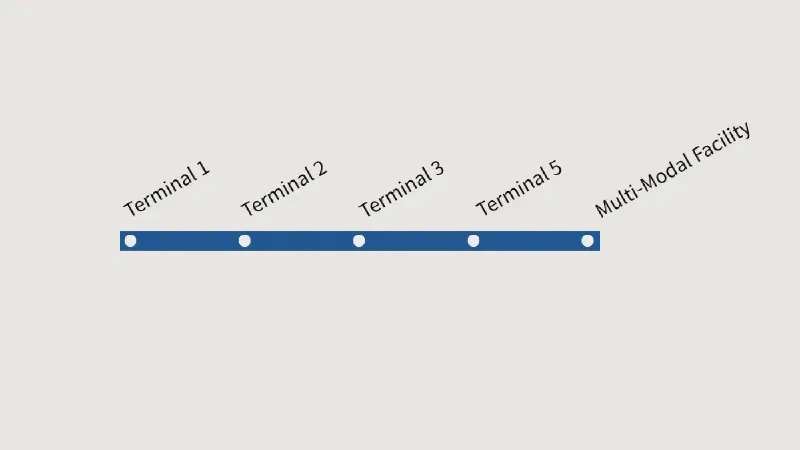
Source: Chicago Department of Aviation
When You Need the ATS
Cross-terminal transfers happen often at O’Hare. United international arrivals come into Terminal 5, but domestic connections depart from Terminal 1 or Terminal 2. The ATS is the link between them. Since it runs outside the security perimeter, transferring between terminals means going through screening again at your departure terminal. Allow extra time for connections.
The same applies if you’re riding the ATS just to complete the line. For same-terminal connections, you wouldn’t normally need to leave the secure area — but boarding the ATS forces you outside, and you’ll need to re-screen on the way back.
Riding Record
Rode from Terminal 3 to the end of the line at Multi-Modal Facility, then back to Terminal 1. All 5 stations, full line covered.
Who Rides the ATS
The mix of passengers shifts noticeably from station to station.
At Multi-Modal Facility, rental car users with large suitcases flood on and off. Families and group travelers fill the cars, and luggage takes up most of the standing room. Around Terminal 5 (international), connecting passengers board with their bags. Terminal 1 (United’s hub), by contrast, had relatively few people getting on — most United passengers at O’Hare are connecting, not originating, so they pass through the terminal without needing the ATS.
Uniformed pilots and crew rode in the same car on more than one occasion. The ATS is a working commute for airport staff, not just a passenger shuttle.
What stood out most was the staffing. Despite being fully automated, the ATS has support staff stationed at every platform. They direct passengers to the right side for their terminal, help with oversized luggage, and answer questions. I watched a traveler ask which platform to stand on for Terminal 1 — the kind of confusion that’s inevitable at an airport with five stops and no ticket gates. I haven’t seen this level of on-platform support at any other airport people mover. At an airport handling this volume of international connections, it makes sense.
Crowding depends on the time of day. When international arrivals cluster, the Terminal 5 stretch gets packed. Outside those windows, there were almost empty.
The View
The ATS runs on an elevated guideway, so you’re looking down at the airport’s landside the entire way. Terminal rooftops, rows of parked aircraft on the apron, runway edges — they scroll past in quick succession. A vantage point that underground systems like Denver’s people mover simply can’t offer. I saw a China Airlines 747 freighter taking off.
One building that catches the eye is the O’Hare Hilton, sitting right next to the terminals. It’s clearly visible from the train. I’ve never stayed there — I always connect straight through — but on a day with major delays or cancellations, that proximity must be worth something.
The cars themselves are clean, a benefit of the 2021 overhaul. Large windows make the elevated views easy to enjoy.
People Movers as Rail-Riding Targets
The ATS is a short line — about 10 minutes one way — and easy to complete. Ride from Terminal 3 to the end and back; that’s it.
That said, turning around at the terminus with no reason to be there feels slightly awkward. Every other passenger has a destination. Being the only person riding for the sake of riding is a particular kind of discomfort that only rail completionists understand.
People Movers at Other Airports
Major U.S. airports often have multiple terminals spread over large distances, so automated rail systems are common: Dallas, Atlanta, San Francisco, Denver, Washington Dulles, Newark, among others. Outside the U.S., large airports like Singapore Changi also have them.
In Japan, Kansai International Airport’s Wing Shuttle is an equivalent system, but full-scale airport rail lines are far less common than in the United States.


